
15Oct
Plastic in the Ocean: How It Reaches the Seafloor
Quick answer: How does plastic reach the seafloor? Plastic reaches the seafloor in three main ways. Dense plastics such as PET and PVC sink straight away. Light plastics become heavy when algae and bacteria grow on them (biofouling), or when they get trapped in sinking clumps of marine snow and animal waste. Then underwater landslides called turbidity currents and deep ocean currents carry them down submarine canyons and pile them into seafloor hotspots.
Key takeaways
- Around 11 million metric tons of plastic enter the ocean each year, much of it through rivers.
- Floating plastic is only a small fraction of what has entered the sea. Much of the "missing" plastic is believed to sit in the deep ocean and on the seafloor.
- A 2024 CSIRO study estimates 3 to 11 million metric tons of plastic now lie on the ocean floor.
- Plastic has been recorded at nearly 11,000 meters deep in the Mariana Trench, and inside animals living there.
- Cutting plastic at the source works better than trying to clean the deep sea.
Where Does Ocean Plastic Come From?
Most plastic in the ocean starts on land. A 2020 study by The Pew Charitable Trusts and SYSTEMIQ estimated that about 11 million metric tons of plastic enter the ocean every year. Without major action, that figure could nearly triple by 2040.
Rivers are the main highway. Plastic waste from rivers includes bags, wrappers, bottles and foam washed off streets and dumps during rain. A 2021 study in Science Advances found that more than 1,000 rivers carry about 80% of river-borne plastic into the sea. Many of them are small urban rivers in South and Southeast Asia, Africa and Central America, not only famous giants like the Ganges or Yangtze.
Other sources include:
- Single-use plastic such as cups, straws, sachets and packaging that are used once and thrown away.
- Fishing gear, including lost or dumped nets, ropes and traps, often called ghost gear.
- Microfibers shed from synthetic clothing. Researchers at the University of Plymouth found a single 6 kg wash of acrylic fabric can release more than 700,000 fibers.
- Tire dust and paint particles washed from roads into drains.
- Industrial pellets (nurdles) spilled during shipping and handling.
Once in the sea, sunlight, waves and heat break large items into smaller pieces. Pieces under 5 mm are called microplastics. Even smaller fragments, under 1 micrometer, are nanoplastics. Smaller pieces behave differently, and that is a big part of why plastic ends up so deep.
Why Most Plastic Doesn't Stay Floating
If you add up all the plastic floating on the ocean surface, it is far less than what has gone into the sea. Scientists call this the "missing plastic" problem. Floating plastic is estimated at only a few hundred thousand metric tons, while tens of millions of tons have entered the ocean over the past decades.
The best-known place where floating plastic gathers is the Great Pacific Garbage Patch, between Hawaii and California. A 2018 study led by The Ocean Cleanup estimated it covers about 1.6 million square kilometers and holds at least 79,000 metric tons of plastic. Nearly half of that mass came from fishing nets.
But garbage patches are not islands of trash. They are more like a thin soup of fragments spread by ocean currents. And they hold only a small share of the total. So where does ocean plastic go? The evidence points in three directions:
- Back to the coast. Much plastic washes up on beaches or gets buried in coastal sand and mud.
- Into the water column. Small pieces drift at different depths, carried by currents.
- Down to the seafloor. This is now thought to be one of the largest sinks of all. A 2024 study by Australia's national science agency, CSIRO, estimated that 3 to 11 million metric tons of plastic rest on the ocean floor.
How Plastic Sinks in the Ocean
Plastic sinks in the ocean when it becomes denser than seawater. Seawater has a density of about 1.025 g/cm³. Anything heavier sinks; anything lighter floats. Three processes decide which way a piece goes.
1. Some plastics are born heavy
Not all plastic floats. Here is how common types compare with seawater:

So a polyester microfiber from your T-shirt can head straight down, while a plastic bag may float for weeks.
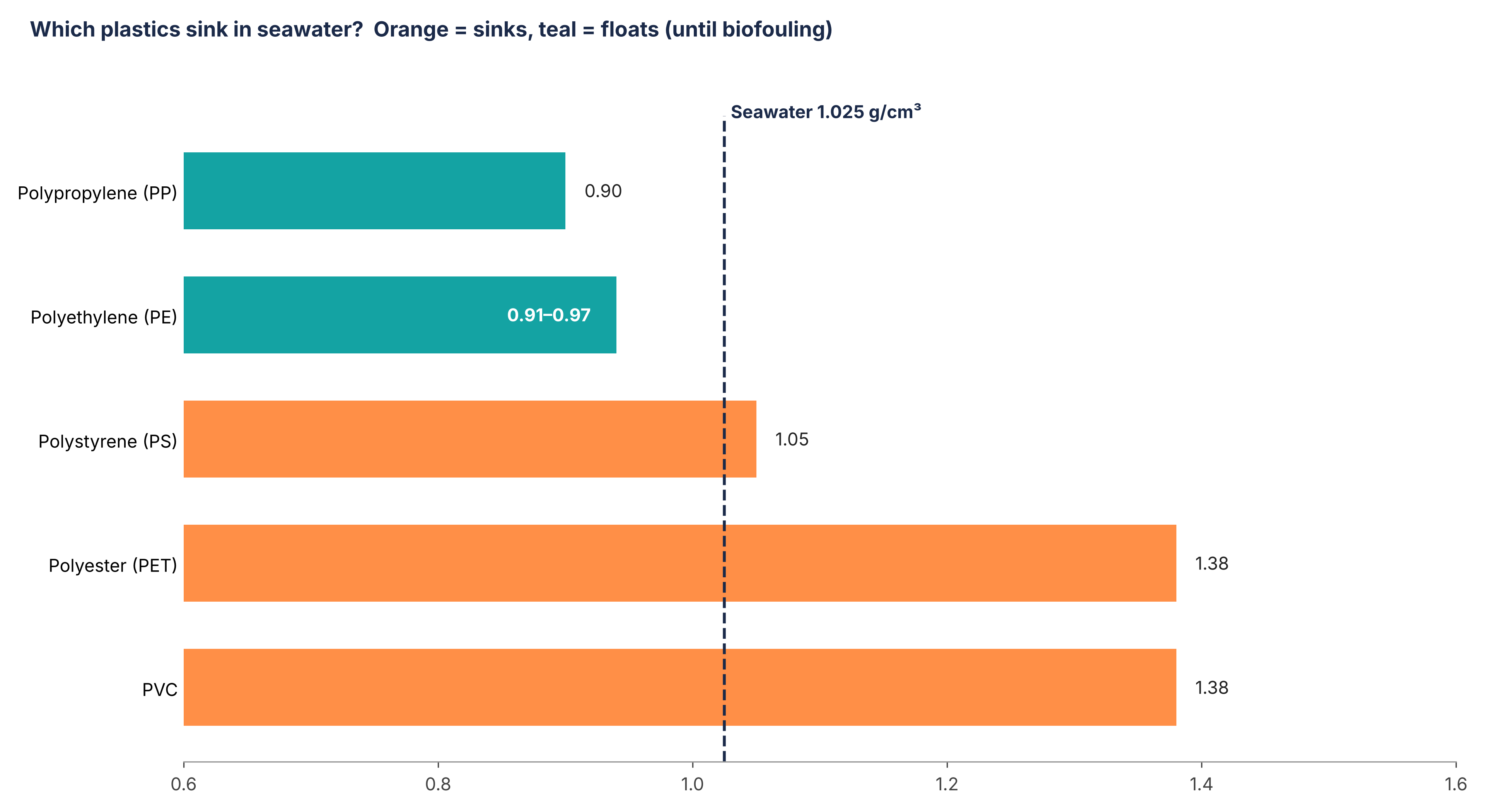
Plastics denser than seawater (1.025 g/cm³) sink; lighter ones float until biofouling weighs them down.
2. Biofouling makes floating plastic heavy
The moment plastic enters the sea, life starts growing on it. Bacteria form a slimy biofilm. Algae, barnacles and tiny animals follow. This process is called biofouling. Studies show this living coat can make floating plastic heavy enough to sink within weeks. Smaller pieces sink faster, because they have more surface area for their size.
Some scientists have even observed pieces bouncing up and down. Fouled plastic sinks into darker water, the algae die off without sunlight, and the piece rises again, until it finally stays down.
3. Marine snow and fecal pellets act like elevators
The ocean is always "snowing." Marine snow is a steady fall of dead plankton, mucus, dust and waste drifting from the surface through the ocean twilight zone to the deep. Microplastics get stuck in these sticky clumps and ride them down.
Animals help too. Tiny zooplankton such as copepods mistake microplastics for food. They pack the particles into fecal pellets, which sink much faster than loose plastic. In this way, the ocean's own food web becomes a delivery system for microplastics in the deep sea.
The Fast Lanes: Canyons, Landslides and Deep Currents
Sinking explains how plastic leaves the surface. But it does not explain why plastic on the ocean floor gathers in thick piles. For that, we need to look at the seafloor itself.
Turbidity currents down submarine canyons
Off many coastlines, submarine canyons cut deep into the continental shelf. Sometimes, sediment on their slopes collapses into an underwater avalanche called a turbidity current. These fast, muddy flows can rush downhill for hundreds of kilometers.
A 2020 study by Durham University and partners recreated these flows in the lab. It showed that turbidity currents can carry microplastics far out into the deep sea and bury them in seafloor sediment. In effect, canyons act as giant drains from the coast to the abyss.
Deep currents create microplastic hotspots
Once plastic reaches the bottom, slow but steady deep ocean currents keep moving it. A 2020 study in Science, led by Ian Kane of the University of Manchester, sampled the floor of the Tyrrhenian Sea in the Mediterranean. It found up to 1.9 million microplastic pieces in a single square meter of seafloor sediment. That is the highest level recorded on the seafloor at the time.
The same currents that carry oxygen and nutrients to deep-sea life were piling microplastics into drifts, much like wind piles snow. Most of these particles were fibers from clothes and textiles.
Deep-sea trenches as final traps
Deep-sea trenches are the lowest points on Earth, as ocean floor mapping shows. Their steep, funnel-like shape and frequent earthquakes shake loose sediment and send it to the trench floor. Scientists believe this makes trenches natural collectors for anything that sinks, including plastic.
Plastic in the Mariana Trench
The Mariana Trench in the western Pacific is the deepest place in the ocean, at almost 11,000 meters. Few humans have ever been there, and most of what we know comes from deep-sea robots. Yet plastic got there first.
- A plastic bag at 10,898 meters. In 2018, Japanese researchers reviewing the JAMSTEC Deep-sea Debris Database reported a single-use plastic bag photographed at 10,898 meters in the Mariana Trench. It was the deepest piece of plastic debris on record at the time.
- Microplastics in trench sediment. A 2018 study of the trench found microplastics in its bottom water and seafloor sediment, in amounts higher than in many surface waters.
- Plastic inside animals. In 2019, a team led by Alan Jamieson at Newcastle University studied amphipods, small shrimp-like scavengers, from six deep-sea trenches around the Pacific. About 72% had swallowed microplastic or microfibers. In the Mariana Trench samples, every single animal contained plastic.
These findings show that no part of the ocean is beyond the reach of human waste. The deepest trench on Earth is now a record of what we throw away on land.
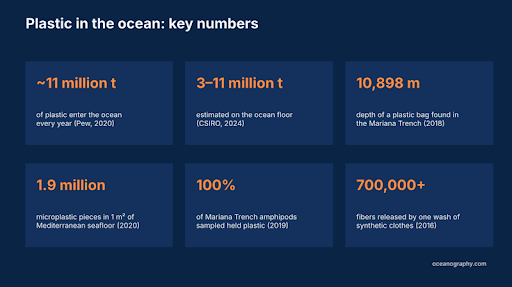
Key numbers on ocean plastic pollution, from the studies cited below.
What Plastic Does to the Marine Ecosystem
Why does plastic on the ocean floor matter if no one sees it? Because the deep sea is not empty. It is home to corals, sponges, sea cucumbers, worms and fish, many still unknown to science.
Here are the main concerns raised by researchers:
- False fullness and blockages. Animals that eat plastic can feel full without getting energy, which may weaken them.
- Chemical load. Plastics contain additives and can absorb pollutants from seawater. Scientists are still studying how much of this passes into the animals that eat them.
- Moving up the food chain. Amphipods and other small animals are food for fish, and fish are food for larger animals, including people.
- Smothering the seafloor. Bags and films can cover sediment, cutting off oxygen to animals living in the mud.
- It does not go away. In the cold, dark deep sea, there is no sunlight to break plastic down. Pieces may last for centuries.
Ocean plastic is not the only stress on sea life. A warming ocean and marine heatwaves already push many species to their limits, and plastic adds one more pressure on top.
Plastic Pollution Solutions: What Actually Helps
We cannot vacuum the deep sea. Once plastic reaches a trench, it is there to stay. That is why most scientists agree the best plastic pollution solutions focus on stopping plastic before it reaches the ocean.
What governments and industry can do
- Cut production of single-use plastic and ban the items most often found as marine debris.
- Improve waste collection and recycling, especially in fast-growing coastal cities, where much plastic waste from rivers begins.
- Make producers responsible for the packaging they sell through extended producer responsibility (EPR) laws.
- Fit filters on washing machines to catch microfibers before they reach drains.
- Recover ghost gear and support gear-marking programs for fishing fleets.
- Agree on global rules. Countries have been negotiating a UN global plastics treaty since 2022, aimed at the full life cycle of plastic.
What you can do
- Carry a reusable bottle, bag and cup, and say no to plastic straws and sachets.
- Wash synthetic clothes less often, use full loads and cool water, and try a microfiber-catching laundry bag.
- Choose natural fabrics such as cotton, wool or linen when you can.
- Never let litter reach drains, canals or rivers. Every drain leads to the sea.
- Join a beach, river or canal cleanup in your area.
- Support brands and local leaders working to cut plastic packaging.
River cleanups matter most. Stopping a bottle in a river is far easier than finding it later in a trench.
EXPLORE OCEANOGRAPHY
Frequently Asked Questions
How much plastic is in the ocean?
No one knows the exact total. About 11 million metric tons enter the ocean each year, and a 2024 CSIRO study estimates 3 to 11 million metric tons now sit on the seafloor alone.
Where does ocean plastic go?
It goes to four main places: coastlines, the ocean surface (including garbage patches), the water column, and the seafloor. The deep ocean and seafloor are now seen as one of the biggest sinks.
Does plastic sink or float in the ocean?
Both. Dense plastics like PET and PVC sink right away. Light plastics like polyethylene and polypropylene float at first, then often sink once algae and bacteria grow on them.
Is there plastic in the Mariana Trench?
Yes. A plastic bag was recorded at 10,898 meters, and a 2019 study found plastic inside every amphipod sampled from the Mariana Trench.
What are microplastics and nanoplastics?
Microplastics are plastic pieces smaller than 5 mm. Nanoplastics are far smaller, under 1 micrometer, and can pass into cells and tissues more easily.
Can we clean plastic from the seafloor?
Not at any useful scale. The deep sea is too vast and fragile. The most effective solution is stopping plastic on land and in rivers before it reaches the ocean.
