
25Aug
Cold Seeps: How Deep-Sea Life Thrives in the Darkness

Introduction
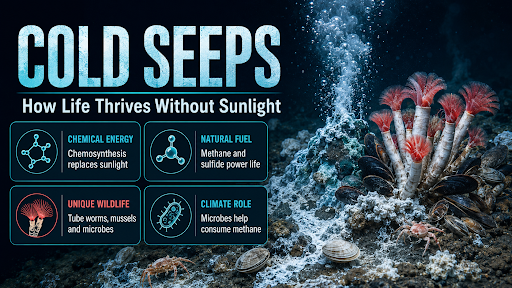
Imagine going so deep into the ocean that no sunlight can reach you. The area may look dark, empty, and lifeless. However, mussels, worms, crabs, and tiny microbes live there. These amazing places are called cold seeps.
Unlike most ecosystems, cold seeps do not need sunlight or plants for energy. Instead, their energy comes from chemicals that rise through the ocean floor. Let’s explore how methane, minerals, and tiny microbes help life survive in the deep, dark ocean.
Key Takeaways
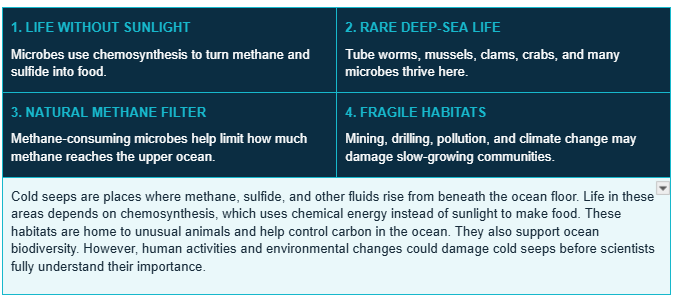
Cold seeps are dark-ocean oases powered by chemicals rather than sunlight. These four ideas explain why they matter.
What Are Cold Seeps?
Cold seeps are seafloor habitats where hydrocarbon-rich fluids and gases slowly escape from underground sediments. They are called “cold” because their fluids remain close to the temperature of the surrounding seawater.
According to NOAA Ocean Exploration, these sites commonly release methane or hydrogen sulfide and support significant chemosynthetic communities. They are like underwater oases scattered across an otherwise food-poor landscape.
How Cold Seeps Form on the Ocean Floor
Cold seeps develop when geological pressure pushes methane, brine, sulfide, or oil upward through cracks and porous sediments. This hydrocarbon seepage may create bubbling vents, carbonate rocks, bacterial mats, or brine pools.
Some seeps form near faults, continental margins, salt deposits, or buried organic material. Unlike a sudden eruption, the flow can continue quietly for decades or centuries.
Where Are Cold Seeps Found?
Scientists have discovered methane seeps in the Gulf of Mexico, Mediterranean Sea, Atlantic Ocean, Pacific Ocean, and many other regions. They can occur in relatively shallow water or several kilometers below the surface.
Because so much of the seabed remains unexplored, researchers probably have not located most existing ocean floor ecosystems of this kind.
How Can Life Survive Without Sunlight?
Most familiar food chains begin when plants capture sunlight. At cold seeps, darkness makes photosynthesis impossible. Yet life without sunlight succeeds because microorganisms use chemical energy instead.
These organisms create food from inorganic compounds. In doing so, they support larger communities of worms, shellfish, crustaceans, and fish.
Chemosynthesis: The Foundation of Cold Seep Life
During chemosynthesis, microbes use methane or sulfide to produce organic matter. Think of them as tiny factories that replace solar panels with chemical batteries.
This process makes chemosynthetic bacteria the primary producers of cold seep communities. Without them, most larger seep animals could not survive.
The Role of Methane and Hydrogen Sulfide
Methane and hydrogen sulfide can be toxic to many organisms, but specialized microbes treat them as fuel. What looks like hazardous waste to us becomes the foundation of a rich ecosystem.
The steady release of these chemicals allows some communities to remain active far longer than many hydrothermal vent communities.
Cold Seep Microorganisms and Symbiotic Partnerships
Marine microorganisms perform the essential chemical work at cold seeps. Some live freely in sediments, while others form partnerships inside animal tissues.
These relationships show how cooperation can succeed in extreme environments. The animal provides protection and access to chemicals, while the microbe produces nutrients.
Methane-Consuming Microbes
Methane-consuming microbes remove methane before much of it reaches the water column. Archaeal and bacterial communities often work together beneath the seabed.
Their activity changes sediment chemistry and contributes to carbonate formation around active seeps.
Chemosynthetic Bacteria
Some chemosynthetic bacteria form white or orange mats across the seafloor. Others live inside mussels, clams, and tube worms.
These microbes feed their hosts, allowing the animals to flourish where ordinary food is scarce.
Remarkable Animals Living Around Cold Seeps
Cold seep animals often appear strange because they are adapted to darkness, pressure, cold water, and unusual chemicals. These extremophile organisms may grow slowly and live for surprisingly long periods.
Researchers encounter dense animal colonies around active flow zones, while the surrounding seabed may support far less visible life.
Giant Tube Worms
Giant tube worms have no conventional digestive system as adults. Instead, internal bacteria use sulfide to manufacture the nutrients the worms need.
Their red plumes absorb oxygen and chemicals from seawater, while root-like tissues reach into the sediment.
Deep-Sea Mussels and Clams
Deep-sea mussels and clams gather in thick colonies called mussel beds or clam beds. Many contain symbiotic bacteria that use methane or sulfide.
Their shells also create shelter for smaller animals, making them important habitat builders.
Crabs, Shrimp, and Other Cold Seep Animals
Crabs, shrimp, snails, sea stars, worms, and fish visit or inhabit seep communities. Some graze on bacterial mats, while others hunt or scavenge.
Together, these creatures turn isolated chemical springs into complex benthic ecosystems.
How Cold Seep Food Webs Work
The deep-sea food web begins with microorganisms that convert chemical energy into food. Grazers eat microbial mats, predators consume smaller animals, and scavengers recycle organic remains.
Some creatures receive nutrition directly from internal bacteria. This combination of feeding and symbiosis makes cold seep food webs unusually flexible.
Cold Seeps vs. Hydrothermal Vents
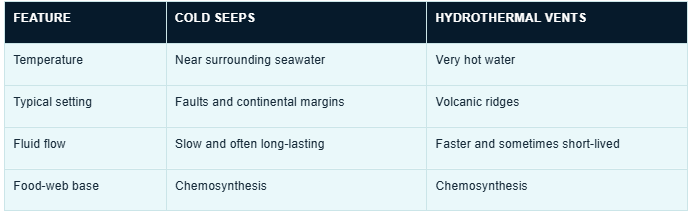
The comparison of cold seeps vs hydrothermal vents reveals both major differences and fascinating similarities. Both are chemically powered sunless ecosystems, but their geology and lifespan can differ.
Understanding these distinctions helps scientists learn how life adapts to separate types of extreme environments.
Differences in Temperature and Energy Sources
Hydrothermal vents release geothermally heated water, often near volcanic ridges. Cold seeps release fluids close to the surrounding seawater’s temperature.
Vents may be short-lived and dramatic, while seeps can flow more slowly and persist for much longer.
Similarities Between These Sunless Ecosystems
Both habitats rely on chemosynthesis and host animals with microbial partners. They also create biological hotspots in the dark ocean.
In each case, chemical energy replaces sunlight as the starting point of the food chain.
Why Cold Seeps Are Important for Ocean Biodiversity
Cold seeps increase ocean biodiversity by supporting specialized species and providing shelter, feeding grounds, and hard surfaces. Some organisms live almost nowhere else.
Studying these communities may also reveal useful enzymes, biochemical processes, and adaptations with future scientific or medical applications.
Cold Seeps and the Global Carbon Cycle
Methane seeps move carbon from beneath the seabed into marine environments. The U.S. Geological Survey explains that seep organisms can consume this carbon.
Therefore, cold seeps act as both carbon pathways and biological filters within the ocean.
Anaerobic Oxidation of Methane
During anaerobic oxidation of methane, microorganisms consume methane without oxygen. They often use sulfate available in seawater to drive the reaction.
This process produces bicarbonate and sulfide, supporting other organisms and encouraging carbonate rock formation.
How Cold Seeps Limit Methane Emissions
Microbial communities consume a substantial amount of methane beneath or near the seafloor. This natural filter can reduce how much enters the upper ocean.
However, its efficiency varies with location, methane flow, water depth, and environmental conditions.
Threats Facing Cold Seep Ecosystems
Cold seeps may look remote, but they are not beyond human influence. Physical damage can be especially serious because many deep-sea organisms grow and reproduce slowly.
Pollution, seabed disturbance, fishing gear, and resource extraction could alter habitats that took centuries to develop.
Deep-Sea Mining and Energy Exploration
Mining equipment, drilling, pipelines, and sediment plumes may damage seep structures or bury animals. Noise and chemical contamination can add further pressure.
Strong environmental assessments are essential before industries operate near sensitive seep communities.
Climate Change and Ocean Disturbance
Ocean warming, acidification, and declining oxygen levels could change seep chemistry and animal distribution. Warming may also destabilize some methane hydrates.
Scientists are still investigating how these changes may affect methane release and deep-ocean life.
How Scientists Explore Cold Seeps
Extreme depth and pressure make direct exploration difficult. Researchers therefore combine marine geology, chemistry, biology, sonar, and robotic technology.
Every expedition can reveal unfamiliar organisms, new seep fields, or unexpected ecological relationships.
Submersibles, ROVs, and Seafloor Mapping
Crewed submersibles and remotely operated vehicles, or ROVs, capture video and collect water, sediment, rocks, and animals. Sonar systems can detect gas plumes and map uneven seabed terrain.
These tools allow scientists to investigate cold seeps without exposing divers to dangerous depths.
Recent Discoveries From Cold Seep Research
New surveys continue to locate seep fields in places where scientists did not expect them. Researchers also keep identifying new species and microbial processes.
Each discovery reminds me how little we know about the planet’s largest living space—the deep ocean.
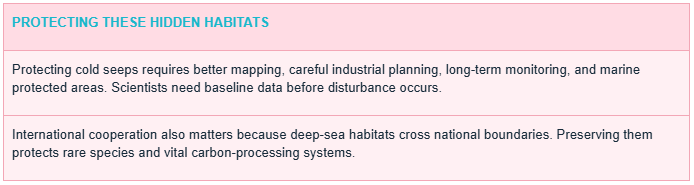
Protecting Cold Seep Habitats
Conclusion: Life Finds Energy in the Darkness
Cold seeps prove that life does not always need sunshine. With methane, minerals, and microbial teamwork, nature creates bustling communities in total darkness.
These ecosystems expand our understanding of habitability while supporting ocean health. If we explore them responsibly, they may continue revealing secrets about evolution, climate, and life’s extraordinary resilience.
EXPLORE MORE OCEAN DISCOVERIES AT OCEANOGRAPHY.COM
Frequently Asked Questions About Cold Seeps
1. Are Cold Seeps Hot or Cold?
Answer: They are generally close to the temperature of surrounding seawater. “Cold” distinguishes them from hot hydrothermal vents.
2. Do Cold Seeps Depend on Sunlight?
Answer: No. Their food chains rely on chemical energy and symbiotic marine organisms, not photosynthesis.
3. What Animals Live at Cold Seeps?
Answer: Typical animals include tube worms, mussels, clams, crabs, shrimp, snails, and specialized fish.
4. How Long Can a Cold Seep Ecosystem Survive?
Answer: Some may remain active for decades, centuries, or even longer, depending on the underground fluid supply.
5. Are Cold Seeps Dangerous?
Answer: They contain toxic chemicals, but adapted organisms can tolerate or use them. They are hazardous mainly to animals lacking those adaptations.
6. How Deep Are Cold Seeps?
Answer: They occur from continental shelves to full ocean depths, so their depth varies greatly.
7. Can Cold Seeps Affect the Climate?
Answer: Yes. They release methane, but microbial filters consume much of it before it can travel farther.
8. Why Do Tube Worms Lack a Mouth?
Answer: Adult tube worms receive nutrition from internal bacteria, so they do not need a normal digestive system.
9. Are New Species Found at Cold Seeps?
Answer: Yes. Exploration frequently reveals previously unknown microbes and animals adapted to extreme conditions.
10. Could Life on Other Planets Resemble Cold Seep Life?
Answer: Possibly. Chemically powered ecosystems show that life might exist in dark oceans beneath the icy surfaces of other worlds.
