
14Sep
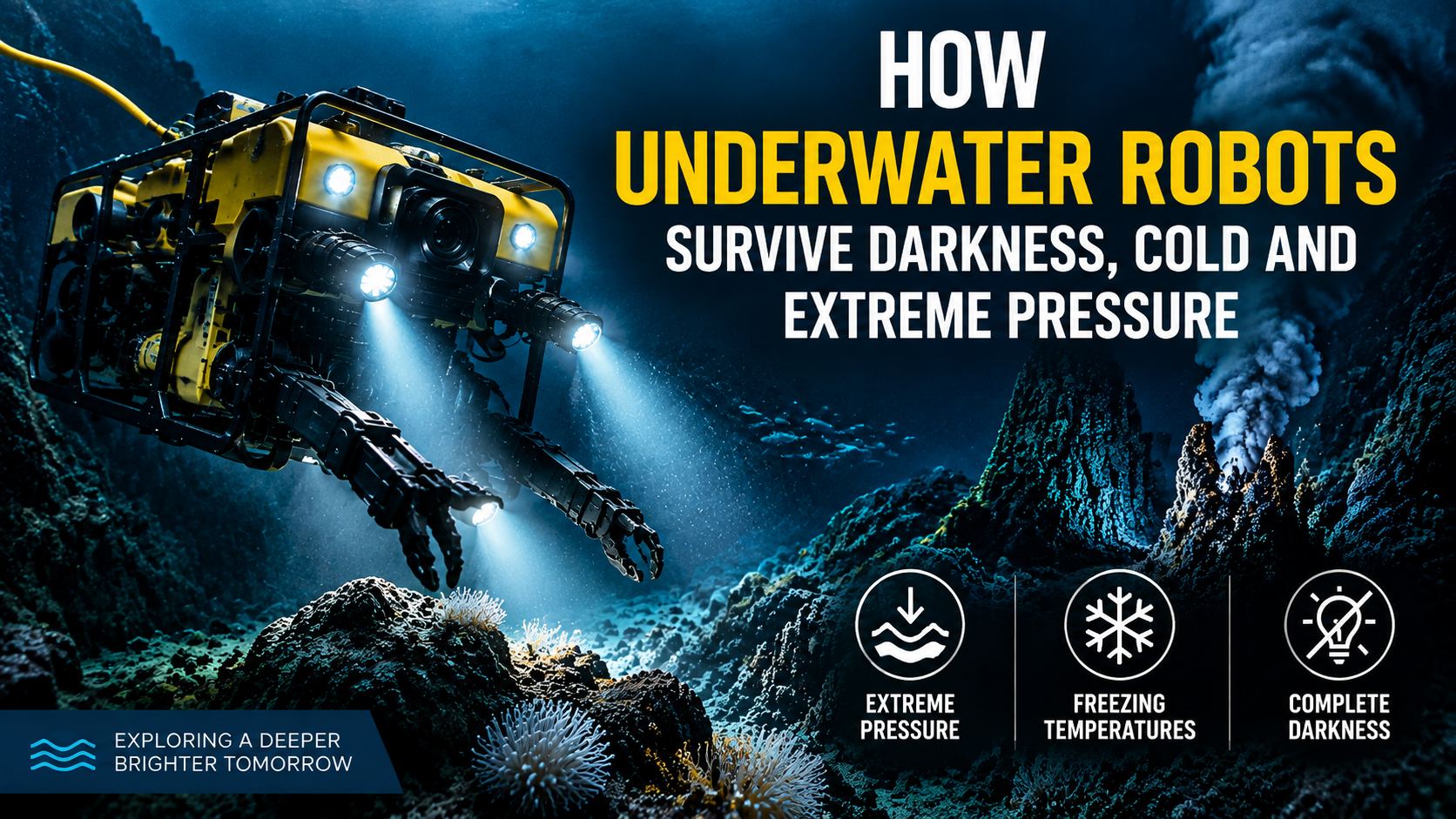
How Underwater Robots Survive Deep Ocean Conditions
Underwater robots are among the most advanced tools used to explore the hidden world beneath the ocean surface. These machines are built to operate in environments where humans cannot easily survive, including deep sea trenches, freezing waters and areas without natural light.
By combining pressure resistant materials, advanced sensors, sonar technology and powerful navigation systems, underwater robots help scientists study marine ecosystems, map the seafloor and collect valuable ocean data.
The deep ocean presents unique challenges. Extreme pressure can damage equipment, cold temperatures can affect electronics, and the absence of sunlight makes exploration difficult. Modern deep-sea robotics solves these problems through careful engineering and innovative design.
Why the deep ocean is challenging for exploration
The ocean becomes more extreme as depth increases. Every additional meter below the surface adds more pressure, creating a demanding environment for machines and electronics.
At great depths, weak materials or poorly designed structures can fail quickly. Engineers must create systems that can handle powerful underwater forces while remaining lightweight and efficient.
Temperature is another major challenge. Deep ocean water is often close to 4°C, which can reduce battery performance and affect mechanical components. Marine engineering teams test equipment carefully to ensure reliability in cold environments.
Communication is also difficult because traditional radio signals do not travel well through seawater. Exploration vehicles need specialized communication methods and underwater navigation systems to complete missions successfully.
How underwater robots survive extreme pressure
The biggest challenge for underwater robots is protecting sensitive electronics from crushing pressure.
Engineers place cameras, computers and sensors inside strong pressure housings made from materials such as titanium and advanced composites. These protective structures allow vehicles to operate thousands of meters below the surface.
Many deep-sea vehicles use rounded designs because curved surfaces distribute pressure more evenly. This reduces stress points and lowers the chance of structural damage.
Buoyancy systems also play an important role. Syntactic foam is commonly used because it is lightweight and resistant to compression. It helps vehicles maintain balance while carrying scientific equipment.
The design process requires a careful balance between durability and efficiency. Stronger materials provide protection but can increase weight and energy requirements.
How robots explore the ocean without sunlight
Deep ocean environments are completely dark because sunlight cannot penetrate beyond certain depths.
To overcome this challenge, exploration vehicles use powerful LED lights and sensitive cameras to capture images and videos. These systems allow researchers to observe marine animals, study geological features and document underwater landscapes.
Sonar technology provides another important solution. Instead of depending only on light, sonar uses sound waves to detect objects and create detailed maps of the surrounding area.
This technology supports ocean mapping and allows scientists to explore areas that remain hidden from human observation.
How deep sea robotics handles freezing temperatures
Cold temperatures can affect almost every part of a robotic system. Batteries may lose efficiency, lubricants can become less effective and electronic components require additional protection.
Engineers select materials and components designed for low temperature operation. Testing is performed under realistic conditions to ensure equipment performs reliably during long missions.
Energy management is another important factor. Since these vehicles cannot easily return to the surface for repairs, they must conserve power.
Efficient batteries, low energy sensors and improved propulsion systems help robotic exploration vehicles operate longer while collecting important scientific information.
Communication challenges below the ocean surface
Communication underwater requires different technology from communication on land.
Because radio waves are limited underwater, many vehicles use acoustic communication systems. These systems send information through sound waves, allowing researchers to receive data and monitor missions.
Remotely operated vehicles (ROVs) remain connected to ships through cables. These cables provide power and allow operators to control the vehicle directly.
Autonomous underwater vehicles (AUVs), however, work independently. They use onboard computers, sensors and programmed routes to explore large areas without constant human control.
How marine life inspires future robot designs
Scientists often study ocean organisms to improve robotic technology.
Many deep sea animals survive harsh environments using flexible bodies and unique adaptations. Researchers use these ideas in bio-inspired robotics to develop machines that move more naturally and interact safely with marine ecosystems.
Future designs may create smaller, more adaptable vehicles capable of exploring delicate underwater environments with less disturbance.
Why underwater robots matter for science
Underwater robots have changed how scientists explore the ocean. They help researchers study marine biology, underwater geology, climate patterns and unknown parts of the seabed.
These machines can reach locations that are too dangerous or expensive for human divers. They collect samples, record images and measure ocean conditions that improve scientific understanding.
From discovering new species to monitoring changes in ocean environments, underwater exploration technology continues to expand our knowledge of the planet.
Conclusion
Underwater robots survive extreme pressure, cold and darkness through advanced engineering, specialized materials and intelligent systems. Their protective structures, sensors and navigation technologies allow them to explore some of Earth’s most challenging environments.
As marine technology advances, these robotic explorers will continue helping scientists uncover the mysteries of the deep ocean.
Explore more ocean science topics and discover how technology is helping researchers understand the underwater world.
Frequently Asked Questions
1. How do underwater robots survive extreme pressure?
Answer: They use strong materials and pressure-resistant housings to protect electronics from deep-sea pressure.
How ocean robots withstand pressure
2. How deep can underwater robots travel?
Answer: Some advanced vehicles can reach the deepest ocean trenches depending on their design and materials.
3. Why do underwater robots need lights?
Answer: They use powerful lights because sunlight cannot reach deep ocean areas.
4. What is the difference between ROVs and AUVs?
Answer: ROVs are controlled through cables, while AUVs operate independently using onboard systems.
NOAA underwater exploration technology
5. How do underwater robots communicate?
Answer: They use acoustic signals because sound travels better underwater than radio waves.
6. How do underwater robots avoid being crushed?
Answer: They use pressure resistant structures and durable materials designed for deep-sea conditions.
7. Can underwater robots work for long periods?
Answer: Yes. Efficient batteries and low-power systems help them complete extended missions.
8. How are underwater robots tested?
Answer: Engineers use pressure chambers, simulations and underwater trials before deployment.
9. Are underwater robots inspired by marine animals?
Answer: Yes. Scientists study marine life to develop flexible and efficient robotic designs.
10. Why are underwater robots important for science?
Answer: They help researchers explore oceans, study ecosystems and collect valuable scientific data.
