
7Sep
Dissolved Oxygen in Ocean Water: A Simple Guide
Introduction
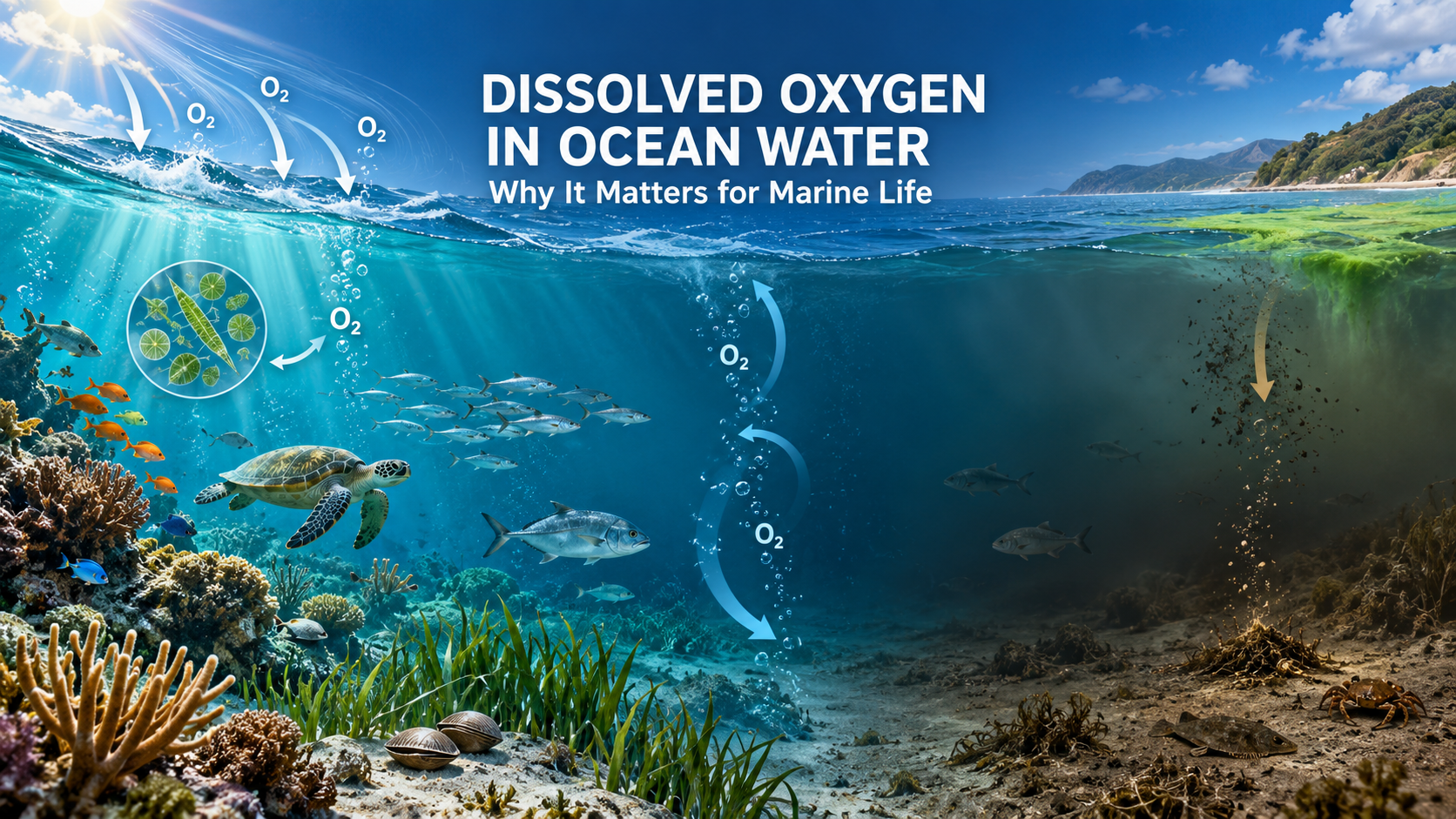
When we picture oxygen, most of us imagine the air around us. However, oxygen also exists underwater. Tiny oxygen molecules dissolve into seawater and create an invisible supply that fish, crabs, corals, and countless other organisms need to survive.

Key Takeaways
What Is Dissolved Oxygen in Ocean Water?
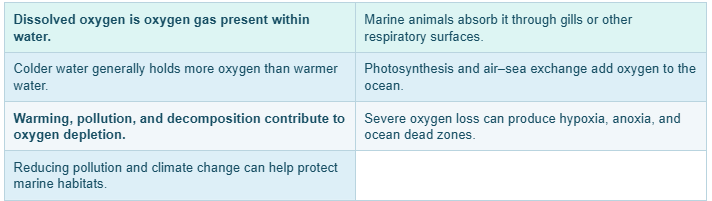
Dissolved oxygen in water refers to oxygen molecules mixed between water molecules. It is not the oxygen chemically bound inside H₂O. Instead, it is free oxygen that aquatic organisms can use for respiration.
Think of seawater as a room containing a limited supply of breathable air. Fish cannot split water molecules to breathe. Their gills extract the oxygen already dissolved in the water, making ocean dissolved oxygen essential to survival.
How Oxygen Becomes Dissolved in Seawater
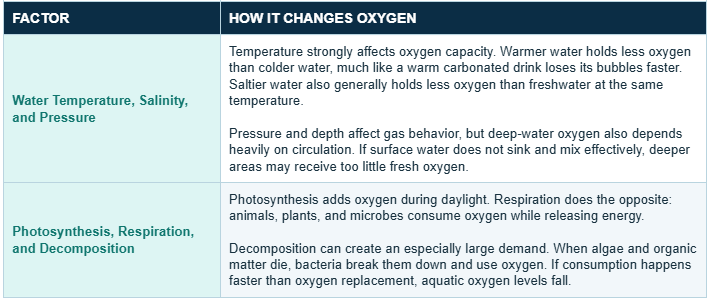
Oxygen enters seawater when waves, wind, and currents mix the atmosphere with the ocean surface. The stronger the surface movement, the greater the opportunity for gases to move between air and water.
Photosynthetic organisms also release oxygen. During daylight, phytoplankton, algae, seagrasses, and other marine plants use sunlight to convert carbon dioxide and water into energy, producing oxygen as a by-product.
Why Is Dissolved Oxygen Important?
Most marine animals depend on oxygen to release energy from food. Fish pass water across their gills, while many smaller organisms absorb oxygen through body surfaces. Without enough marine oxygen, their bodies cannot function normally.
Healthy oxygen conditions also support feeding, growth, reproduction, and movement. That is why the importance of dissolved oxygen extends beyond individual animals—it influences entire marine ecosystems and their food webs.
Dissolved Oxygen and Ocean Biodiversity
Different species tolerate different oxygen levels. Some jellyfish and microbes can survive conditions that force fish, shellfish, and other sensitive animals to leave.
As oxygen falls, a diverse community may become dominated by only a few tolerant species. This reduces marine biodiversity and changes the balance between predators, prey, and competitors.
Where Does Ocean Oxygen Come From?
The atmosphere is one major source. Oxygen crosses the ocean surface through diffusion, while breaking waves and storms accelerate mixing. Currents then help carry oxygen-rich water into deeper areas.
Marine photosynthesis is another important source. Microscopic phytoplankton produce oxygen near the sunlit surface, while seagrasses and algae add oxygen in coastal habitats. Together, these processes strengthen ocean circulation and oxygen supply.
What Are Healthy Dissolved Oxygen Levels?
Scientists commonly express oxygen levels in seawater in milligrams per liter, or mg/L. There is no single perfect level for every habitat because temperature, salinity, depth, season, and species all matter.
Many fish and invertebrates perform better when oxygen is comfortably above stressful levels. The U.S. Environmental Protection Agency describes hypoxia as conditions commonly below approximately 2–3 mg/L, although biological effects can begin earlier for sensitive species. Learn more about aquatic hypoxia from the EPA.
What Affects Dissolved Oxygen Levels?
Why Are Ocean Oxygen Levels Declining?
Ocean deoxygenation describes the long-term loss of oxygen from marine waters. Climate-driven warming contributes because warm seawater stores less oxygen. Warming can also strengthen ocean layering, preventing oxygen-rich surface water from reaching deeper layers.

What Are Hypoxia and Ocean Dead Zones?
Hypoxic waters contain too little oxygen to support many organisms normally. Anoxia is more extreme: oxygen is effectively absent. Animals that can swim may escape, while slower species can become trapped.

Oxygen Minimum Zones
Natural oxygen minimum zones occur at intermediate ocean depths where respiration uses oxygen faster than circulation replaces it. Specialized microorganisms can live there, but many larger animals avoid them.
Climate change may expand some of these zones. Oxygen minimum zone expansion compresses usable habitat, pushing marine animals into smaller areas where competition and exposure to predators may increase.
How Low Oxygen Affects Marine Life
Low oxygen can slow growth, reduce reproductive success, change behavior, and weaken disease resistance. Fish may rise toward the surface, crowd into oxygenated refuges, or leave valuable feeding grounds.
Why Are Ocean Oxygen Levels Declining?
Ocean deoxygenation describes the long-term loss of oxygen from marine waters. Climate-driven warming contributes because warm seawater stores less oxygen. Warming can also strengthen ocean layering, preventing oxygen-rich surface water from reaching deeper layers.

What Are Hypoxia and Ocean Dead Zones?
Hypoxic waters contain too little oxygen to support many organisms normally. Anoxia is more extreme: oxygen is effectively absent. Animals that can swim may escape, while slower species can become trapped.


Effects on Food Webs and Coastal Communities
When sensitive species disappear, predators lose prey and competitors move into new habitats. These shifts can reshape an ocean food web from the bottom upward.

Oxygen Minimum Zones
Natural oxygen minimum zones occur at intermediate ocean depths where respiration uses oxygen faster than circulation replaces it. Specialized microorganisms can live there, but many larger animals avoid them.
Climate change may expand some of these zones. Oxygen minimum zone expansion compresses usable habitat, pushing marine animals into smaller areas where competition and exposure to predators may increase.
How Low Oxygen Affects Marine Life
Low oxygen can slow growth, reduce reproductive success, change behavior, and weaken disease resistance. Fish may rise toward the surface, crowd into oxygenated refuges, or leave valuable feeding grounds.
How Scientists Measure Dissolved Oxygen
Scientists collect water samples and use electronic sensors called oxygen probes. Research ships can measure oxygen across different depths, revealing how conditions change from the surface to the seafloor.
Autonomous floats, gliders, moorings, and underwater vehicles gather information over longer periods. Satellites cannot directly measure deep-water oxygen, but their observations of temperature, algae, and circulation help researchers improve ocean models.
Can Ocean Oxygen Loss Be Reduced?
Reducing fertilizer runoff and improving sewage treatment can lower the amount of organic matter consuming oxygen in coastal waters. Restoring wetlands also helps because these habitats filter nutrients before they reach the sea.

Why Dissolved Oxygen Matters for the Ocean’s Future
Dissolved oxygen may be invisible, but it is one of the clearest signs of ocean health. Its decline tells us that physical, chemical, and biological systems are changing together.

Conclusion: Protecting Oxygen-Rich Marine Waters
The ocean cannot thrive without sufficient oxygen. Temperature, circulation, photosynthesis, respiration, and pollution all influence how much oxygen is available and where it can be found.
EXPLORE MORE OCEAN SCIENCE AT OCEANOGRAPHY.COM
Discover the forces shaping our seas and learn why protecting ocean health matters for everyone.
Frequently Asked Questions
1. What Is Dissolved Oxygen in Simple Terms?
Answer: It is oxygen gas mixed into water that fish and other aquatic organisms can use for respiration.
2. How Does Oxygen Enter Ocean Water?
Answer: It enters through air–sea exchange, wave action, ocean mixing, and photosynthesis by phytoplankton, algae, and marine plants.
3. What Is a Healthy Dissolved Oxygen Level?
Answer: Healthy levels vary by habitat and species. Conditions below roughly 2–3 mg/L are commonly considered hypoxic.
4. Why Does Warm Water Hold Less Oxygen?
Answer: Gas molecules escape more easily from warmer water, reducing its capacity to retain dissolved oxygen.
5. What Causes Low Oxygen in Coastal Waters?
Answer: Common causes of low dissolved oxygen include warming, weak mixing, nutrient runoff, algal blooms, respiration, and decomposition
6. What Is the Difference Between Hypoxia and Anoxia?
Answer: Hypoxia means oxygen is dangerously low. Anoxia means oxygen is essentially absent.
7. Are Ocean Dead Zones Permanent?
Answer: Some are seasonal and shrink when waters mix. Others may persist when nutrient pollution or poor circulation continues.
8. How Does Low Oxygen Affect Fish?
Answer: It can cause stress, slower growth, reduced reproduction, habitat displacement, suffocation, and death.
9. How Is Dissolved Oxygen Measured?
Answer: Researchers use chemical tests and electronic probes to determine oxygen concentrations in milligrams per liter or micromoles per kilogram.
10. Can Ocean Deoxygenation Be Reversed?
Answer: Local conditions may improve when nutrient pollution decreases. Global recovery also depends on limiting warming and restoring effective ocean circulation.
