
5Oct
Thermohaline Circulation: How the Ocean Conveyor Works
Beneath the waves, a slow river of seawater links every ocean basin on Earth. It carries heat toward the poles, delivers oxygen to the deep sea, and returns nutrients to the surface where plankton can use them. Scientists call this system thermohaline circulation, and understanding it explains everything from regional climate to the productivity of fisheries.
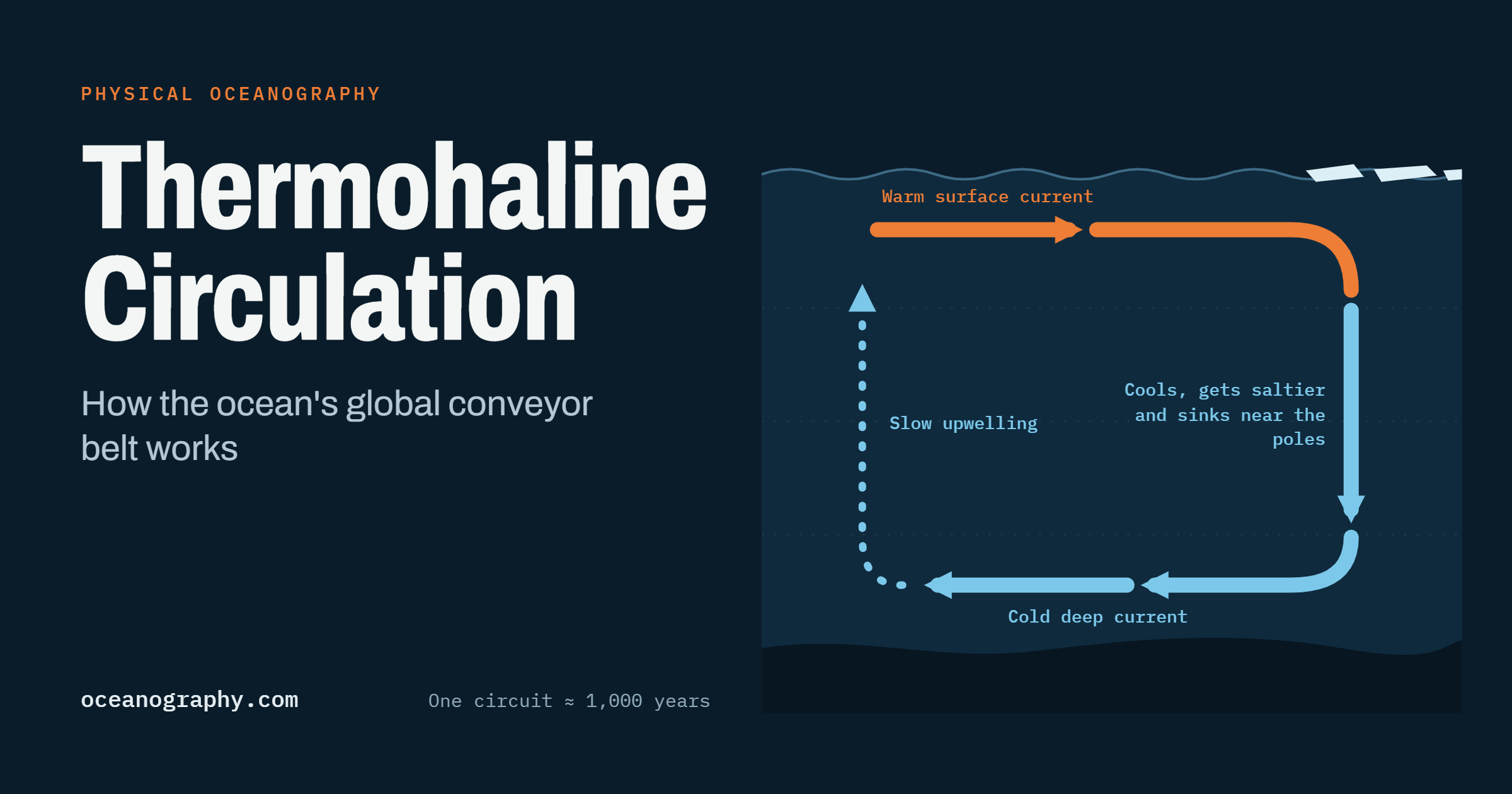
Quick answer: Thermohaline circulation is the part of ocean circulation driven by differences in seawater density, which depend on temperature ("thermo") and salinity ("haline"). Cold, salty water sinks in the polar North Atlantic and around Antarctica, spreads through the deep ocean, gradually rises, and returns along surface currents. NOAA estimates that a single parcel of water takes about 1,000 years to complete the full loop.
Key Takeaways
- Thermohaline circulation is driven by density differences created by temperature and salinity.
- Deep water forms mainly in the North Atlantic and around Antarctica.
- A full circuit takes roughly 1,000 years.
- The system moves heat, carbon, oxygen, and nutrients.
- The AMOC is expected to weaken with warming, but the scale of change is still under study.
What Is Thermohaline Circulation?
The name combines two Greek-derived roots: thermo for heat and haline for salt. Together, temperature and salinity set the density of seawater, and density decides whether water sinks or floats.
Why density drives the flow
Seawater becomes denser when it gets colder or saltier. When surface water becomes denser than the water beneath it, it sinks, and other water moves in to replace it. Repeated across vast regions, this creates a planet-scale overturning pattern.
Many oceanographers prefer the term meridional overturning circulation (MOC), because winds and tides also supply the energy that keeps deep water mixing and rising. Density still explains how the system starts.
How the Global Conveyor Belt Works, Step by Step
The image of a "global conveyor belt," popularized by geochemist Wallace Broecker in the 1980s, is a simplification, but a useful one. Follow a single parcel of water through four stages.
1. Sinking in polar seas
Warm, salty surface water travels north through the Gulf Stream and North Atlantic Current. In the Nordic and Labrador Seas, winter air chills it. When sea ice forms, most of the salt is left behind in the surrounding water, a process called brine rejection. The cold, salty water sinks to form North Atlantic Deep Water.
A similar process near Antarctica, especially in the Weddell and Ross Seas, produces Antarctic Bottom Water, the densest water mass in the open ocean.
2. Spreading through the deep ocean
Deep water flows south through the Atlantic, joins the circumpolar flow around Antarctica, and branches into the Indian and Pacific Oceans. It moves at only a few centimeters per second, far slower than surface currents, yet its total volume is enormous.
3. Rising back to the surface
Deep water cannot stay down forever. Much of it returns upward in the Southern Ocean, where strong westerly winds help pull it toward the surface. Elsewhere, it rises slowly through gradual mixing. The oldest deep waters, in the North Pacific, may not have touched the atmosphere for around a thousand years.
4. Returning along surface currents
Once at the surface, the water warms and joins wind-driven currents that carry it back toward the Atlantic, through the Indian Ocean and around southern Africa, completing the loop.
Density-Driven vs. Wind-Driven Currents
Most named currents on a map, such as the Gulf Stream or Kuroshio, are primarily wind-driven and confined to roughly the upper kilometer of the ocean. Density-driven flow reaches the seafloor. The two systems interact constantly: surface currents deliver salty water north, and the overturning helps sustain the northward flow in the Atlantic.
- Wind-driven currents: fast, relatively shallow, and responsive to weather over weeks to months.
- Density-driven circulation: slow, deep, and operating over centuries.
Why Thermohaline Circulation Matters
Heat and climate
The Atlantic Meridional Overturning Circulation (AMOC), the Atlantic branch of the system, moves heat northward. It contributes to milder winters in parts of northwestern Europe than latitude alone would suggest, although the atmosphere also carries much of that heat, and researchers still debate the exact share.
Carbon and oxygen
When surface water sinks, it carries dissolved oxygen and carbon dioxide into the deep ocean. This ventilation keeps the deep sea habitable and stores carbon away from the atmosphere for centuries, a key part of the global carbon cycle.
Nutrients and marine life
Deep water accumulates nutrients as organic matter sinks and decomposes. When that water rises, especially in the Southern Ocean, it fertilizes phytoplankton, the base of marine food webs. Changes in the circulation can therefore ripple through ecosystems and fisheries.
Is the Circulation Slowing Down?
This is where the science is active and uncertain. Warming surface waters and added freshwater from Greenland's melting ice sheet and increased rainfall make North Atlantic surface water less dense, which could weaken sinking.
Direct measurements of the AMOC, such as those from the RAPID array at 26.5°N since 2004, show variability, but the record is too short to separate natural swings from a long-term trend with confidence. Reconstructions from sediments and ocean temperature patterns suggest it may be weaker now than in previous centuries.
The Intergovernmental Panel on Climate Change (IPCC) Sixth Assessment Report concluded that the AMOC is very likely to weaken during the 21st century, with medium confidence that it will not collapse abruptly before 2100. Some newer studies argue that collapse risk is higher than earlier estimates suggested, while others find limited evidence of decline so far. The honest summary: weakening is expected, and the size and timing of any tipping point remain open questions.
Conclusion
Thermohaline circulation connects polar ice, tropical heat, deep-sea ecosystems, and the climate on land into one system. Once you understand how density moves water, related topics such as coastal upwelling, El Niño, and sea level rise become easier to follow.
Explore more ocean current guides on oceanography.com, from wind-driven gyres to the latest research on the Atlantic overturning.
Frequently Asked Questions
1. What does "thermohaline" mean?
Answer: Thermohaline combines "thermo" (heat) and "haline" (salt). It describes ocean circulation driven by differences in seawater density, which depend mainly on temperature and salinity. Colder and saltier water is denser, so it sinks below warmer, fresher water.
2. What drives thermohaline circulation?
Answer: Surface cooling, evaporation, and sea ice formation make polar surface water dense enough to sink. That sinking pushes deep water through the ocean basins. Winds and tides then supply much of the mixing energy that lets deep water rise again, so the circulation depends on more than density alone.
3. Where does deep water form?
Answer: Deep water forms in a few small regions. North Atlantic Deep Water forms mainly in the Nordic and Labrador Seas. Antarctic Bottom Water, the densest water mass in the open ocean, forms around Antarctica, especially in the Weddell and Ross Seas.
4. How long does water take to travel the global conveyor belt?
Answer: About 1,000 years. NOAA estimates that any given cubic meter of seawater needs roughly a millennium to complete the full circuit. You can follow each stage of the route in NOAA's global conveyor belt tutorial.
5. How fast does thermohaline circulation move?
Answer: Very slowly. Deep, density-driven flow typically moves around 1 to a few centimeters per second, compared with tens to hundreds of centimeters per second for wind-driven and tidal currents. Britannica's overview of thermohaline circulation explains how this sluggish flow still reaches the seafloor across the global ocean.
6. Is the AMOC the same as thermohaline circulation?
Answer: Not exactly. The Atlantic Meridional Overturning Circulation (AMOC) is the Atlantic branch of the global overturning system. It includes the density-driven sinking in the North Atlantic, plus wind-driven surface flow such as the Gulf Stream that carries warm water north.
7. How does thermohaline circulation affect climate?
Answer: It moves heat from the tropics toward the poles and helps moderate winters in parts of northwestern Europe. It also carries heat and carbon dioxide into the deep ocean, where they can remain for centuries, which slows the rate of surface warming.
8. Could the AMOC collapse?
Answer: It is possible but uncertain. The IPCC Sixth Assessment Report judged that the AMOC is very likely to weaken this century, with medium confidence that it will not collapse abruptly before 2100. Some newer studies suggest a higher risk, and research is ongoing.
9. How does thermohaline circulation affect marine life?
Answer: Sinking water delivers oxygen to the deep sea, keeping it habitable. Rising deep water returns nutrients to the surface, especially in the Southern Ocean, feeding phytoplankton at the base of marine food webs. Changes in the circulation can affect productivity and fisheries.
10. How do scientists measure ocean overturning?
Answer: Researchers use moored instrument arrays such as RAPID at 26.5°N and OSNAP in the subpolar North Atlantic, along with Argo profiling floats, ship-based surveys, and satellite data. Chemical tracers and seafloor sediment cores help reconstruct how the circulation behaved in the past.
