
28Sep
Ocean Sediment Records: What They Reveal About Earth
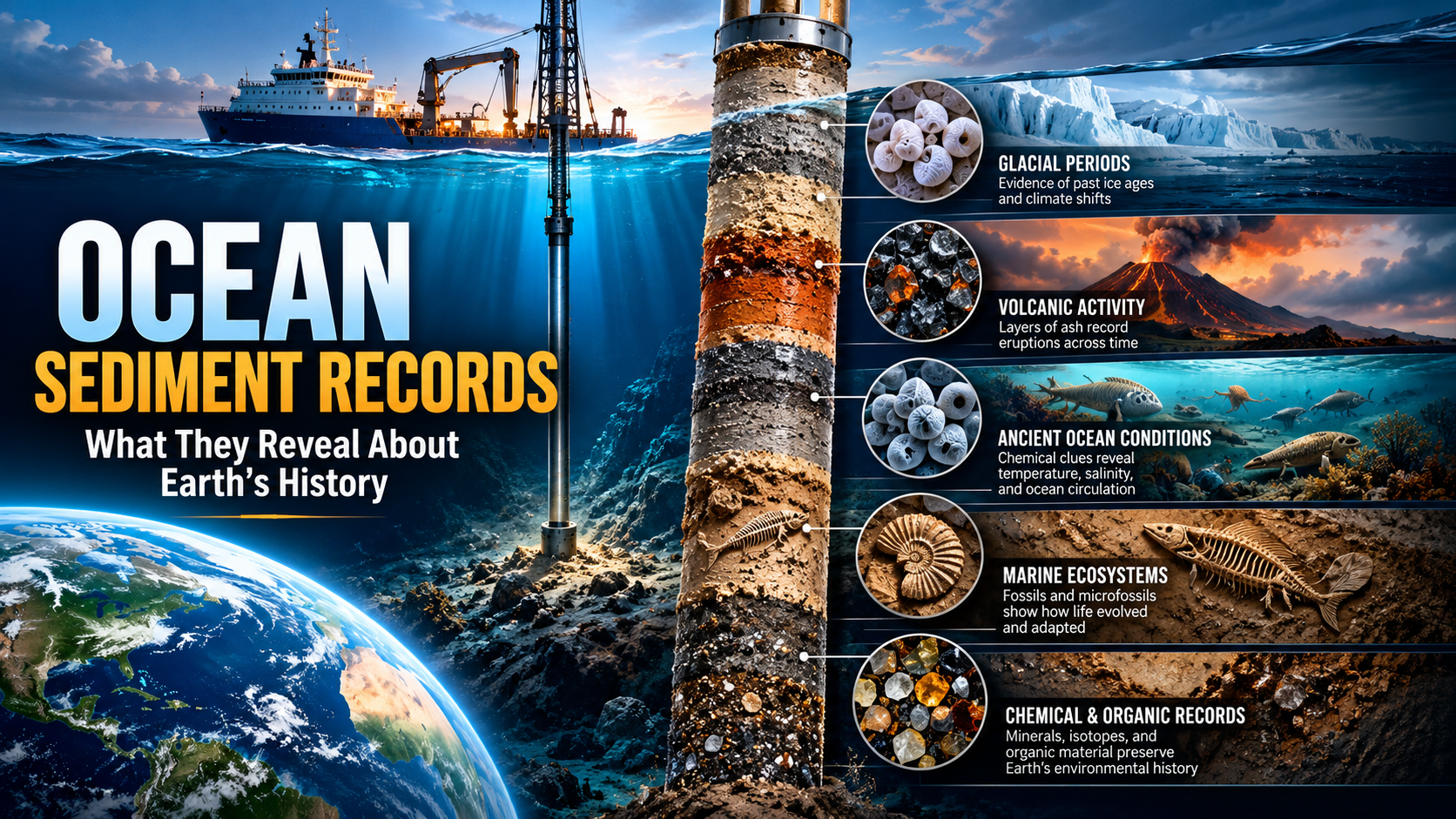
Ocean sediments record Earth’s history by preserving microfossils, minerals, volcanic ash, organic matter, and chemical signatures in layers on the seafloor. Scientists analyze these clues in sediment cores to reconstruct past ocean temperatures, climate shifts, circulation patterns, marine ecosystems, volcanic events, and other environmental changes extending millions of years into the past.
Every grain, fossil, chemical signature, and layer can carry information. Together, ocean sediment records allow researchers to investigate how Earth’s climate and ocean system changed long before thermometers, satellites, or written observations existed.
Why Are Ocean Sediments So Valuable?
Material continuously settles toward the ocean floor. Some comes from continents through rivers, wind, glaciers, and erosion. Other particles originate in the ocean itself, including microscopic shells and organic remains. Volcanic eruptions can contribute ash, while chemical reactions in seawater produce additional minerals.
Over time, these materials accumulate in layers.
In suitable environments, deeper layers are generally older than the material above them. Scientists can therefore recover sediment cores and examine successive chapters of environmental history.
The U.S. Geological Survey identifies sediments as an important paleoclimate archive containing proxies such as pollen, molecular fossils, algae, charcoal, and remains of planktonic and benthic organisms.
This makes the seabed much more than a collection of mud and sand. It is a physical record of interactions among the atmosphere, oceans, continents, ice sheets, and living organisms.
Sediment Cores Work Like Environmental Timelines
Scientists retrieve long cylinders of sediment using specialized coring and ocean-drilling equipment. Once recovered, cores can be photographed, scanned, dated, sampled, and subjected to physical, biological, and geochemical analyses.
Researchers may examine grain size, mineral composition, microfossils, stable isotopes, trace metals, organic molecules, magnetic properties, and other indicators.
According to NOAA’s National Centers for Environmental Information, paleoceanographic records can be reconstructed from deep-sea sediment proxies including fossil-plankton species, trace metals, isotopic composition, and sediment lithology.
A sediment core is more than a timeline. One core can preserve evidence of changing temperature, marine life, seawater chemistry, and circulation, sometimes within the same sequence of layers.
What Do Ocean Sediments Reveal About Ancient Climate?
One of their most important applications is paleoclimatology: the reconstruction of climates that existed before instrumental observations.
Past Ocean Temperatures
Tiny marine organisms called foraminifera build shells using materials in seawater. After they die, many of those shells settle to the seafloor.
The chemistry preserved in fossil shells can provide evidence about environmental conditions at the time the organisms lived. Researchers use measurements including stable oxygen isotopes and magnesium-to-calcium ratios in certain foraminifera to reconstruct aspects of past ocean conditions.
A Gulf of Mexico sediment core provides a concrete example. Researchers measured Mg/Ca ratios and stable oxygen isotopes in planktonic foraminifera to reconstruct changes in sea-surface temperature and seawater conditions across roughly the past 11,700 years. Examples like this show how microscopic shells buried in sediment can become quantitative records of past ocean change.
Because of proxies like these, ocean sediment records help scientists examine periods when the planet was significantly colder or warmer than today.
Ice Ages and Glacial Cycles
Earth has repeatedly shifted between colder glacial periods and warmer intervals.
Those transitions altered glaciers, ice sheets, sea level, ocean temperatures, and the movement of sediment. Marine deposits can preserve physical, chemical, and biological evidence of those changes.
Sediment cores can therefore help researchers determine when major climate transitions occurred and investigate how different parts of the Earth system responded.
Ancient Ocean Circulation Leaves Chemical Clues
Ocean currents redistribute enormous amounts of heat, nutrients, carbon, and dissolved substances around the planet. But direct measurements of those currents cover only a tiny fraction of Earth’s history.
Sediments provide another route into the past.
Scientists analyze chemical and biological proxies whose distributions or compositions respond to water temperature, salinity, productivity, terrestrial inputs, and water-mass properties. USGS describes marine climate proxies as tools for reconstructing variables including sea-surface and bottom-water temperature, salinity, relative sea level, precipitation, productivity, and terrestrial inputs.
By comparing ocean sediment records from different locations, researchers can investigate large-scale changes in ocean circulation and how those changes coincided with shifts in climate.
Microfossils Reveal Lost Marine Ecosystems
Sediments also preserve remains of organisms that once inhabited the ocean.
Foraminifera, diatoms, radiolarians, coccolithophores, and other microscopic organisms can leave durable remains in marine deposits. Different species thrive under different environmental conditions.
A change in the abundance or distribution of fossil species can therefore signal a change in the surrounding ocean.
Microfossil assemblages may help scientists investigate questions such as:
- Was the water warmer or colder?
- Did marine productivity increase or decrease?
- Did local environmental conditions change?
- Did ecological communities shift rapidly or gradually?
- How did organisms respond to major climate transitions?
Microfossils show scientists something chemistry alone cannot: which organisms were actually living in the ocean as conditions changed.
Volcanic Eruptions Can Leave Distinct Sediment Layers
Large eruptions can distribute volcanic ash across oceans and continents. Some of that material eventually settles onto the seabed.
When an identifiable ash layer occurs across multiple sediment cores, it can serve as a useful stratigraphic marker. Researchers can analyze its mineral and chemical composition and compare it with material associated with known volcanic sources or eruptions.
Such layers can help correlate environmental records from different locations and establish the sequence of geological events.
Sediments can also contain evidence delivered by winds, rivers, glaciers, and ocean currents. Changes in the amount, size, or composition of this material can reveal how conditions on nearby continents changed through time.
Sediment Chemistry Reveals Changes Invisible to Fossils
Not every important historical signal appears as a visible fossil or dramatic layer.
Sediments contain chemical information.
Researchers analyze stable isotopes, trace elements, biomarkers, organic carbon, and other geochemical indicators. These proxies can provide evidence related to temperature, biological productivity, oxygen conditions, precipitation, salinity, and other environmental variables.
No single proxy tells the complete story. Scientists often combine independent indicators to build stronger reconstructions.
That multiproxy approach is a major strength of ocean sediment records: physical particles, fossils, and chemistry can independently record different aspects of the same environmental transition.
How Do Scientists Determine the Age of Ocean Sediments?
Interpreting a sediment core requires an age model.
Researchers can use several dating and correlation techniques depending on the age and composition of the material. Methods may include radiocarbon dating for suitable younger organic or carbonate material, isotope stratigraphy, paleomagnetism, fossil biostratigraphy, and correlation with recognizable volcanic layers.
Scientists then combine age information with sediment depth.
Once an age-depth relationship is established, changes found at different levels of the core can be placed into chronological context. Researchers can estimate when an event occurred, how long a transition lasted, and sometimes how quickly environmental conditions changed.
Why Ocean Sediments Matter Today
Historical records matter because modern instruments cover only a very short interval compared with Earth’s climate history.
Sediments extend that perspective far beyond human observations. They reveal natural variability, abrupt changes, long-term cycles, and environmental conditions unlike those experienced during the modern observational era.
USGS notes that paleoclimate reconstructions help researchers investigate climate variability beyond the relatively short period covered by instrumental measurements.
Scientists can also compare proxy reconstructions with climate-model simulations. Agreement and disagreement between geological evidence and model results can improve understanding of how the climate system behaves under different conditions.
That makes old sediments useful for modern science. Researchers can compare what actually happened during past climate shifts with the behavior predicted by climate models.
The Seafloor Is an Archive of a Changing Planet
Ocean sediments preserve an extraordinary range of evidence: microscopic fossils, minerals transported from continents, volcanic ash, organic molecules, chemical signatures, and indicators of ancient seawater conditions.
Read together, these clues help scientists reconstruct climate cycles, ocean circulation, marine ecosystems, geological events, and environmental transitions across immense spans of time.
A layer of seafloor mud can preserve several kinds of evidence at once from microscopic shells and volcanic ash to isotope ratios and organic compounds. When scientists date those layers and compare multiple proxies, the sediment becomes a chronological record of how oceans, climate, and marine life changed together.
Want to go deeper? Explore Oceanography.com guides to marine geology, seafloor processes, ocean circulation, and climate science to see how researchers reconstruct the changing ocean from evidence preserved beneath the waves.
FAQs
1. How do ocean sediments record Earth’s climate history?
Answer: Marine sediments preserve climate proxies such as microfossils, isotopes, minerals, and organic molecules. Scientists analyze how these indicators change between sediment layers to reconstruct past environmental conditions.
2. How old can sediments on the ocean floor be?
Answer: Their age varies enormously by location and geological setting. Some marine sediment sequences preserve records extending millions of years into Earth’s past.
3. What can scientists learn from deep-sea sediment cores?
Answer: Cores can reveal past ocean temperatures, circulation patterns, biological productivity, volcanic events, continental inputs, and changes in marine ecosystems.
4. How are ocean sediment cores collected?
Answer: Research vessels use coring or drilling equipment to penetrate the seafloor and retrieve cylindrical sections of layered sediment. NOAA maintains extensive paleoceanography data derived from marine archives.
5. What are climate proxies in ocean sediments?
Answer: Climate proxies are measurable physical, chemical, or biological indicators that respond to environmental conditions and can be used to reconstruct aspects of past climate.
6. How do foraminifera reveal ancient ocean temperatures?
Answer: Scientists analyze the chemistry and isotopic composition of fossil foraminifera shells. Certain chemical measurements can be calibrated to infer conditions such as past seawater temperature.
7. Can ocean sediments reveal ancient volcanic eruptions?
Answer: Yes. Volcanic ash deposited on the seafloor can form identifiable layers that help scientists recognize and correlate past eruptive events.
8. How do scientists date marine sediment layers?
Answer: Methods can include radiocarbon dating, paleomagnetism, biostratigraphy, isotope stratigraphy, and volcanic-ash correlation, depending on the material and time period.
9. Why are marine sediments important for climate research?
Answer: They extend climate evidence far beyond modern instrumental observations and help researchers examine natural variability and major environmental transitions. The USGS paleoclimate archive explains how sediment records preserve climate evidence.
10. Can ocean sediments help scientists understand future climate change?
Answer: They provide evidence of how Earth’s climate and oceans responded to previous changes. Scientists can use those reconstructions to investigate climate mechanisms and evaluate models used to understand climate behavior.
