
19Oct
4 Types of Ocean Sediments and What They Hold
Right now, a slow and silent rain is falling through the ocean. Grains of dust, flakes of marine snow, tiny shells and even specks of space rock drift down into the dark. Over thousands of years, they pile up on the seafloor in layers, and those layers quietly record the story of our planet.
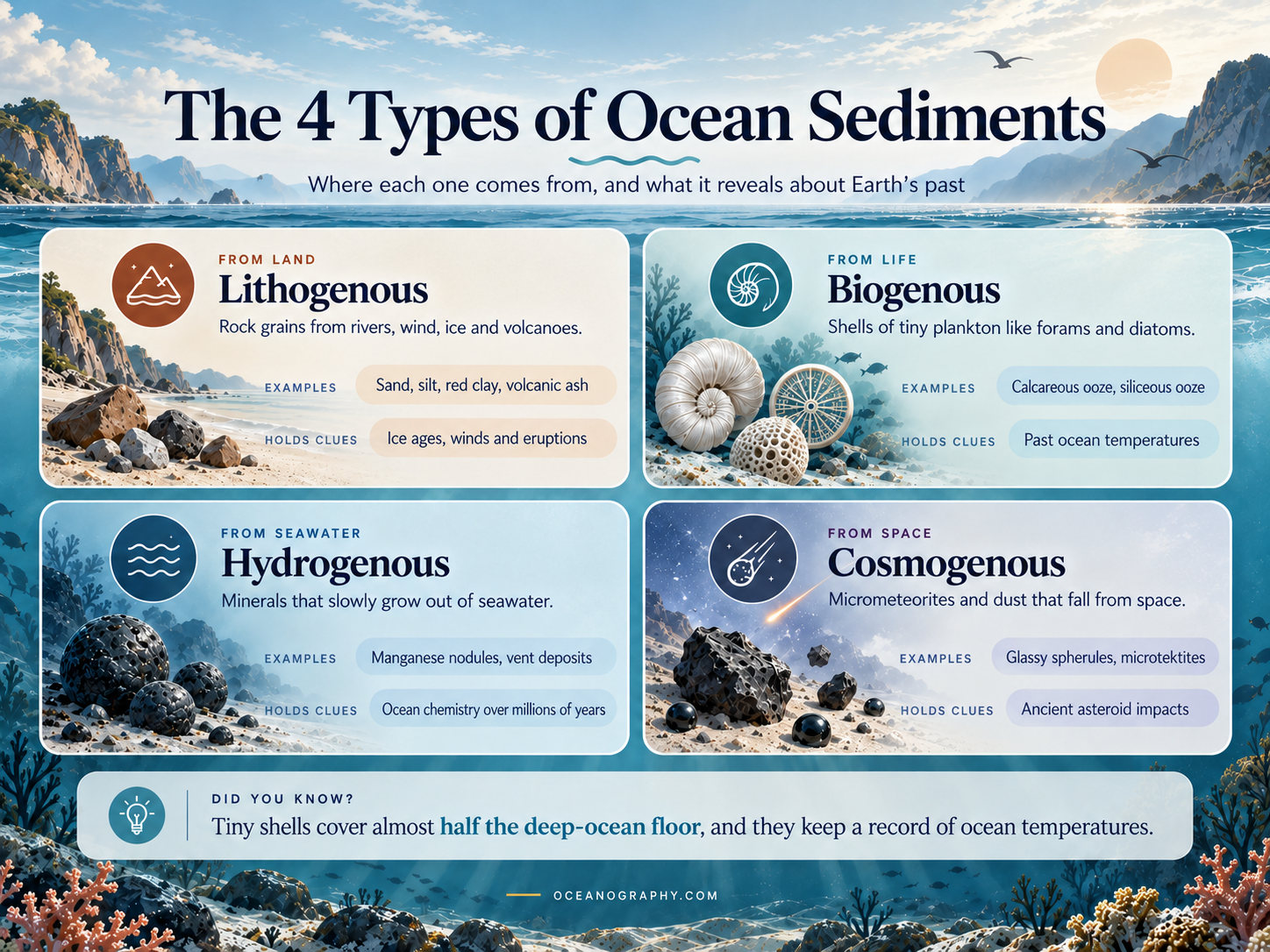
Scientists sort this material into four types of ocean sediments, also called types of marine sediments or types of seafloor sediments. This classification of marine sediments answers one simple question: where do ocean sediments come from? The answer gives us four groups. Lithogenous sediment comes from land, biogenous sediment comes from living things, hydrogenous sediment grows out of seawater, and cosmogenous sediment falls from space. Each one keeps a different secret about Earth's past, from ice ages to asteroid impacts.
What Are Ocean Sediments?
Ocean sediments, also called marine sediments or ocean floor sediments, are loose particles that settle on the seafloor. They include sand, silt, clay, shells, minerals and dust. Over millions of years, they can harden into sedimentary rock.
Where sediment lands matters:
● Neritic sediment settles near the coast, on the continental shelf. It is often coarse and builds up quickly.
● Pelagic sediment settles in the deep, open ocean, on the abyssal plain. It is fine and builds up very slowly, about 1 millimeter to 1 centimeter every 1,000 years.
Near the continents, sediment layers can be more than 10 kilometers thick. Near mid-ocean ridges, where the seafloor is young, they are much thinner
1. Lithogenous Sediment: Rock Dust From Land
Lithogenous sediment, also called terrigenous sediment, starts as rock on land. Weathering and erosion break that rock into grains. Then nature carries the grains to the sea:
● Rivers deliver sand, silt and mud to the coast.
● Wind blows desert dust far out over the ocean.
● Glaciers and icebergs drop stones known as ice-rafted debris.
● Volcanoes blast ash into the air, which falls onto the water.
What it holds: Ice-rafted debris found far from land shows that icebergs drifted there during an ice age. A thin band of volcanic ash marks a single eruption. (Learn how underwater volcanoes build new seafloor.) Fine red clay, also called abyssal clay, records wind and dust patterns across millions of years.
Sometimes this sediment moves fast. Underwater avalanches called turbidity currents race down slopes and dump thick layers in hours. Today, the same currents carry plastic to the deep seafloor.
2. Biogenous Sediment: Shells of Tiny Ocean Life
Biogenous sediment is made from the remains of living things, mostly plankton too small to see. When at least 30% of a sediment comes from these remains, scientists call it ooze.
There are two main kinds:
● Calcareous ooze comes from calcium carbonate shells, such as foraminifera and coccolithophores. It covers about 48% of the deep ocean floor. It dissolves in very deep, cold water, so it is rare below about 4,000 to 5,000 meters.
● Siliceous ooze comes from glassy silica shells made by diatoms and radiolarians. It covers about 15% of the deep seafloor.
What it holds: Foraminifera are tiny climate recorders. The oxygen isotopes in their shells change with water temperature and global ice volume, so scientists use them to track past ice ages and warm periods. The mix of species also shows how ocean life changed. Explore biological oceanography to meet these plankton.
3. Hydrogenous Sediment: Minerals Grown From Seawater
Hydrogenous sediment forms right on the seafloor. Metals dissolved in seawater slowly come out of the water and build solid minerals.
The best-known example is the manganese nodule. These dark, potato-sized lumps grow in rings around a tiny core, such as a shark tooth or shell fragment. They grow only a few millimeters every million years, mostly at depths of 3,000 to 6,000 meters. They contain manganese, iron, nickel, copper and cobalt.
Hydrothermal vents also create hydrogenous sediment. Hot, mineral-rich water gushes out and leaves metal deposits around the vents.
What it holds: Because nodules grow so slowly, their rings record ocean chemistry over millions of years, a bit like tree rings. Today, they also sit at the center of debates about deep-sea mining.
4. Cosmogenous Sediment: Dust From Space
Cosmogenous sediment comes from space. It is the rarest type, making up only about 1% of ocean sediment. Still, a surprising amount arrives. A 2021 study found that about 5,200 tons of micrometeorites reach Earth's surface every year. In seafloor mud, this space dust shows up as tiny metal or glass spherules. Big impacts also leave microtektites, glassy beads of melted rock.
What it holds: The most famous example involves the dinosaurs. In rock that formed on an ancient seafloor in Italy, scientists found a thin clay layer packed with iridium, a metal rare on Earth but common in asteroids. It helped show that an asteroid struck Earth about 66 million years ago.
How Scientists Read Ocean Sediment Layers
In calm parts of the deep ocean, seafloor layers stack up in order: younger on top, older below. Paleoclimate scientists read them with sediment cores, long tubes of mud drilled from the seafloor.
1. Drill a core. Research ships pull up long columns of sediment from deep below the seafloor.
2. Describe the layers. Scientists log color, grain size and texture.
3. Study the fossils. Microscopes reveal foraminifera, diatoms and more.
4. Date the layers. Radiocarbon dating works for the last 50,000 years or so. Magnetic reversals, volcanic ash and fossils date older layers.
5. Compare the clues. Many signals together build a timeline of Earth's past.
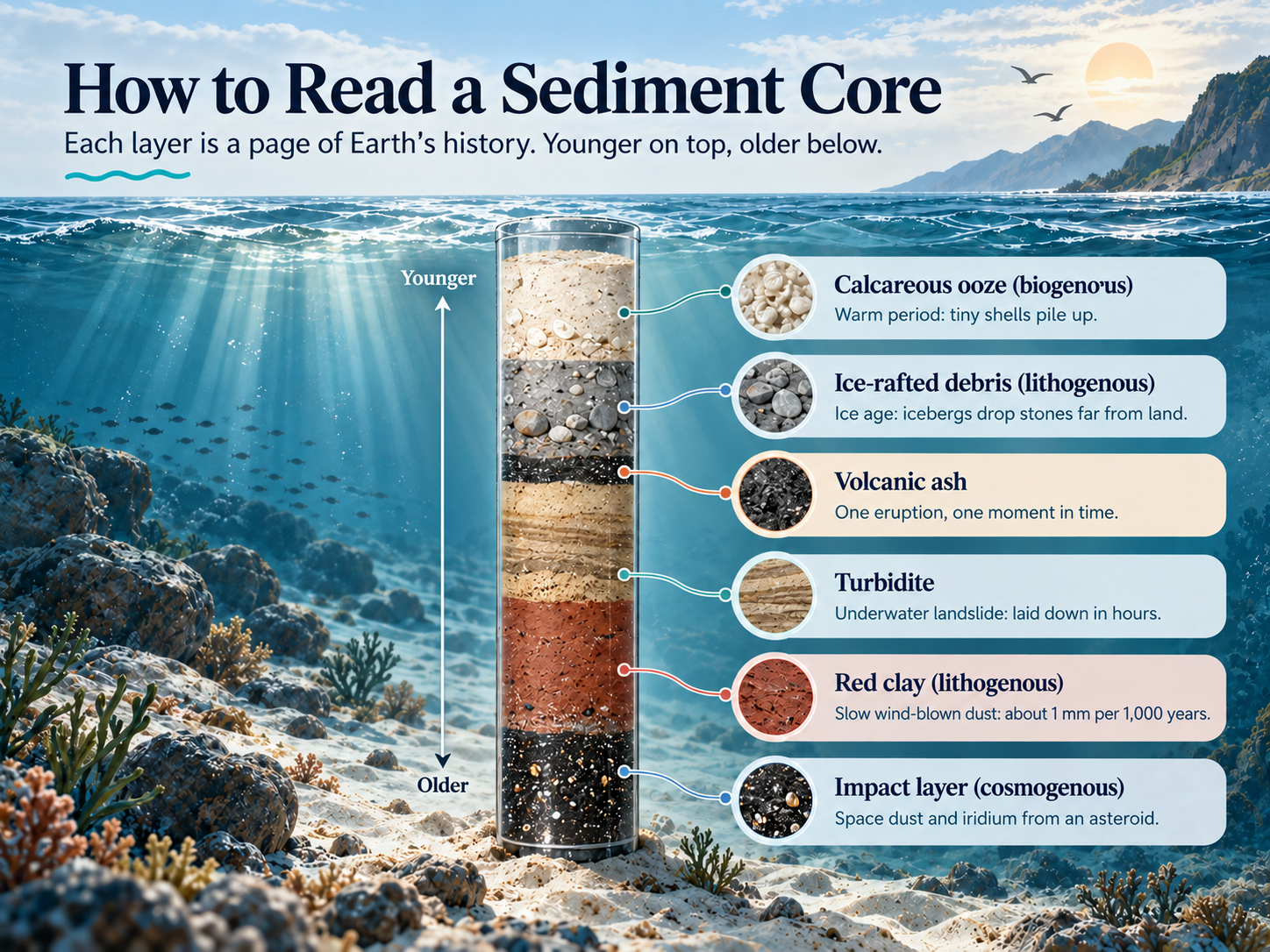
Layers are not always perfect. Burrowing animals mix the mud, and turbidity currents can drop thick beds quickly, so scientists cross-check every clue. For a deeper look at this detective work, read our guide to ocean sediment records.
Why Ocean Sediments Matter Today
Deep sea sediments are much more than old mud. They:
● Test climate models by showing how the ocean behaved in past warm and cold periods.
● Store carbon for thousands to millions of years.
● Warn of hazards such as underwater landslides that can snap seafloor cables.
● Hold valuable metals, which raises big questions about deep-sea mining.
● Track ocean currents that move heat around the planet. See how the ocean conveyor works.
The Big Picture
The four types of ocean sediments come from land, life, seawater and space. Together, they turn the seafloor into Earth's longest diary. Every layer of sand, shell, mineral or space dust holds a page of that story, from ice ages to asteroid impacts. The next time you stand on a beach, remember that some of those grains may one day join that record.
Ready to go deeper? Search ocean research articles on Oceanography.com, find classroom ideas in our Teacher Resources, or ask a question in the Oceanography.com Forum.
Frequently Asked Questions
1. What are the 4 types of ocean sediments?
Answer: The four types of ocean sediments are lithogenous (rock grains from land), biogenous (shells and remains of sea life), hydrogenous (minerals that form from seawater) and cosmogenous (dust from space). The LibreTexts oceanography textbook explains each type in more detail.
2. Which type of ocean sediment is most common?
Answer: On the deep ocean floor, biogenous calcareous ooze covers the most area, about 48%. Red clay covers about 38%. Near the continents, lithogenous sediment dominates. Our guide to ocean sediment records shows how scientists study these deep-sea sediments.
3. What is the difference between lithogenous and biogenous sediment?
Answer: Lithogenous sediment comes from rock on land, carried by rivers, wind, ice and volcanoes. Biogenous sediment comes from living things, such as plankton shells. Many of those shells sink to the bottom inside marine snow.
4. What is ooze on the ocean floor?
Answer: Ooze is a soft seafloor sediment made of at least 30% tiny shells. Calcareous ooze comes from foraminifera and coccolithophores, while siliceous ooze comes from diatoms and radiolarians. Learn about these plankton in biological oceanography.
5. What are manganese nodules?
Answer: Manganese nodules are hydrogenous sediment: dark, potato-sized lumps that grow from metals in seawater. They grow only a few millimeters every million years and contain nickel, copper and cobalt. GEOMAR explains how manganese nodules form.
6. Can ocean sediment come from space?
Answer: Yes. Cosmogenous sediment is made of micrometeorites and space dust. It is only about 1% of ocean sediment, but about 5,200 tons of micrometeorites reach Earth's surface each year, according to a CNRS-led study in Antarctica.
7. Where are ocean sediments found?
Answer: Neritic sediment collects near coasts on the continental shelf. Pelagic sediment covers the deep abyssal plain. Layers are thickest near continents and thinnest near mid-ocean ridges, where underwater volcanoes create young seafloor.
8. How do ocean sediments reveal past climate?
Answer: Scientists study a sediment core layer by layer. Oxygen isotopes in foraminifera shells show past temperatures and ice volume, and ice-rafted debris marks ice ages. These clues also show how currents like the ocean conveyor changed over time.
9. How fast do ocean sediments build up?
Answer: In the deep sea, very slowly. Red clay grows about 1 millimeter every 1,000 years, and ooze about 1 centimeter. Near coasts it is much faster, and turbidity currents can dump thick layers in hours. These same currents move plastic to the seafloor.
10. How can students learn the types of ocean sediments?
Answer: Start with a simple chart of the four types of ocean sediments, then try a jar experiment that lets sand, clay, and shells settle into layers. Find lesson ideas in our Teacher Resources and real studies through Search Articles.
