
7Aug
What Is Marine Snow and How Does It Feed Deep Sea Life?

Introduction
The deep ocean is vast, cold and mostly dark. With little or no sunlight, most organisms living far below the surface cannot depend on local photosynthesis for food. Yet deep waters and the seafloor support complex communities of bacteria, crustaceans, worms, fishes and other animals.
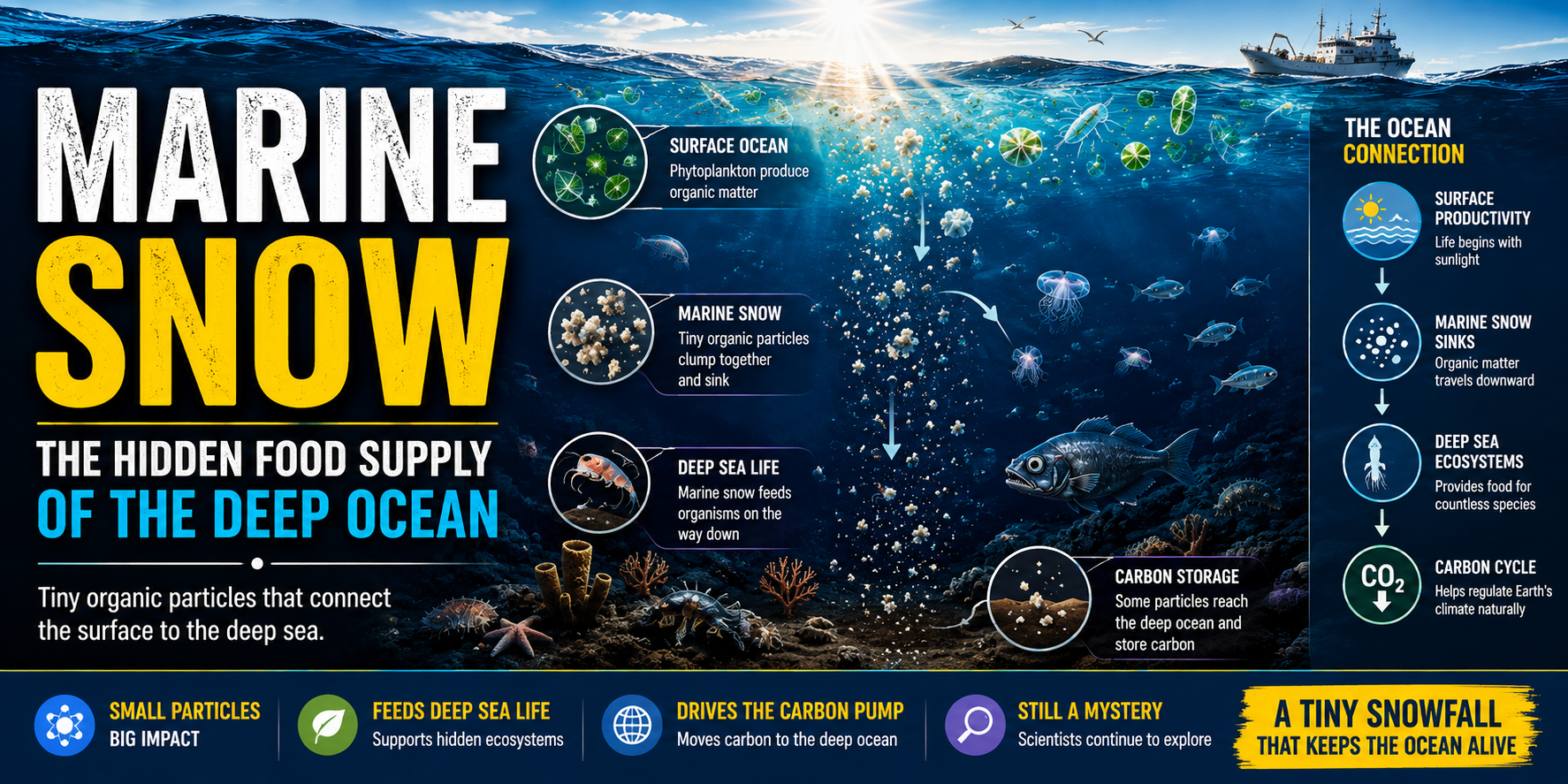
One of the most important processes supporting deep ocean life is marine snow, the continuous movement of tiny organic particles from productive surface waters into the dark ocean below. The name describes its appearance, not its temperature: the particles drift and swirl through the water like snowflakes, but they are not frozen.
What Is Marine Snow Made Of?
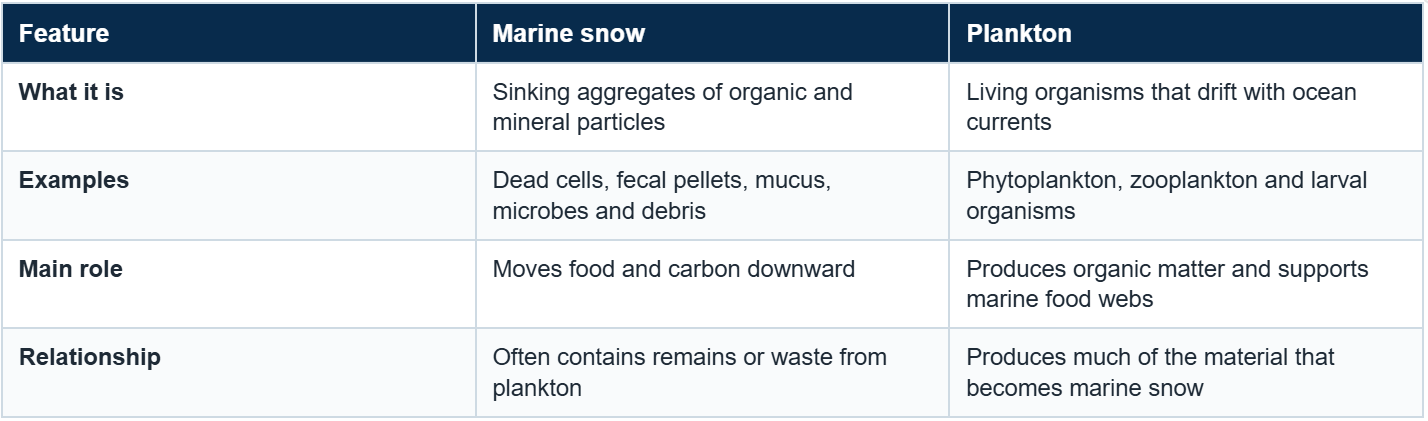
Marine snow is not one material. It is a changing mixture of biological debris, microorganisms and small mineral particles. As individual pieces collide, sticky substances help them form larger aggregates that sink more quickly.
- Dead or damaged phytoplankton and zooplankton
- Fecal pellets and other animal waste
- Mucus and transparent organic gels released by marine organisms
- Bacteria and other microbes living on the particles
- Fragments of shells, suspended sediment, soot or dust
Scientists often describe the carbon rich portion of these sinking particles as particulate organic carbon (POC). POC is important because it can be eaten and recycled in the water column or transported into deeper ocean layers.
How Does Marine Snow Form?
The process begins near the surface, where sunlight supports phytoplankton growth. Marine snow develops through a sequence of production, aggregation, sinking and recycling.
- Surface production: Phytoplankton use sunlight, carbon dioxide and nutrients to build organic matter through photosynthesis.
- Particle release: Dead cells, waste, mucus and fragments enter the surrounding water.
- Aggregation: Small particles collide and stick together, creating larger, flake like clumps.
- Sinking and transformation: Gravity pulls the aggregates downward while microbes and animals eat, break apart and chemically alter them.

The Journey From Surface Waters to the Seafloor
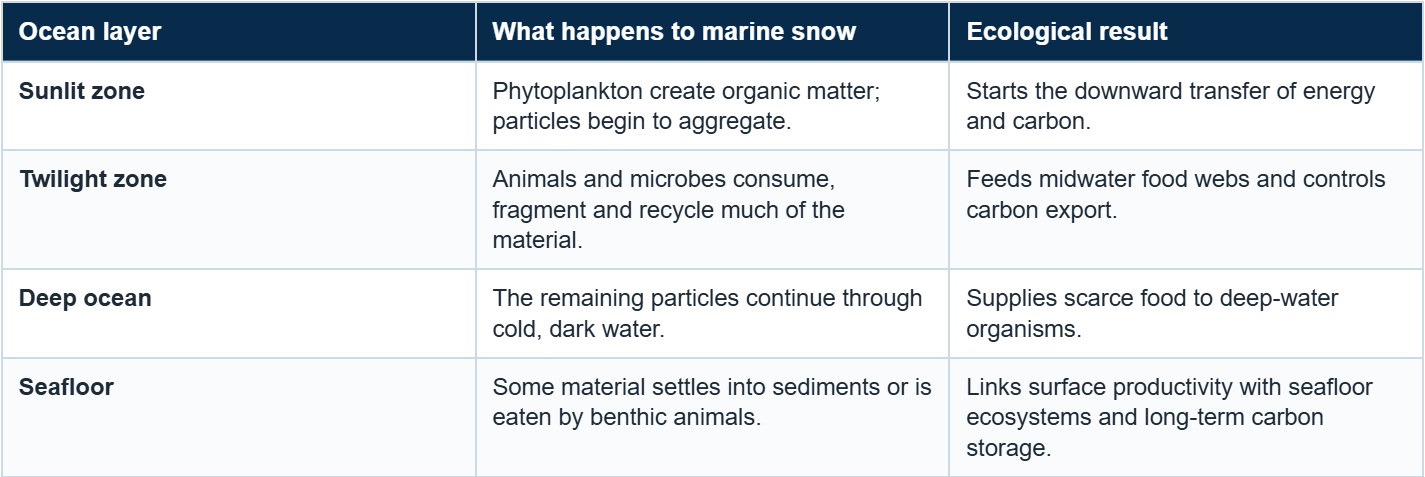
Marine snow passes through distinct ocean layers. At every stage, organisms consume and transform the particles, so only part of the original material reaches the deepest water or becomes buried in sediment.
Why Marine Snow Is a Deep Sea Food Source
Below the sunlit surface, food becomes progressively harder to find. Bacteria colonize marine snow particles, small animals capture them while they sink, and seafloor organisms consume what finally arrives. The particles therefore transfer surface produced energy through several levels of the deep-ocean food web.
Marine snow is especially important across broad areas of the open deep sea. It is not the only deep-ocean energy source: ecosystems around hydrothermal vents and cold seeps can rely on chemosynthesis. Away from those specialized habitats, however, organic matter falling from above is a central food supply.
- Bacteria and archaea
- Zooplankton and amphipods
- Jellies and other gelatinous animals
- Worms and small crustaceans
- Fishes and seafloor scavengers
Marine Snow vs. Plankton: What Is the Difference?
Marine Snow and the Ocean Biological Carbon Pump
At the surface, phytoplankton use photosynthesis to convert dissolved carbon dioxide into organic matter. When part of that material sinks as marine snow, it carries carbon out of surface waters. Scientists call the combined biological processes that move carbon downward the ocean biological carbon pump.
Most sinking organic matter is consumed or decomposed before it reaches the deep sea. Microbes convert some of its carbon back into dissolved carbon dioxide, while animals use it for growth and respiration. A smaller fraction continues below the twilight zone, where it may remain isolated from the atmosphere for much longer periods or become buried in seafloor sediment.
Woods Hole Oceanographic Institution explains that the twilight zone controls how much organic carbon is recycled and how much continues toward the deep ocean.
How Scientists Study Marine Snow
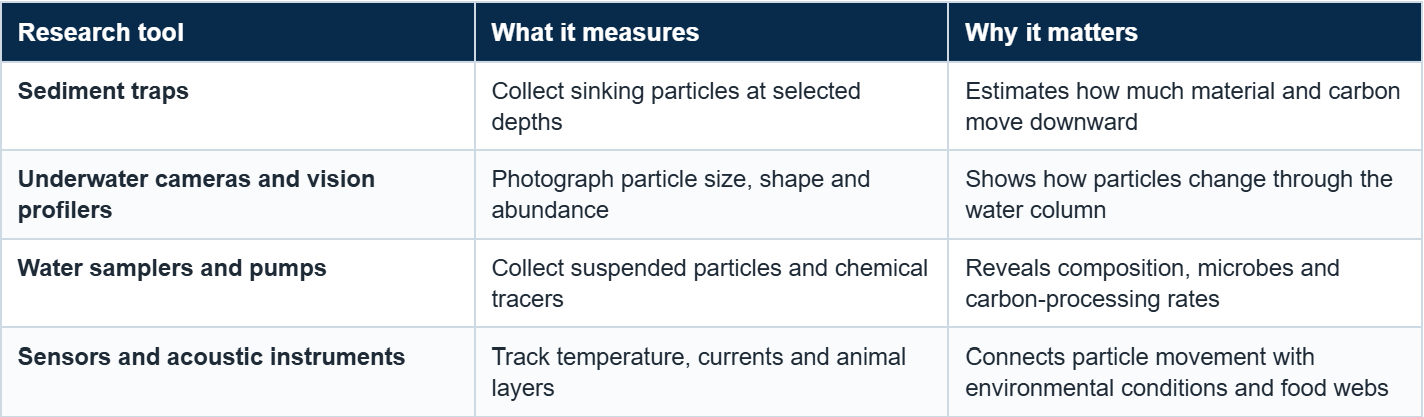
Researchers cannot understand marine snow from surface samples alone. They use instruments throughout the water column to measure particle abundance, composition, sinking speed and carbon flux.
A Real Research Example: The Ocean Twilight Zone Observation Network
In the Northwest Atlantic, Woods Hole Oceanographic Institution has developed an observation network that combines sediment traps, acoustic instruments, cameras and autonomous platforms. Sediment traps positioned deep in the water column measure the rate of marine snow fall, while other instruments observe animal communities and currents.
This approach shows why marine-snow research is interdisciplinary. Particle measurements are most useful when scientists can compare them with plankton production, animal migration, temperature and water movement.
Another Observation: A Marine Snow “Storm” in the Gulf of Alaska
NOAA supported exploration in the Gulf of Alaska documented dense marine snow in productive waters. The observation illustrates how nutrient-rich surface conditions can produce large amounts of phytoplankton and sinking aggregates, creating a visible pathway from surface productivity to deep sea food webs.
How Changes in the Ocean May Affect Marine Snow
Changes in ocean temperature, nutrient supply and plankton communities may influence how much organic material sinks into deeper waters. Because marine snow connects surface ecosystems with the deep ocean, changes near the surface can affect life far below.
- Surface productivity: Changes in light and nutrients can alter how much organic matter phytoplankton produce.
- Particle composition: Different plankton communities create particles with different sizes, densities and nutritional value.
- Microbial activity: Warmer water and changing chemistry can affect how quickly microbes decompose sinking material.
- Ocean circulation: Currents and mixing can transport, disperse or slow particles before they reach deeper layers.
Scientists are still working to determine how these interacting changes will affect carbon export and deep ocean food supply in different regions. The outcome will not be identical everywhere because productivity, temperature, oxygen and circulation vary across the global ocean.
Why Marine Snow Matters Beyond the Deep Ocean
Marine snow shows how microscopic biological events can influence global systems. A phytoplankton cell formed near the surface may become part of a sinking aggregate, feed an animal in the twilight zone, be broken down by bacteria, or carry carbon toward the seafloor. Each pathway connects marine food webs with the larger carbon cycle.

What Scientists Are Still Trying to Learn
- How quickly do different types of marine snow particles sink?
- Which organisms create, consume and break apart the particles at each depth?
- How much particulate organic carbon escapes the twilight zone?
- How do temperature, oxygen, nutrients and currents change particle transport?
- How will climate-driven shifts in plankton communities alter deep ocean food supply?
Answering these questions requires long-term observations, research cruises, autonomous instruments and improved models. Better measurements will help scientists connect processes that occur over minutes and meters with carbon storage and ecosystem change over decades and ocean basins.
Conclusion
Marine snow is a steady rain of particles that links productive surface waters with the dark ocean below. It delivers food to deep-sea organisms, supports microbial and animal communities throughout the water column, and carries particulate organic carbon into deeper layers.
The process is not a simple one way fall. Most particles are eaten, fragmented or recycled along the journey, and that transformation is itself essential to ocean food webs. A process too small to see can influence ecosystems thousands of meters below the surface, showing how connected Earth's ocean systems are.
Continue exploring ocean science topics to understand how microscopic processes, marine ecosystems and global climate systems are connected.
Read more about biological oceanography and phytoplankton, or explore the latest articles at Oceanography.com.
Frequently Asked Questions
1. What is marine snow in the ocean?
Answer: Marine snow is a mixture of sinking organic and mineral particles that falls from upper ocean waters toward the deep sea. It commonly includes dead plankton, fecal material, mucus, microbes and fine debris.
2. Why is marine snow important?
Answer: Marine snow supplies food to organisms below the sunlit zone and transports particulate organic carbon from surface waters into deeper ocean layers.
3. Is marine snow actual snow?
Answer: No. Marine snow is not frozen water. The name describes the way pale particles drift through the ocean like falling snowflakes.
4. Where does marine snow come from?
Answer: Most marine snow begins in productive surface waters. Phytoplankton, zooplankton and other organisms release cells, waste and mucus that combine with microbes and debris to form sinking aggregates.
5. How does marine snow support deep sea animals?
Answer: Bacteria, zooplankton, fishes and seafloor animals consume marine snow directly or feed on organisms that use it. This transfers energy from surface photosynthesis into deep-ocean food webs.
6. What is the ocean biological carbon pump?
Answer: The biological carbon pump is the set of biological processes that moves carbon from surface waters into the ocean interior. Marine snow is one important pathway. See Woods Hole Oceanographic Institution's biological pump overview for a scientific explanation.
7. Does all marine snow reach the ocean floor?
Answer: No. Most particles are consumed, fragmented or decomposed before they reach the seafloor. Only a fraction continues into the deepest water or becomes buried in sediment.
8. How can marine snow affect climate?
Answer: Marine snow can carry organic carbon below the surface and into deeper water. Carbon that reaches sufficient depth may remain separated from the atmosphere for longer periods, making marine snow part of the ocean carbon cycle.
9. How do scientists measure marine snow?
Answer: Researchers use sediment traps, underwater cameras, optical particle profilers, water samplers, chemical tracers and environmental sensors to study particle abundance, sinking speed, composition and carbon transport.
10. Where can students learn more about marine snow?
Answer: NOAA provides an accessible overview, video and research context in What is marine snow?.
