
7Oct
Underwater Volcanoes and the Creation of New Ocean Floor
Every ocean basin on Earth has a birthplace, and it is volcanic. Along a chain of seafloor mountains longer than any range on land, molten rock rises, cools, and becomes new crust. Underwater volcanoes do more than erupt in isolation. Working along plate boundaries, they build the floor of the ocean itself, shaping seawater chemistry, deep-sea ecosystems, and the long-term structure of the planet.
Short Answer
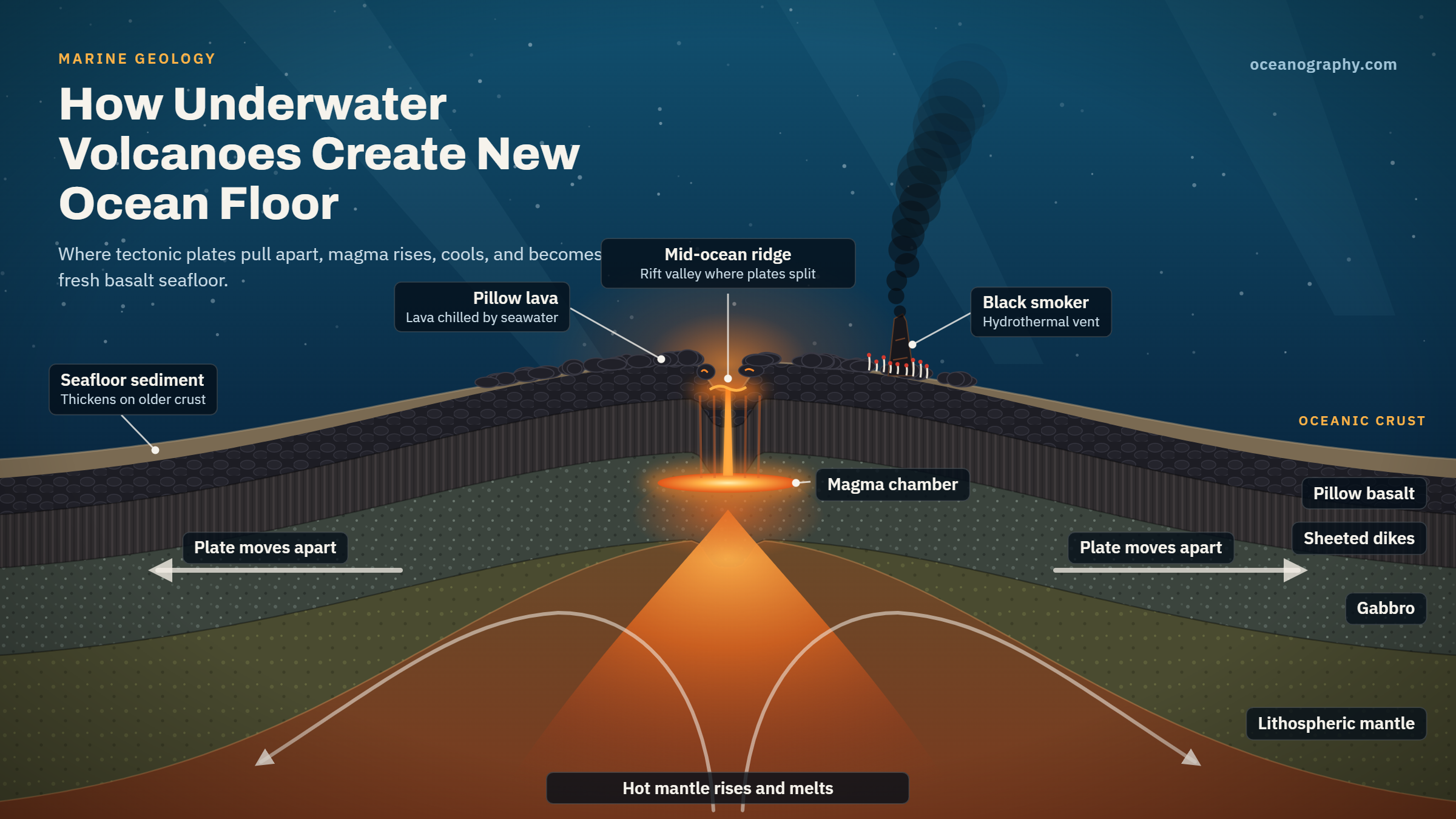
New ocean floor forms at mid-ocean ridges, where tectonic plates move apart. As the plates separate, hot mantle rock rises and partially melts. That magma erupts or intrudes as basalt, cools into fresh oceanic crust, and is carried away from the ridge as spreading continues. This process is called seafloor spreading.
How Underwater Volcanoes Build New Crust
Decompression Melting
The mantle beneath a ridge is mostly solid rock called peridotite. When plates pull apart, this rock rises toward the surface and the pressure on it drops. Lower pressure lowers its melting point, so a small fraction melts without added heat. Geologists call this decompression melting. Because the melt is less dense than the surrounding rock, it rises and can accumulate in magma-rich zones beneath the ridge axis.
From Magma to Seafloor
Magma reaches the surface in several ways, and each leaves a distinct layer in the crust:
- Pillow lavas and sheet flows form the top layer. Lava erupting into cold seawater chills almost instantly, producing rounded pillow shapes with glassy rinds.
- Sheeted dikes sit beneath them. These are vertical sheets of magma that solidified in the cracks feeding eruptions.
- Gabbro forms the deepest crustal layer. It is the same basaltic chemistry, but it cooled slowly at depth, so it grew larger crystals.
Geologists study this layered structure on land at ophiolites, slices of oceanic crust pushed onto continents.
Spreading Rate Shapes the Ridge
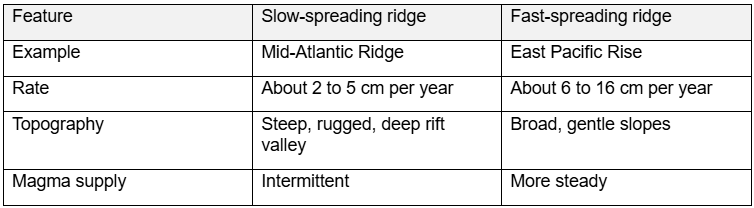
Not all ridges behave alike. NOAA reports that the Mid-Atlantic Ridge spreads at about 2 to 5 centimeters per year and has a deep central rift valley. The East Pacific Rise spreads at roughly 6 to 16 centimeters per year and forms a broader, smoother profile with a more continuous magma supply.
Not All Underwater Volcanoes Create New Ocean Floor
Submarine volcanism happens in three main settings, and only one of them produces new oceanic crust at a large scale.
- Mid-ocean ridges create new crust as plates diverge. This is the main source of ocean floor.
- Hotspots build seamounts and volcanic islands on top of existing crust. The Hawaiian Islands are the classic example.
- Subduction zones produce volcanic arcs where one plate sinks beneath another. The 2022 eruption of Hunga Tonga-Hunga Ha'apai occurred in this setting.
One exception stands out. Behind some subduction zones, back-arc basins such as the Lau Basin in the southwest Pacific open by spreading and form new crust of their own. Iceland is another special case, where a hotspot sits on the Mid-Atlantic Ridge and lifts part of it above sea level.
The Evidence for Seafloor Spreading
Seafloor spreading was proposed by Harry Hess in the early 1960s. The decisive test came from magnetism. As basalt cools, magnetic minerals record the direction of Earth's magnetic field, which has reversed many times. In 1963, Fred Vine and Drummond Matthews, and independently Lawrence Morley, explained the symmetric magnetic stripes found on either side of ridges as a record of crust forming and moving away during these reversals.
Rock ages confirm the pattern. Ocean crust is youngest at the ridge axis and grows older toward the edges of ocean basins. Because old crust is eventually recycled at subduction zones, the oldest ocean floor is roughly 180 million years old, far younger than the oldest continental rocks.
Why This Process Matters
Underwater volcanoes along ridges influence far more than geology.
- Ocean chemistry: Seawater circulates through hot, fractured crust and returns as hydrothermal fluid, exchanging elements such as magnesium, iron, and sulfur with the ocean.
- Deep-sea life: Hydrothermal vents, first observed in 1977 on the Galápagos Rift, support communities built on chemosynthesis rather than sunlight.
- Mineral deposits: Vent systems form seafloor massive sulfide deposits, which are now part of the debate over deep-sea mining.
- Hazards: Shallow submarine eruptions can generate tsunamis, ash plumes, and floating pumice, as the Tonga eruption showed.
Where Does New Oceanic Crust Form?
Most new oceanic crust forms along the global mid-ocean-ridge system, where tectonic plates move apart and mantle material rises and partially melts. The resulting magma cools beneath and at the seafloor, creating new crust that moves away from the ridge. New crust also forms in some back-arc basins behind subduction zones.
How Scientists Study Eruptions They Cannot See
Most ridge eruptions happen under kilometers of water and go unnoticed. Researchers rely on indirect tools:
- Hydrophones detect the low-frequency sound of earthquakes and eruptions traveling through the ocean.
- Ocean-bottom seismometers and pressure sensors measure ground shaking and the slow inflation of a volcano as magma accumulates.
- Multibeam sonar maps the seafloor before and after eruptions to measure new lava flows.
- Remotely operated and autonomous vehicles sample rocks, fluids, and organisms at the seafloor.
Axial Seamount, on the Juan de Fuca Ridge off the U.S. Pacific Northwest, shows how this works in practice. It erupted in 1998, 2011, and 2015. The 2015 eruption was recorded in real time by a cabled seafloor observatory, giving researchers continuous data on inflation, earthquakes, and lava emplacement.
Practical Cautions
Eruption records remain incomplete because much of the seafloor is poorly monitored. Spreading rates are averages, and individual ridge segments can vary. Educational diagrams also simplify the crust into neat layers, while real sections, especially at slow-spreading ridges, can be thin, faulted, or missing layers entirely.
Conclusion
Volcanism and magmatic intrusion at mid-ocean ridges are fundamental to the creation of new oceanic crust, while seafloor spreading carries that crust away and subduction eventually recycles it. Decompression melting supplies the magma, spreading carries new crust away, and subduction eventually recycles it. Understanding underwater volcanoes connects plate tectonics, ocean chemistry, and deep-sea biology into one system.
Ready to go deeper? Explore related guides on oceanography.com covering plate tectonics, hydrothermal vent ecosystems, and seafloor mapping to see how this hidden volcanic system shapes the ocean you study.
Frequently Asked Questions
1. What is an underwater volcano?
An underwater volcano, or submarine volcano, is an opening in the seafloor where magma reaches the surface. It can be a single seamount, a volcanic island that began below sea level, or part of a long volcanic ridge such as the mid-ocean ridge system.
2. How do underwater volcanoes create new ocean floor?
At mid-ocean ridges, plates move apart and the mantle beneath them rises and partially melts. The magma erupts or intrudes as basalt and cools into new oceanic crust, which then moves away from the ridge. NOAA Ocean Exploration's overview of mid-ocean ridges describes this global system and its spreading rates.
3. How fast does new ocean floor form?
Spreading rates vary by ridge. The Mid-Atlantic Ridge spreads at about 2 to 5 centimeters per year, while parts of the East Pacific Rise spread at roughly 6 to 16 centimeters per year. These are long-term averages, so individual segments and time periods can differ.
4. What is the difference between a seamount and a mid-ocean ridge?
A seamount is an individual underwater mountain, usually a volcano, that does not reach the sea surface. A mid-ocean ridge is a continuous volcanic mountain chain along a divergent plate boundary. Ridges create new crust, while most seamounts are built on top of crust that already exists.
5. Why is ocean crust so much younger than continental crust?
Ocean crust is constantly made at spreading ridges and destroyed where plates sink back into the mantle at subduction zones. This recycling means the oldest ocean floor is roughly 180 million years old. The USGS guide to plate boundaries and plate motions explains how crust is created at divergent boundaries and recycled at convergent ones.
6. What is pillow lava?
Pillow lava forms when basaltic lava erupts underwater. The outer surface chills immediately in cold seawater and forms a glassy skin, while the molten interior pushes out new lobes. The result is a pile of rounded, pillow-shaped forms that is a reliable sign of underwater eruption.
7. Can underwater eruptions be dangerous?
Deep ridge eruptions generally pose little direct hazard to people at the surface, although submarine eruptions can still produce significant acoustic, thermal, chemical, and ecological effects. Shallow eruptions present greater potential hazards, including tsunamis and atmospheric disturbances. Shallow submarine volcanoes are different. The 2022 Hunga Tonga-Hunga Ha'apai eruption produced a tsunami and a large atmospheric blast, showing that shallow eruptions can affect coastlines and air travel.
8. How do scientists know when an underwater volcano erupts?
Most eruptions are detected indirectly. Hydrophones pick up the sound of earthquake swarms, seafloor pressure sensors record inflation and sudden deflation, and repeat sonar surveys reveal fresh lava flows. Cabled observatories, such as the one at Axial Seamount, can record an eruption as it happens.
9. Are hydrothermal vents the same as underwater volcanoes?
No, but they are closely linked. Hydrothermal vents are places where seawater that has circulated through hot volcanic crust flows back out. Hydrothermal vent fluids can exceed about 340°C, while the extreme pressure at depth keeps them from boiling in the usual way. They are powered by volcanic heat and usually sit on or near active ridges, but they are not eruption sites themselves.
10. Where can students see oceanic crust on land?
Ophiolites are sections of oceanic crust and upper mantle that tectonic forces have pushed onto continents. Well-known examples include the Troodos ophiolite in Cyprus and the Samail ophiolite in Oman. They let geologists walk through layers that normally lie kilometers below the seafloor.
