
17Nov
How Seamounts Become Hotspots of Marine Biodiversity
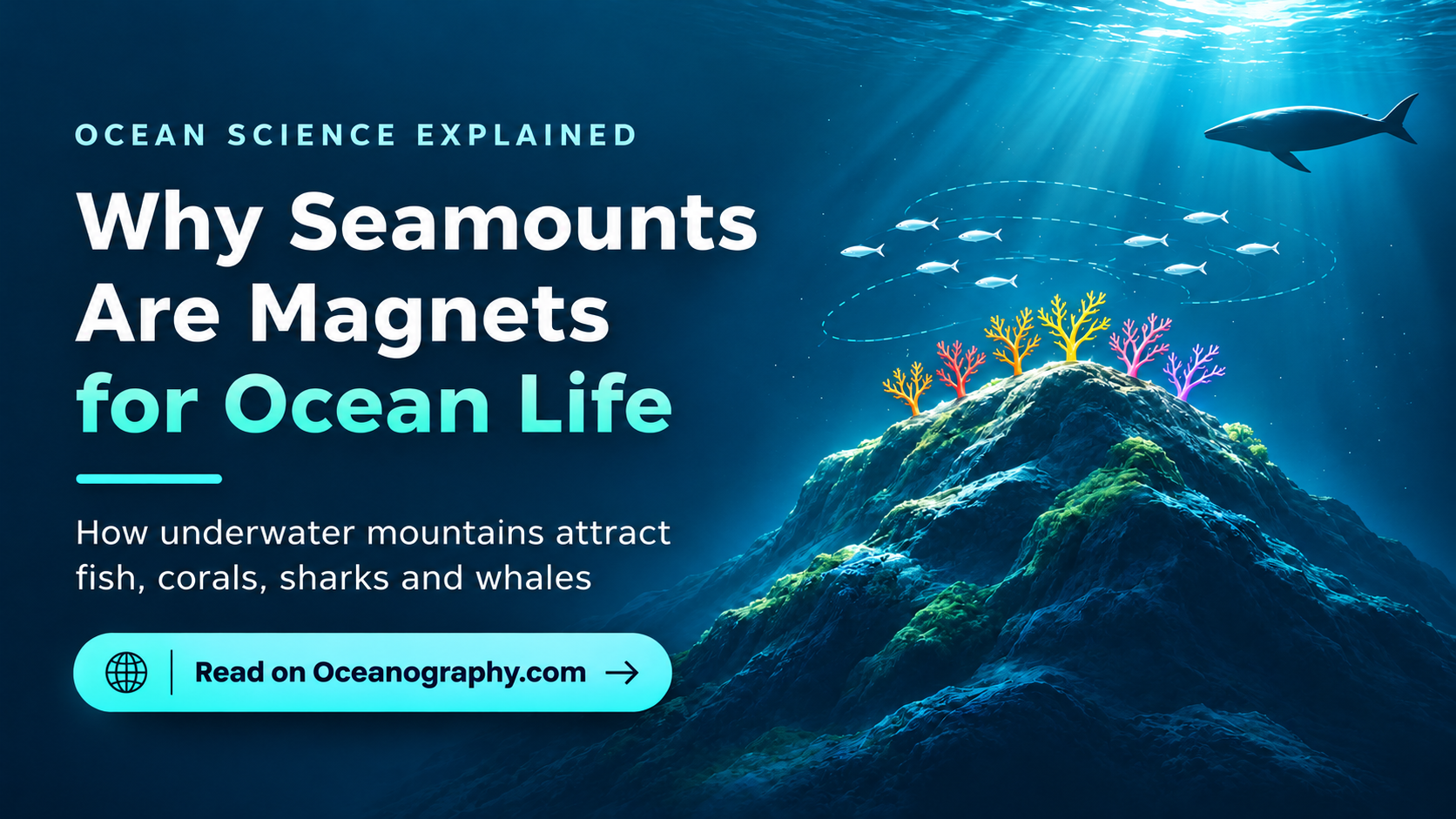
Seamounts become hotspots of marine biodiversity because they bend ocean currents. When moving water hits an underwater mountain, it speeds up, stirs nutrients and traps drifting plankton over the summit. That steady food supply feeds everything from 4,000-year-old corals to tuna, sharks and whales.
Not every seamount works this way, but the ones that do are among the richest places in the open ocean. Below, we explain the physics behind it, the animals involved, real US examples and why seamount protection became a hot debate in 2026.
What Is a Seamount?
A seamount is an underwater mountain, usually an extinct volcano, that rises at least 1,000 meters (about 3,300 feet) above the seafloor without breaking the surface. Smaller peaks are often called knolls, and flat-topped seamounts that were once islands are called guyots.
They are far more common than most people realize. In 2023, a Scripps-led team used satellite measurements of sea-surface height to identify more than 19,000 previously unknown seamounts, bringing the known total to about 43,454. Scientists working with data from the NASA–CNES SWOT satellite say that number could more than double, possibly to as many as 100,000.
Here's the catch: only about a quarter of the seafloor has been mapped in detail by sonar, so most seamounts have never been seen by a scientist or a camera.
Related: Search peer-reviewed seamount research in the Oceanography.com Articles index
Why Do Seamounts Attract So Much Marine Life?
Seamounts attract marine life because they turn a featureless stretch of open ocean into a place where food piles up. Four physical processes do most of the work, and they often operate together.
1. Faster currents feed animals that can't move
Water flowing over a seamount gets squeezed and speeds up. (New to how currents move? Start with our guide to global ocean circulation.) Corals, sponges and other filter feeders are rooted in place and depend on currents to deliver food. Faster flow means more food particles sweeping past every minute.
The rock itself matters too. Most of the deep seafloor is soft mud, so a seamount's hard volcanic surface gives corals and sponges a rare place to anchor, and their branches shelter crabs, shrimp and young fish.
2. Taylor columns trap water over the summit
When a steady current hits an isolated seamount, it can form a slowly spinning dome of water above the peak called a Taylor column (or Taylor cap). Water inside the dome stays put instead of drifting away. That means eggs, larvae and plankton can be held over the seamount for longer.
This retention helps explain why some seamounts host species found nowhere else.
3. Internal waves and upwelling stir up nutrients
Tides pushing water against steep seamount slopes create internal waves: large underwater waves that travel along layers of different density. As they break, they mix the water and can lift cold, nutrient-rich water toward the summit.
This upwelling is real but has limits. Researchers have found it rarely reaches the sunlit surface layer long enough to fuel a big plankton bloom on its own.
4. Trophic focusing: the seamount as a plankton trap
The most important mechanism for many fish is called trophic focusing. Every night, billions of tiny animals swim up toward the surface to feed, then dive back down at dawn. Over a shallow seamount, the descending animals run into the summit and get stranded right where predators are waiting.
Research on seamount plankton dynamics points to this "bottom trapping" of migrating plankton, plus the constant arrival of food carried in sideways by currents, as the main reason fish over seamounts are so well fed. In plain terms, a seamount doesn't need to grow its own food. It intercepts food from a huge area of ocean and concentrates it in one spot.
Which Species Live on and Around Seamounts?
Seamount life falls into three groups: animals fixed to the rock, fish that live near the bottom, and far-ranging visitors that use the seamount as a feeding stop.
• Residents attached to the rock: deep-sea corals (black, bamboo and bubblegum corals), glass sponges, sea fans, crinoids and basket stars.
• Bottom-associated fish: orange roughy, rockfish, grenadiers and other deep-water species that school near the slopes.
• Visitors from the open ocean: tuna, billfish, sharks, sea turtles, seabirds, dolphins and whales.
The evidence for that third group is strong. A widely cited 2010 study in PNAS analyzed tuna longline observer data from the Pacific and found higher species richness near seamounts than in coastal or open-ocean areas. Some sharks, billfish and tuna were more likely to be caught close to seamounts.
A more recent study in the tropical Atlantic found more of seven species of sharks, predatory fish and seabirds within 5 km of two shallow seamounts (summits under 100 m), but not around a deeper one at 260 m. Tagged tuna and silky sharks also used the seamounts as "hubs" inside much larger foraging ranges, coming back to them for months or years.
Related: Biological Oceanography explained
Are All Seamounts Biodiversity Hotspots?
No. Some seamounts are packed with predators while others nearby are quiet, mostly because of summit depth and location.
Location matters too. A study supported by the Lenfest Ocean Program compared 1,649 Pacific seamounts and linked tuna hotspots to oceanic fronts, the boundaries where two different water masses meet. A seamount sitting near a front gets a double boost.
Here is how summit depth usually changes what you find:
• Shallow seamounts (summit shallower than ~400 m): trap migrating plankton well, so tuna, sharks and seabirds are often abundant. Examples include the Chagos Archipelago and the Gulf of California.
• Intermediate seamounts (~400–1,000 m): trap plankton only some of the time. Coral beds, like Hawaii's black corals, are often rich, and deep-sea trawlers target the fish here.
• Deep seamounts (summit deeper than 1,000 m): rarely draw surface predators but often hold very old coral and sponge gardens. Davidson Seamount is a classic example.
Checklist: Is this seamount likely a hotspot?
• Summit is shallow enough to meet migrating plankton (roughly the upper few hundred meters)
• Sits near a current front or boundary between water masses
• Strong, steady currents flow across it
• Hard rock exposed (not buried in sediment)
• Isolated from other features, so it concentrates life rather than spreading it out
• Lightly fished or protected, so old coral and fish communities survive
The more boxes it ticks, the more likely it is to be a true hotspot.
Which US Seamounts Are Biodiversity Hotspots?
The US has some of the best-studied seamounts on Earth, and each one shows a different side of seamount biodiversity.
Davidson Seamount, California
Davidson Seamount sits about 80 miles southwest of Monterey. According to NOAA, it is 26 miles long and 8 miles wide, with a summit 4,101 feet below the surface and a base at 12,743 feet. Expeditions by NOAA and the Monterey Bay Aquarium Research Institute (MBARI) in 2002 and 2006 found huge coral forests and sponge fields, plus species new to science.
It was added to Monterey Bay National Marine Sanctuary in 2008, making it the first seamount protected in US waters.
Northeast Canyons and Seamounts, off New England
About 130 miles off Cape Cod lies the only marine national monument in the Atlantic: the Northeast Canyons and Seamounts Marine National Monument, created in 2016 and covering roughly 4,913 square miles. It is home to 54 species of coral and is a feeding ground for whales, dolphins, sea turtles and more than 10 species of shark.
It is also a political flashpoint. On February 6, 2026, President Trump signed a proclamation reopening the monument to commercial fishing, and in April 2026 the administration finalized a rule removing the fishing restrictions (Harvard's environmental policy tracker has the full timeline). The proclamation states that well-managed commercial fishing won't harm what the monument protects. Fishing groups welcomed the move, while conservation groups oppose it and have vowed to fight it.
Hawaii's deep coral seamounts
The Hawaiian chain, including Papahānaumokuākea, is lined with seamounts and deep slopes. In 2015, NOAA and Smithsonian scientists described a black coral, Leiopathes annosa, found at 1,000–1,600 feet. Some colonies are more than 4,000 years old, which makes it the longest-lived marine organism known.
Related: Why Are Estuaries Important? 3 Ways They Help Sea Life, People and Water
Why Are Seamount Ecosystems So Vulnerable?
The same traits that make seamounts rich also make them fragile. Their animals grow slowly, live a long time and gather in predictable places, which makes them easy to find and slow to recover.
• Slow-growing fish: Orange roughy, a classic seamount fish, can live 150 years or more and doesn't reproduce until about 20–30 years old. Stocks that crash may need half a century or longer to recover.
• Ancient corals: Deep-sea corals and sponges grow very slowly and are easily broken. NOAA notes they are especially vulnerable to physical disturbance and environmental change.
• Bottom trawling: A single pass of heavy gear can flatten coral that took centuries to grow.
• Deep-sea mining interest: Many older seamounts are coated in manganese crusts that hold valuable metals, which draws mining interest.
• Climate change: Warming, falling oxygen and ocean acidification all hit slow-growing deep-water life hardest.
Common mistake to avoid: assuming "deep" means "safe." Deep-sea fishing fleets have targeted seamount fish since the late 1970s, and many seamount coral beds were damaged before anyone surveyed them.
Related: How to Restore Kelp Forests: Why They Vanish and How They Grow Back
How Can You Help Protect Seamounts?
You don't need a submarine to make a difference:
1. Choose seafood carefully. Skip orange roughy and check Seafood Watch ratings before buying deep-sea fish.
2. Watch live deep-sea dives. NOAA Ocean Exploration and Nautilus Live stream seamount expeditions for free, often with scientists answering questions.
3. Explore the data yourself. Browse the research institutes that share real-time and historical ocean data on Oceanography.com.
4. Comment on federal rules. NOAA fishing and sanctuary rules open public comment periods on Regulations.gov, and every comment becomes part of the official record.
5. Visit a museum or institute. Find one near you in our Museums & Institutes directory.
6. Teach it. Educators can pair this post with our Teacher Resources.
Related: Ocean science courses and lectures
The Bottom Line
The link between seamounts and marine biodiversity comes down to one idea: underwater mountains capture moving water and the food inside it. Faster currents feed corals and sponges, Taylor columns hold larvae in place, internal waves stir up nutrients, and shallow summits trap migrating plankton for hungry fish, sharks and whales.
But only some seamounts become true hotspots, and those are exactly the places most exposed to fishing, mining and policy shifts. With tens of thousands of seamounts still unexplored, the next decade of US decisions will shape what survives to be discovered.
Keep exploring: Search the Oceanography.com Articles index for the latest seamount research, or tell us what you've seen on a seamount livestream in the Oceanography.com Forum.
Frequently Asked Questions
What is a seamount in simple terms?
A seamount is an underwater mountain, usually an extinct volcano, that rises at least 1,000 meters from the seafloor but stays below the surface. Scientists know of over 43,000 and expect many more.
Why are seamounts called oases of the ocean?
They concentrate food in the otherwise empty open ocean. Currents, swirling water and trapped plankton create a reliable buffet that draws in fish, sharks, turtles and whales.
How many seamounts are there in the world?
About 43,000–44,000 large seamounts have been identified using satellite data. New satellite measurements suggest the real number could reach 100,000.
Are there seamounts in US waters?
Yes. Well-known examples include Davidson Seamount off California, the Northeast Canyons and Seamounts off New England, and many seamounts along the Hawaiian chain.
Why are seamounts important for fishing?
Many commercially valuable fish, such as tuna and orange roughy, gather around seamounts. That makes them productive fishing grounds, but also easy to overfish because slow-growing species recover slowly.
Can you scuba dive on a seamount?
Only on rare shallow seamounts whose summits come within recreational diving depth. Most seamounts are hundreds or thousands of feet deep and are explored with submersibles and remotely operated vehicles (ROVs).
What is a Taylor column?
A Taylor column is a slowly rotating dome of water that can form above a seamount when a steady current flows past it. It holds plankton, eggs and larvae over the summit, which helps explain why some seamounts have species found nowhere else.
What is the difference between a seamount and a guyot?
A guyot is a seamount with a flat top. Most guyots were once volcanic islands whose peaks were worn flat by waves before they slowly sank below the surface.
What is the oldest animal found around seamounts?
A deep-water black coral from Hawaii, Leiopathes annosa, can live more than 4,000 years, making it the longest-lived marine organism known. It grows at about 1,000 to 1,600 feet deep.
Are seamounts protected in the United States?
Some are. Davidson Seamount has been part of Monterey Bay National Marine Sanctuary since 2008. The Northeast Canyons and Seamounts Marine National Monument is still a monument, but it was reopened to commercial fishing in 2026, so how much protection it gets is still being debated.
