
5Nov
How to Restore Kelp Forests: Why They Vanish and How They Grow Back
Learning how to restore kelp forests starts with one question: why are they dying? These tall underwater forests grow along cool coasts around the world. Many are shrinking fast, but our kelp forest recovery guide shows they can grow back.
Quick Answer
Kelp forests are disappearing because of warm ocean water, low nutrients, and too many sea urchins after their predators died. To bring them back, people remove extra urchins, protect predators like sea otters, plant young kelp on “green gravel,” and breed heat-tolerant kelp. Projects work best near healthy forests.
Key Takeaways
• Warm water and hungry purple urchins are the two biggest threats.
• Northern California lost about 95% of its kelp canopy after 2013.
• Urchin removal, green gravel, and predator recovery are the main fixes.
• Restoration works best close to an existing kelp forest.
• Protecting the kelp we still have is the first and cheapest step.
Why Are Kelp Forests Disappearing?
Kelp is a large brown alga, not a plant. It grows very fast. NOAA says kelp can grow up to 18 inches a day in good conditions. But it needs cool water full of nutrients.
On the US West Coast, three problems hit at once:
1. Sea stars died. In 2013, a wasting disease killed most sunflower sea stars. These stars eat urchins.
2. The ocean got hot. A marine heatwave called “the Blob” lasted from 2014 to 2016. Warm water holds fewer nutrients, so kelp grew poorly.
3. Urchins took over. With no predator, purple urchin numbers exploded. They ate kelp down to bare rock.
These bare patches are called urchin barrens. Urchins can live there for years with little food. That makes recovery slow.
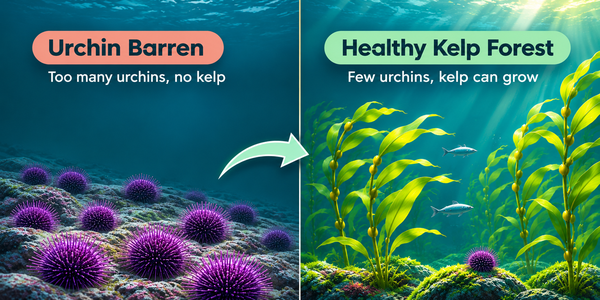
A study funded by the National Science Foundation tracked the damage. Northern California’s kelp fell by about 95% after 2013.
Australia has a similar story. CSIRO reports that Tasmania has lost about 95% of its giant kelp. A warm, low-nutrient current moved south and brought urchins with it.
How to Restore Kelp Forests by Removing Sea Urchins
Fewer urchins means young kelp has a chance to grow. Here is how teams do it:
1. Survey the reef and count urchins in each square metre.
2. Pick a small site next to any remaining kelp.
3. Send trained divers to remove purple urchins by hand.
4. Return often to keep urchin numbers low.
5. Watch for young kelp to return on its own.
In Mendocino County, California, commercial divers cut urchin numbers to a target level. The catch is simple. If removal stops, urchins can come back.
How Does Green Gravel Help Kelp Grow Back?
Green gravel is a simple idea first tested in Norway. Small rocks get seeded with baby kelp in a lab. Then they are scattered on the reef.
1. Collect spores from healthy, fertile kelp.
2. Seed small stones with the spores in water tanks.
3. Grow the young kelp for a few weeks.
4. Drop the gravel from a boat or place it by diver.
5. Check the kelp over the next few months.
In the 2020 Norway trial, kelp stayed on the stones and kept growing. Gravel dropped from a boat did as well as gravel placed by divers. That keeps costs low. One weak spot: strong waves can wash small stones away.
Can Sea Otters and Other Predators Bring Kelp Back?
Yes. Predators keep urchin numbers in balance. Sea otters are the best-known example.
1. Protect sea otters and their coastal habitat.
2. Support breeding programs for sunflower sea stars.
3. Return predators only where it is safe and legal.
4. Track urchin and kelp levels over time.
A Monterey Bay Aquarium study looked at 100 years of data. Kelp held up better where sea otters returned in central California. In Monterey Bay, otters ate healthy urchins inside kelp patches. That helped save the last patches, which can reseed bare reefs later.
How to Restore Kelp Forests in Warmer Oceans
Some kelp handles heat better than others. Scientists in Tasmania use this to plan for the future.
1. Find wild kelp that survived past heatwaves.
2. Grow its young in a lab.
3. Test which young plants cope best with warm water.
4. Plant the strongest ones on the reef.
5. Keep plenty of genetic variety in each batch.
CSIRO, the University of Tasmania, The Nature Conservancy, and Google work on this together. They study kelp DNA to learn what makes some plants tougher.
How Can You Help Restore Kelp Forests?
You do not need a lab or a boat to help. Here is how anyone can take part:
1. Join a local kelp or reef survey as a citizen scientist.
2. Sign up for a licensed urchin removal dive if you scuba dive.
3. Support groups that protect sea otters and coastal waters.
4. Cut plastic and chemical waste that runs into the sea.
5. Share what you learn so more people care about kelp.
Which Method Should You Use?
• Reef covered in urchins: start with urchin removal.
• Few urchins but no kelp nearby: try green gravel or kelp transplants.
• Predators missing: support predator recovery for long-term balance.
• Water keeps getting warmer: use heat-tolerant kelp.
• Healthy kelp still present: protect it first.
A global review of 259 restoration projects found one clear pattern. Projects near an existing forest did best. So when you plan how to restore kelp forests, start close to healthy kelp. Most teams mix two or more methods.
Why Does Kelp Restoration Matter?
Kelp forests are home to fish, abalone, seals, and otters. Young fish hide and feed there. Kelp also calms waves near shore and takes in carbon, a role you can read about in our guide to blue carbon ecosystems.
When kelp vanishes, people feel it too. Fishing, diving, and tourism all depend on healthy reefs. Knowing how to restore kelp forests helps both nature and coastal jobs.
Frequently Asked Questions About Kelp Forest Restoration
What is a kelp forest?
It is a dense stand of large brown algae in cool, shallow coastal water. NOAA explains how kelp forests work.
Why are kelp forests disappearing?
Warm water, low nutrients, and too many sea urchins after their predators died off.
What is an urchin barren?
It is a rocky seafloor where urchins have eaten nearly all the kelp.
Can kelp forests recover on their own?
Sometimes. Kelp grows fast when urchin numbers drop and the water stays cool.
How long does kelp restoration take?
Young kelp can grow tall within months. Full forest recovery usually takes years of care.
What is green gravel?
Small rocks seeded with baby kelp, then spread on a reef. Read the original study.
Do sea otters help kelp forests?
Yes. Otters eat urchins, which protects the kelp that remains.
What is the most successful kelp restoration method?
In a global review, moving kelp into areas next to existing forests worked best.
How can I help restore kelp forests?
Join citizen science surveys or licensed urchin dives. You can also support groups that protect otters and coasts.
Where is kelp restoration happening now?
Projects run in California, Norway, Tasmania, Japan, South Korea, and many other places.
