
11Aug
How Whale Falls Create Entire Deep-Sea Ecosystems

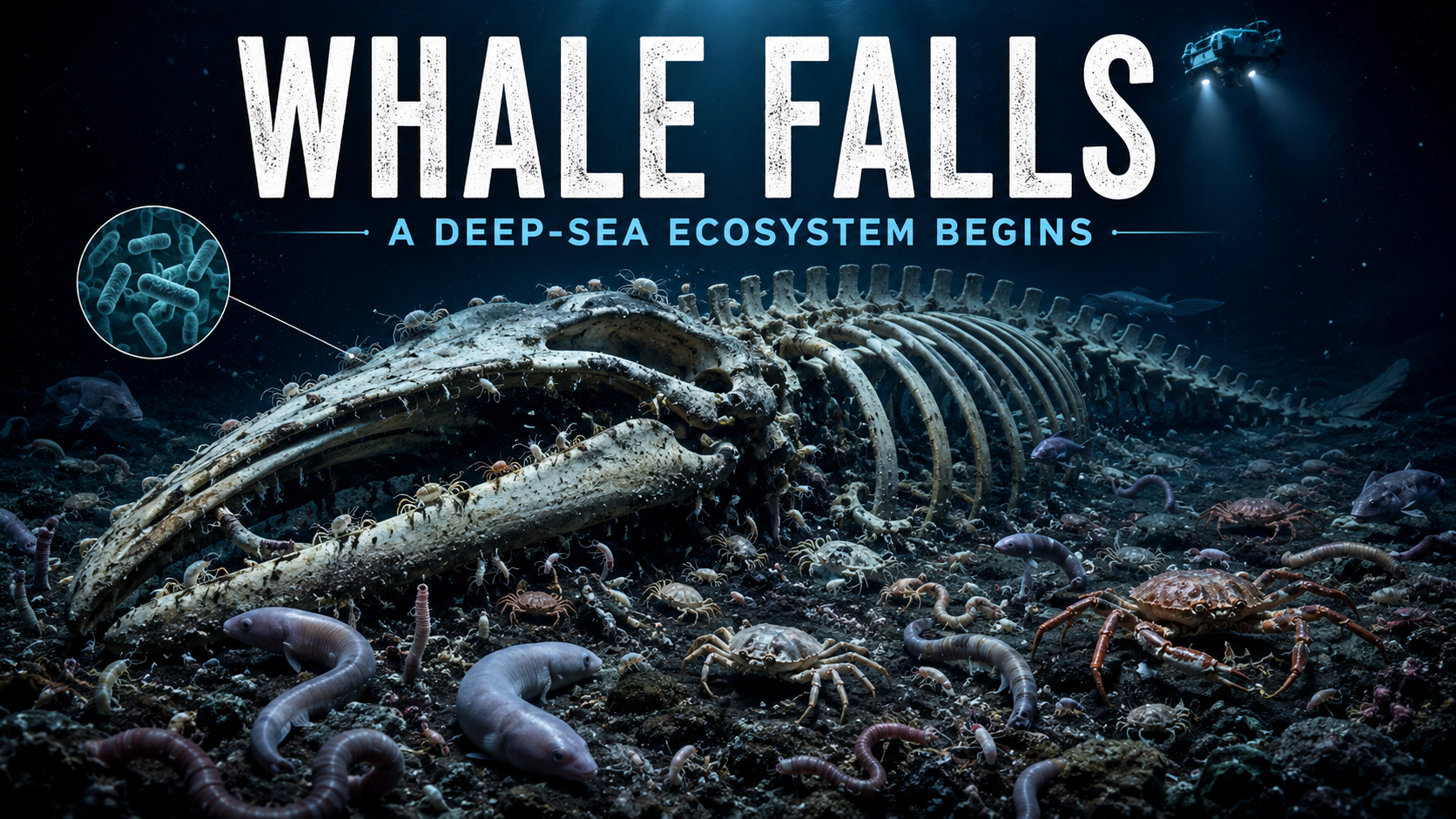
A whale fall occurs when a dead whale sinks to the deep ocean floor and becomes a rare biological event: a single carcass can transform into a temporary ecosystem. Over years or even decades, its tissues and bones provide energy, nutrients, and habitat for scavengers, microbes, and highly specialized deep sea species.
Introduction
Food is scarce across much of the deep seafloor. Most organisms living there depend on small particles that drift down from productive surface waters, but a whale carcass delivers an unusually large pulse of organic material all at once. That sudden arrival changes the local environment, drawing mobile scavengers first and then supporting smaller animals, microbes, and bone associated communities.
Whale falls are therefore more than decomposing skeletons. They are natural experiments in nutrient recycling, ecological succession, adaptation, and deep sea biodiversity. NOAA describes them as concentrated nutrient sources that can support seafloor communities from months to decades, depending on the stage and the remaining tissues and bones.

Scientific Discovery Behind Whale Falls
Modern whale fall research expanded rapidly after deep sea observations showed that whale skeletons host specialized communities. In 2002, MBARI researchers exploring Monterey Bay encountered a gray whale carcass covered with unusual red plumed worms. The animals were later described as a new genus, Osedax - a name meaning "bone devourer." These worms lack a conventional mouth and gut and use root-like tissues, together with symbiotic bacteria, to obtain nutrition from vertebrate bones.
The discovery changed how researchers viewed whale skeletons: instead of passive remains, bones can function as both food rich material and habitat. Smithsonian Ocean also highlights Osedax as a specialized bone associated organism and documents how whale falls become multi-stage deep sea communities.
What Is a Whale Fall?
A whale fall is the carcass or skeletal remains of a whale that reaches the seafloor. Because whales contain large stores of fat, protein, minerals, and other organic material, the carcass provides a concentrated food source in an environment where energy is usually dispersed and limited.
The carcass does not support one fixed community. Instead, different organisms become important as the soft tissues disappear, surrounding sediments become enriched, bone lipids are broken down, and the skeleton gradually loses its remaining organic material.
What Organisms Live on a Whale Fall?
Whale fall communities can include several functional groups:
- Large scavengers such as sharks and hagfish that remove soft tissues.
- Crustaceans, worms, snails, and other enrichment opportunists that use scraps and nutrient-rich sediments.
- Bacteria and archaea that decompose organic compounds and drive chemical cycling.
- Chemosynthesis-associated animals that benefit from sulfide produced during bone decomposition.
- Osedax bone-eating worms that penetrate vertebrate bones and accelerate skeletal breakdown.
- Attached invertebrates that can use exposed bones as hard substrate later in decomposition.
A deep Atlantic whale fall found at 4,204 meters contained 41 documented benthic taxa, including galatheid crabs, gastropods, and polychaeta worms. The study also reported a new Osedax species, illustrating how individual whale falls can reveal poorly known deep sea biodiversity.
The Four Broad Stages of a Whale Fall Ecosystem
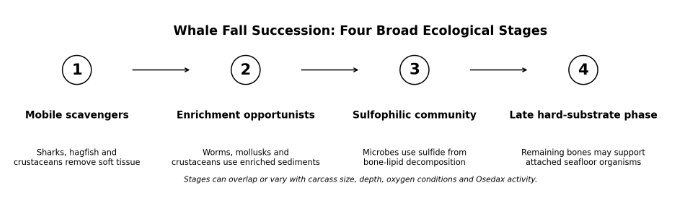
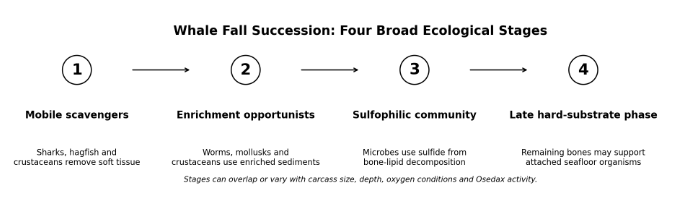
The classic whale fall model divides ecological succession into four broad stages. They are useful for understanding the process, but the boundaries can overlap, and some carcasses may skip or compress parts of the sequence.
1. Mobile Scavenger Stage
Large scavengers arrive first and remove most of the soft tissue. Sharks, hagfish, amphipods, crabs, and other mobile animals can consume a large share of the carcass while it still contains flesh and blubber.
2. Enrichment Opportunist Stage
After most soft tissue is gone, smaller worms, crustaceans, mollusks, and microbes exploit leftover organic matter and the enriched sediments around the carcass. The whale fall becomes a local patch of unusually high food availability.
3. Sulfophilic Stage
As microbes break down organic material and lipids remaining in bones, sulfide can be produced. Sulfur oxidizing microbes and animals associated with chemosynthetic food webs can then use this chemically rich environment.
4. Late Hard-Substrate or Reef Stage
Once much of the easily available organic material has been depleted, remaining bones can act as hard substrate for attached organisms. Scientists note that this late stage is less consistently observed than the earlier stages, especially where Osedax rapidly degrades bones.
Examples of Famous Whale Fall Discoveries
Monterey Bay, 2002 - Osedax discovery
MBARI scientists investigating a gray whale carcass around 3,000 meters deep discovered unusual bone associated worms that were later named Osedax. The finding became one of the best known examples of specialization at whale falls.
Davidson Seamount, 2019
Researchers exploring Monterey Bay National Marine Sanctuary encountered a whale fall at 10,623 feet (about 3,238 meters). NOAA reported octopuses, fishes, crabs, and Osedax around the carcass, providing a well-documented modern example of a whale fall in action.
Southwest Atlantic, 4,204 meters
A natural whale fall described from the deep Atlantic contained 41 benthic taxa. Many organisms were poorly known, and the carcass included a newly recognized Osedax species, expanding knowledge beyond the better-studied northeast Pacific.
How Whale Falls Connect to Climate and Carbon Cycling
A whale stores carbon in its tissues and skeleton during life. When the animal dies and sinks, some of that carbon is transferred from surface waters into the deep ocean, where it is consumed, recycled through deep-sea organisms, incorporated into sediments, or retained in skeletal material for varying periods.
NOAA Fisheries discusses whale falls as one pathway of carbon sequestration because sinking carcasses move biomass derived carbon to the seafloor. The exact amount and duration of storage depend on decomposition, burial, scavenging, water depth, sediment conditions, and other local factors, so whale falls should be viewed as one component of the broader ocean carbon cycle rather than a single fixed carbon storage value.
Why Whale Falls Matter to Deep Sea Biodiversity
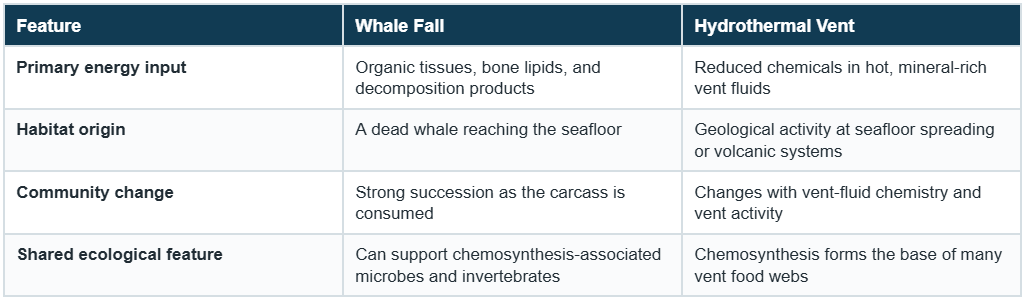
Whale falls create temporary islands of food and habitat in a landscape where large organic inputs are rare. They can support dense local populations, specialized bone associated species, microbial communities, and organisms that also occur at other chemically fueled habitats such as cold seeps and hydrothermal vents.
Their importance is not limited to species counts. Whale falls help scientists test how organisms disperse between isolated habitats, how communities change through time, and how large pulses of organic matter alter deep sea nutrient and sulfur cycling.
Whale Falls vs. Hydrothermal Vents
How Scientists Study Whale Falls
Because whale falls are scattered across vast and difficult to reach seafloors, researchers rely on deep sea technology. Remotely operated vehicles (ROVs) provide video, sampling, and precise manipulation; sonar can identify unusual seafloor targets; sediment cores and bone samples reveal chemical and biological changes; and repeated visits show how communities develop over months and years.
- ROV cameras document scavengers, microbial mats, Osedax, and attached organisms.
- Sonar helps locate carcasses or skeletons across broad seafloor areas.
- Sediment and water samples measure chemical changes around the carcass.
- Bone sampling allows taxonomic, microbial, and molecular analysis.
- Long term revisits reveal ecological succession rather than a single snapshot.
What Whale Falls Teach Us About Nature
A whale fall demonstrates a direct link between surface ecosystems and the deep ocean: nutrients stored in a whale's body can become energy sources for bacteria, worms, scavengers, and other organisms thousands of meters below the surface. The event turns one animal into a temporary food web and a long lived research site.
That link is why whale falls are so valuable scientifically. They reveal how deep sea communities respond to sudden resources, how specialized species evolve around rare habitats, and how carbon and nutrients move through the ocean after a large animal dies.
Conclusion
Whale falls are among the clearest examples of ecological recycling in the deep ocean. A carcass that begins as a concentrated food source can pass through scavenger, sediment-enrichment, chemically fueled, and late skeletal phases while supporting very different organisms along the way.
Discover More Ocean Science Stories
From whale falls and deep sea ecosystems to marine discoveries and ocean research, explore the science behind our planet’s largest ecosystem.
Frequently Asked Questions
1. What is a whale fall?
Answer: A whale fall is the body or skeleton of a whale that sinks to the seafloor. The carcass provides a large pulse of food, nutrients, chemicals, and hard habitat, supporting scavengers, microbes, worms, crustaceans, mollusks, and other deep sea organisms as decomposition progresses.
2. How long can a whale fall ecosystem last?
Answer: A whale fall can influence the seafloor for years or decades, but there is no single fixed duration. Carcass size, depth, oxygen conditions, local scavengers, sediment chemistry, and bone eating Osedax worms all affect how quickly tissues and bones are consumed.
3. What are the main whale fall stages?
Answer: Scientists commonly describe mobile scavenger, enrichment opportunist, sulfophilic, and late hard-substrate or reef stages. These are broad ecological phases rather than a strict schedule, and studies show that stages can overlap, vary, or be shortened depending on local conditions and carcass size.
4. What animals live on whale falls?
Answer: Whale falls may attract sharks, hagfish, crabs, amphipods, worms, snails, octopuses, fishes, bacteria, and many smaller seafloor organisms. Later stages can support specialized species such as Osedax, which penetrate bones and obtain nutrients with help from symbiotic bacteria.
5. What are Osedax bone eating worms?
Answer: Osedax are specialized annelid worms associated with sunken vertebrate bones. Females grow root like tissues into bone and rely on symbiotic bacteria to help access nutrients. The genus was discovered on a whale carcass in Monterey Bay in 2002 and has since been found in multiple ocean regions. Smithsonian Ocean - Zombie Worms
6. Do whale falls support chemosynthesis?
Answer: Yes, some stages can support chemosynthesis associated communities. During anaerobic decomposition of organic material in whale bones, sulfide can be produced. Sulfur oxidizing microbes use chemical energy from these compounds and can support other organisms that live in the sulfide rich whale fall environment.
7. Are whale falls related to the carbon cycle?
Answer: Yes. A sinking whale transfers carbon stored in its body from surface waters to the deep sea. During decomposition, that carbon may move through deep sea food webs, microbes, sediments, and skeletal material. The amount retained and the storage duration vary among whale falls.
8. How do scientists find and study whale falls?
Answer: Researchers use sonar, remotely operated vehicles, deep sea cameras, sediment cores, water sampling, and biological collections. Repeated ROV visits are especially useful because they show how the same carcass changes over time and which organisms dominate at different stages. NOAA - What is a whale fall?
9. Are whale falls common?
Answer: Whale falls are natural, but direct observations are uncommon because the deep seafloor is vast and difficult to survey. Scientists continue to discover new sites, and each observation provides information about local biodiversity, decomposition rates, seafloor chemistry, and the distribution of specialized organisms.
10. Why are whale falls important to science?
Answer: Whale falls allow scientists to study ecological succession, deep sea biodiversity, nutrient recycling, chemosynthesis, specialized evolution, and carbon transfer in one localized system. Because carcasses change over time, they also provide rare opportunities to observe how deep sea communities respond to a major resource pulse.
