
23Aug
Why Are Brine Pools Called Toxic Lakes of the Ocean?

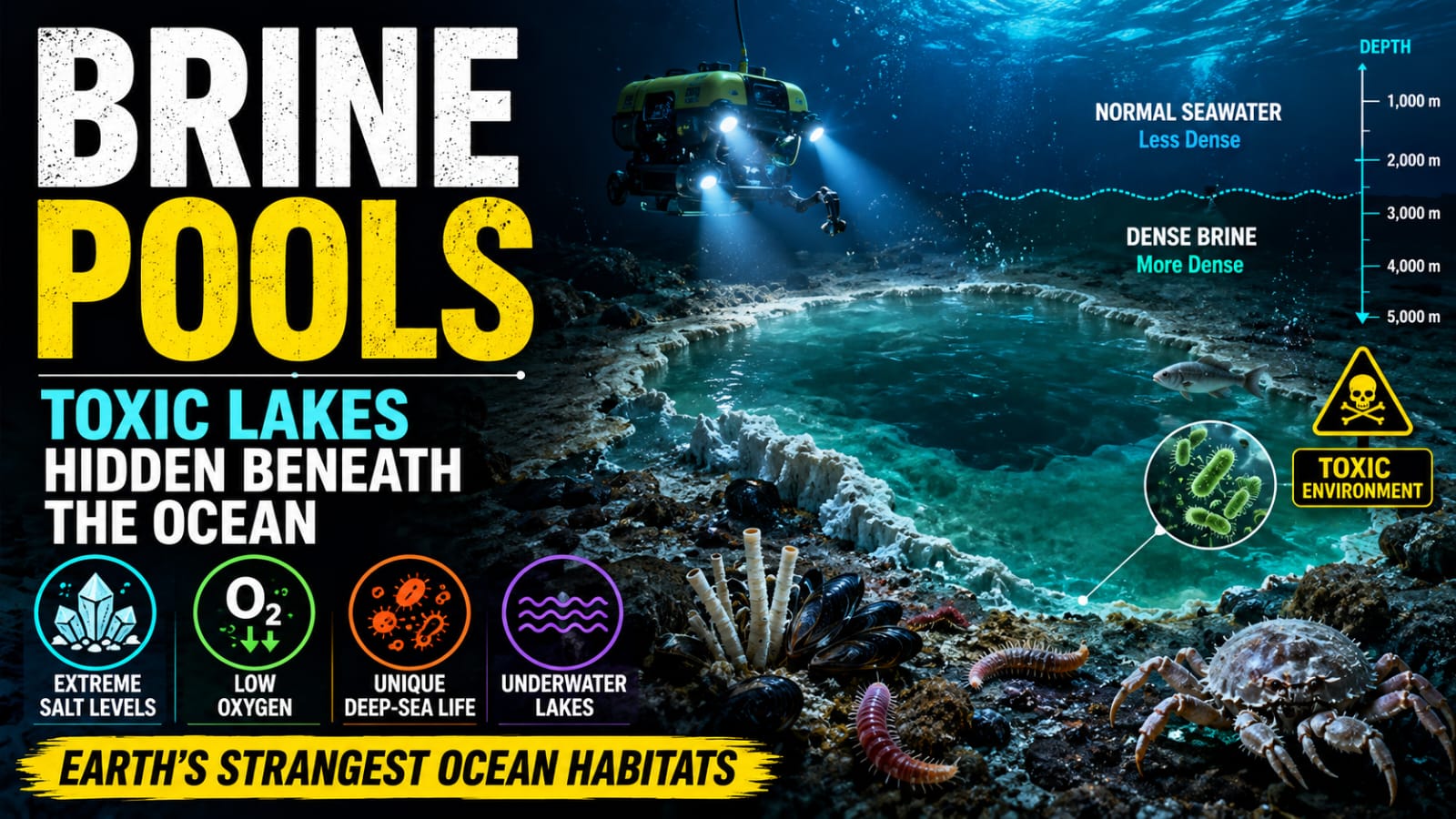
Thousands of meters beneath the ocean surface, scientists have discovered strange underwater landscapes that look almost impossible: lakes sitting on the seafloor. These formations are known as brine pools extremely salty bodies of water that collect in deep ocean basins.
Brine pools are often called “toxic lakes of the ocean” because their water contains unusually high salt concentrations and chemicals such as hydrogen sulfide and methane that can be harmful to many marine animals. However, these environments are not lifeless. Instead, they support unique ecosystems filled with specially adapted organisms.
Unlike normal seawater, brine pool water is much denser, allowing it to remain separated from the surrounding ocean like an underwater lake.
What Are Brine Pools?
A brine pool is a naturally occurring underwater lake made of extremely salty water that forms on the deep ocean floor.
These pools develop when ancient salt deposits beneath the seafloor dissolve and mix with seawater. Because the resulting water contains much higher salt concentrations, it becomes heavier than normal seawater and settles into deep depressions.
Key characteristics of brine pools include:
- Extremely high salinity
- Very low oxygen levels
- High pressure from deep ocean conditions
- Unique chemical environments
- Specialized forms of marine life
Some brine pools remain separated from surrounding seawater for thousands of years, creating isolated ecosystems unlike anywhere else in the ocean.
Why Are Brine Pools Called Toxic Lakes?
Brine pools are called toxic lakes because their chemical conditions can be deadly to many ocean animals.
The water inside these pools may contain:
- Hydrogen sulfide: A toxic chemical that can interfere with oxygen use in many organisms
- Methane: A gas that supports specialized microbial communities
- Extremely high salt concentrations: Conditions that most marine animals cannot tolerate

How Do Brine Pools Form?
Brine pools usually form in regions where ancient salt deposits exist beneath the ocean floor.
The formation process generally involves:
- Ancient seawater becomes trapped and evaporates, leaving behind salt deposits.
- Geological activity buries these salt layers beneath sediments.
- Seawater interacts with the underground salt deposits.
- Dense salty water moves upward and collects in deep-sea depressions.
- The concentrated brine remains separated from surrounding seawater.
Because brine is heavier than normal seawater, it creates a visible boundary called a halocline, where two different water environments meet.
Where Are Brine Pools Found?
Scientists have discovered brine pools in several deep ocean regions, including:
Gulf of Mexico Brine Pools
The Gulf of Mexico contains some of the most studied brine pools on Earth. One famous example is the Orca Basin, a deep depression containing highly saline water.
Researchers use remotely operated vehicles (ROVs) to explore these environments and study:
- Deep-sea chemistry
- Microbial communities
- Extreme marine adaptations
Mediterranean Deep-Sea Basins
Some brine pools are also found in the Mediterranean region, including areas influenced by ancient salt deposits.
What Lives Inside and Around Brine Pools?
Although brine pools can be deadly for many animals, they support fascinating ecosystems around their edges.
Organisms associated with brine pools include:
Microbes
Bacteria and archaea are often the foundation of these ecosystems. They can survive chemical conditions that would be impossible for most organisms.
Mussels and Clams
Some deep sea mussels live near brine pools and use relationships with bacteria to obtain energy from chemicals.
Worms and Other Invertebrates
Small marine animals may live around the boundary where normal seawater mixes with brine.
Microbial Communities
Some organisms use chemosynthesis, a process where microbes create energy from chemical reactions instead of sunlight. This is similar to ecosystems found around hydrothermal vents.
Why Are Brine Pools Important to Scientists?
Brine pools are natural laboratories for studying life in extreme environments.
Scientists study them to understand:
How Life Survives Without Sunlight
Unlike surface ecosystems, brine pools exist in complete darkness. Many organisms depend on chemical energy rather than photosynthesis.
How Extreme Environments Shape Evolution
The organisms living near brine pools have developed special adaptations for high salt levels, low oxygen, high pressure, and chemical stress.
How Earth’s Ecosystems Work
Brine pools help researchers understand how nutrients and chemicals move through deep ocean environments.
Brine Pools vs Hydrothermal Vents: What Is the Difference?
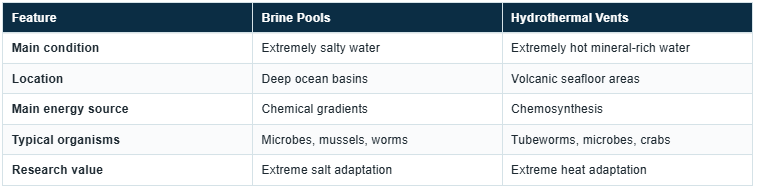
Both environments prove that complex ecosystems can exist without sunlight.
Are Brine Pools Dangerous to Humans?
Direct contact with brine pools would be dangerous because of their extreme chemistry, but they are not dangerous like a polluted area.
Their “toxicity” comes from natural geological processes rather than human contamination.
Scientists study these environments safely using:
- Remotely operated vehicles
- Deep-sea cameras
- Sampling equipment
Could Brine Pools Help Scientists Find Life Beyond Earth?
Brine pools are interesting to astrobiologists because they provide clues about where life might exist in extreme environments beyond Earth.
Some moons in our solar system, such as Europa and Enceladus, are believed to contain salty water environments beneath their surfaces.
Studying Earth’s extreme ecosystems helps scientists understand what conditions may support life elsewhere.
Continue Exploring Ocean Science
The ocean contains hidden ecosystems that challenge what we know about life on Earth. From brine pools and hydrothermal vents to deep-sea creatures and marine discoveries, every exploration reveals another piece of the planet’s underwater story.
Explore more ocean science discoveries, deep-sea ecosystems, and marine research stories at Oceanography.
Frequently Asked Questions
1. What are brine pools?
Answer: Brine pools are areas of extremely salty water that collect on the deep ocean floor and remain separated from surrounding seawater because of their high density.
2. Why are brine pools called underwater lakes?
Answer: They are called underwater lakes because their dense salty water forms visible boundaries and behaves similarly to a lake resting on the seafloor.
3. Are brine pools dangerous?
Answer: Many brine pools have conditions that are dangerous for ordinary marine animals because of high salt levels, low oxygen, and toxic chemicals.
4. Are brine pools related to deep-sea exploration?
Answer: Yes. Researchers use underwater vehicles and scientific instruments to explore and study these hidden ocean environments. For more information about deep ocean research, visit NOAA Ocean Exploration.
5. Can anything live in brine pools?
Answer: Yes. Some microorganisms and specialized deep-sea organisms can survive near or around brine pools.
6. Where are brine pools found?
Answer: Brine pools have been discovered in several deep ocean regions, especially areas with ancient salt deposits beneath the seafloor.
7. How do brine pools form?
Answer: They form when seawater interacts with underground salt deposits and becomes extremely concentrated, creating dense salty water that collects on the ocean floor.
8. What organisms live near brine pools?
Answer: Microbes, bacteria, worms, clams, mussels, and other deep-sea organisms may live around brine pool environments.
9. Why do scientists study brine pools?
Answer: Scientists study brine pools to learn about extreme ecosystems, ocean chemistry, and how life adapts to harsh environments.
10. Could brine pools help scientists understand life beyond Earth?
Answer: Yes. Extreme environments like brine pools help researchers study how life might survive in harsh conditions similar to environments that may exist on other worlds. Learn more about ocean science research from NASA Ocean Worlds Research.
