
12Jun
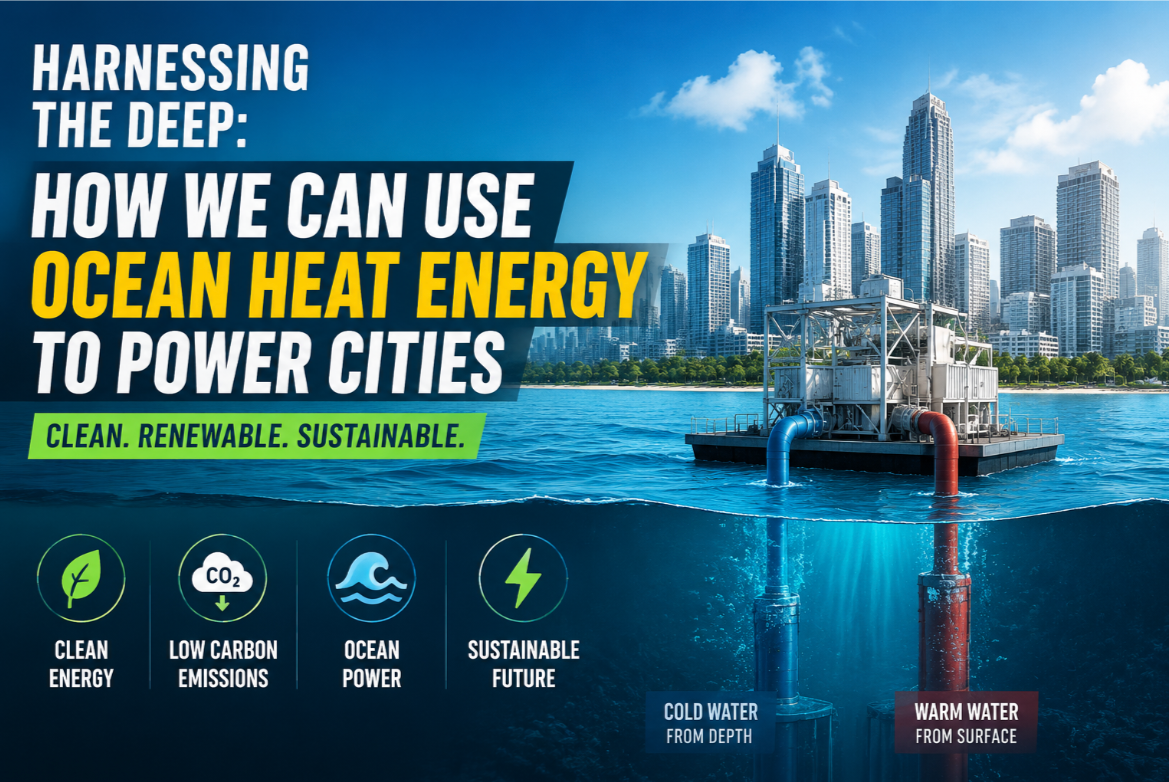
Harnessing the Deep: How We Can Use Ocean Heat Energy to Power Cities
The oceans cover more than 70% of Earth’s surface and contain a huge amount of unused energy. Deep in the ocean, there is a natural temperature difference between the warm water at the surface and the cold water far below. This temperature difference can be used to create energy. This gradient can be harnessed as ocean heat energy, providing a clean, constant, and scalable source of power for cities. Here’s how this technology works and why it could reshape urban energy landscapes.
What Is Ocean Heat Energy?
Ocean heat energy also called ocean thermal energy relies on the temperature difference between tropical surface water (around 25–30°C) and cold deep water (around 5°C). By exploiting this gradient, energy systems can generate electricity continuously, unlike solar or wind power, which depend on weather conditions.
The principle is straightforward: warm surface water vaporizes a working fluid with a low boiling point. The vapor spins a turbine, generating electricity. Cold deep water then condenses the vapor back into liquid, completing the cycle. This process is known as the Ocean Thermal Energy Conversion (OTEC) cycle.
Benefits of Using Ocean Heat Energy
1. Renewable and Reliable
OTEC systems operate 24/7. Tropical oceans maintain consistent surface temperatures year-round. Unlike solar or wind, power production isn’t intermittent, making it ideal for energy-hungry cities.
2. Low Environmental Impact
OTEC plants generate electricity without burning fossil fuels. They reduce greenhouse gas emissions and offer potential for sustainable urban energy planning. Cold deep seawater can also support aquaculture, desalination, and cooling systems, creating a multi-purpose solution.
3. Energy Security
Coastal cities, particularly in tropical regions, can tap into local energy sources. This reduces reliance on imported fuels, stabilizes energy prices, and strengthens resilience against global market fluctuations.
How Cities Can Integrate Ocean Heat Energy
Urban Power Grids
OTEC plants can feed electricity directly into city grids. Cities with ports or nearby deep-water access have the advantage of shorter transmission distances, reducing energy loss.
Desalination and Water Supply
Cold deep seawater pumped through OTEC systems can support desalination plants. Cities facing freshwater scarcity can gain a dual benefit: electricity and potable water. For example, tropical coastal regions can use this method to address both energy and water shortages simultaneously.
District Cooling
The cold water output from OTEC can be circulated to air-conditioning systems in high-density urban areas. This district cooling approach cuts electricity demand for conventional cooling and reduces heat island effects in cities.
Technological Considerations
Plant Size and Location
OTEC plants vary in size, from small 100 kW units to large 100 MW plants. Optimal placement requires deep water close to shore and stable tropical surface temperatures. Countries like Japan, the Philippines, and Hawaii are leading OTEC research due to favorable conditions.
Economic Viability
Initial construction costs are high, primarily due to deep-water pipelines and large heat exchangers. However, operational costs remain low, and long-term benefits include reduced fossil fuel expenses and reliable energy supply. Public-private partnerships can accelerate deployment and offset capital expenditures.
System Types
There are three main OTEC configurations:
- Closed-cycle: Uses a working fluid like ammonia.
- Open-cycle: Vaporizes seawater directly to drive turbines.
- Hybrid: Combines both approaches for efficiency.
Each system has advantages depending on local temperature gradients, water depth, and intended co-benefits like desalination.
Global Potential
Estimates suggest that tropical oceans could theoretically supply over 10 terawatts of continuous electricity enough to meet global energy demand multiple times over. Integrating ocean heat energy into coastal cities could drastically reduce reliance on fossil fuels and accelerate the transition to clean energy infrastructure.
Research shows that combining OTEC with other renewable sources enhances grid stability. For instance, pairing OTEC with solar or wind creates a complementary energy portfolio, maintaining consistent supply regardless of weather variability.
Economic and Social Impacts
Deploying OTEC infrastructure generates skilled jobs in engineering, construction, and maintenance. Local communities benefit from energy access, freshwater availability, and climate-friendly technologies. Additionally, urban planners can leverage OTEC’s cold water byproduct for aquaculture, creating sustainable food sources alongside energy production.
Challenges to Overcome
- High Capital Cost: Requires investment in pipelines, heat exchangers, and turbine systems.
- Technical Maintenance: Deep-water systems need corrosion-resistant materials and regular monitoring.
- Environmental Concerns: Discharge of cold deep water must be managed to prevent ecological disruption.
Despite these challenges, continued research and pilot projects demonstrate that OTEC can be both environmentally safe and economically viable.
Future Outlook
Cities seeking energy independence should consider ocean heat energy as a cornerstone of sustainable development. Advances in material science, turbine efficiency, and hybrid plant designs will make OTEC more cost-effective. Coastal urban centres with tropical waters could become self-sufficient, powered largely by the oceans themselves.
Harnessing the deep is no longer science fiction. With ongoing advancements, ocean heat energy could power entire cities sustainably, providing electricity, cooling, and fresh water. Coastal cities ready to embrace this technology may soon thrive on the oceans themselves.
Explore Ocean Heat Energy for Cities →
FAQs About Ocean Heat Energy
What is the principle behind ocean heat energy?
It uses the temperature difference between warm surface water and cold deep water to generate electricity via turbines.
Where is OTEC most effective?
Tropical coastal regions with stable surface temperatures and nearby deep water are ideal.
Can OTEC provide continuous power?
Yes, unlike solar or wind, OTEC works 24/7, offering reliable electricity.
What are the main types of OTEC systems?
Closed-cycle, open-cycle, and hybrid systems, each suitable for different temperature gradients.
How does OTEC support desalination?
Cold deep seawater can condense vapor and produce fresh water, integrating electricity and water supply.
What are the economic challenges of OTEC?
High upfront costs for pipelines and heat exchangers; operational costs are low over time.
Can OTEC reduce urban heat?
Yes, cold water byproducts can be used for district cooling systems, lowering city temperatures.
How can cities start adopting ocean heat energy?
By partnering with developers to build OTEC plants near coastal urban centers with favorable conditions.
