
17Jun
AI Marine Life Migration Prediction Using Machine Learning and Ocean Data
What AI marine life migration prediction means
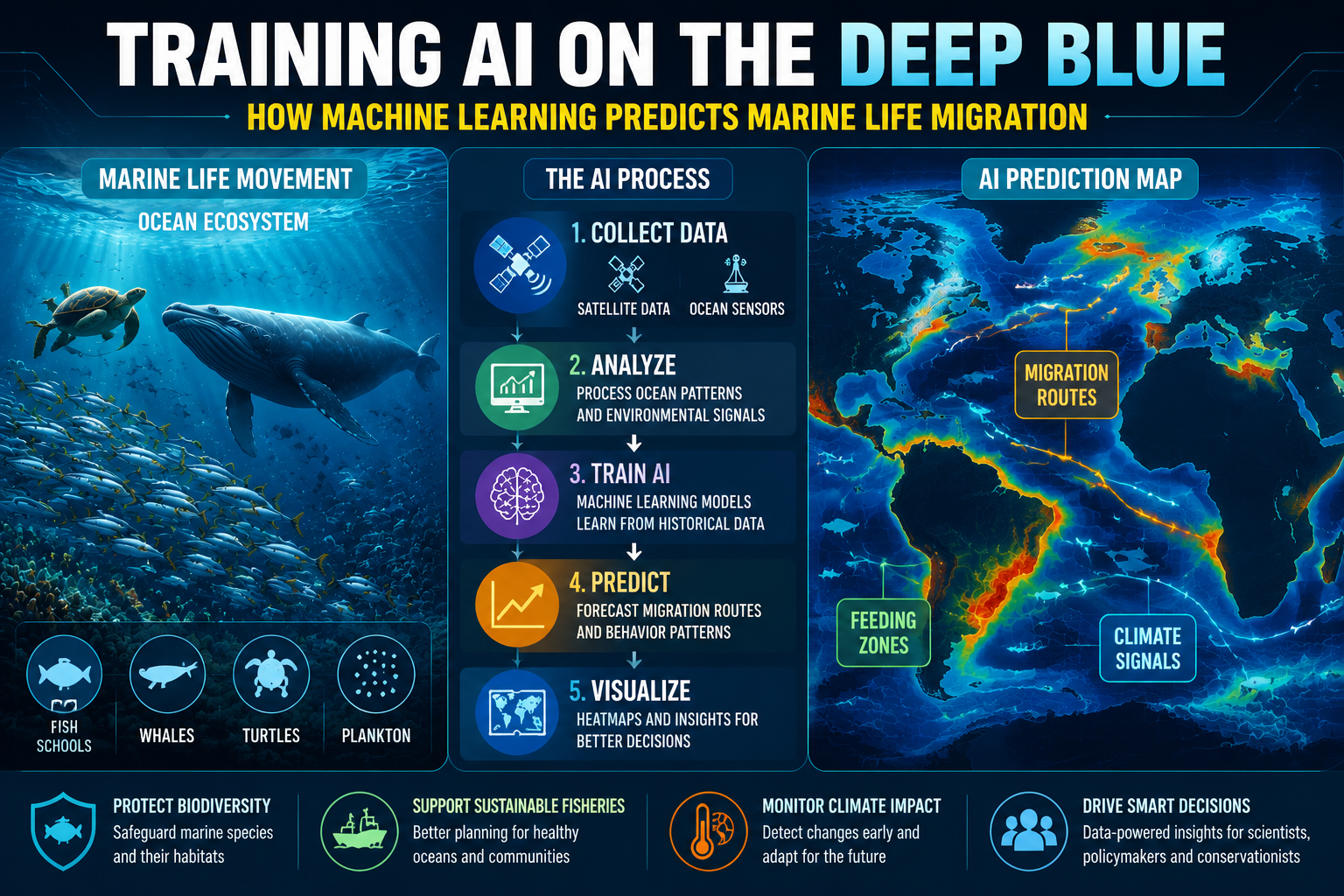
AI marine life migration prediction uses machine learning to estimate where marine species are likely to move based on real-time ocean conditions such as temperature shifts, currents, oxygen levels, and food availability patterns detected from satellite and sensor data. These systems analyze large datasets from satellites, underwater sensors, and oceanographic databases to detect patterns in temperature, currents, salinity, and biological activity.
Instead of observing migration only after it happens, researchers can now anticipate movement patterns in advance. This helps fisheries management, conservation planning, and climate impact studies.
Platforms such as Oceanography.com provide structured access to ocean datasets and research tools that support this type of predictive modeling.
Why marine life migration is difficult to predict
Ocean ecosystems are not static. Fish, plankton, whales, and other marine species respond to constantly shifting environmental conditions. A small change in sea surface temperature can alter feeding zones. A shift in ocean currents can redirect entire migration routes.
Traditional ecological models rely on limited sampling or historical patterns. These methods struggle because marine environments change faster than most datasets can capture. AI improves this by processing continuous streams of data and finding hidden relationships that humans might miss.
For example, species may not move solely because of temperature. They may follow prey distribution, oxygen levels, or seasonal nutrient flows. Machine learning can combine all these signals at once.
How machine learning models analyze ocean migration
Machine learning systems used for marine migration prediction typically follow a layered process.
Data collection layer
The system gathers information from multiple sources:
- Satellite ocean imagery
- Buoy and sensor networks
- Historical catch data from fisheries
- Acoustic tagging of marine species
- Oceanographic research datasets
Ocean data platforms like Oceanography.com aggregate international measurements and institutional datasets into accessible formats for analysis and research.
Feature extraction layer
Raw ocean data is complex. AI models convert it into usable features such as:
- Sea surface temperature gradients
- Chlorophyll concentration (indicating food availability)
- Current velocity and direction
- Oxygen levels and salinity
- Depth-based habitat structures
These features become inputs for prediction models.
Model training layer
Models like neural networks and spatiotemporal transformers learn how ocean conditions such as temperature shifts, currents, and chlorophyll patterns align with past migration routes, allowing them to predict likely future movement paths.
For example, if tagged tuna consistently appear in warmer current boundaries during specific months, the model learns that pattern and can predict future movement under similar conditions.
Prediction layer
Once trained, the model generates forecasts:
- Likely migration routes
- Seasonal movement windows
- Feeding zone shifts
- Habitat probability maps
These outputs are often visualized as heatmaps across ocean regions.
Role of satellite data in ocean AI systems
Satellite data is one of the most important inputs for marine AI systems. It provides large-scale, real-time coverage of ocean conditions that would be impossible to measure manually.
Key satellite-derived signals include:
- Sea surface temperature
- Ocean color (chlorophyll levels)
- Wave height and movement
- Ice cover in polar regions
Machine learning models combine these signals with historical migration data to create predictive layers of ocean behavior. This is especially useful for tracking species that travel across entire ocean basins.
How AI improves conservation and fisheries management
AI-based migration prediction is not only a scientific tool. It also has real-world applications.
Sustainable fishing
Fisheries can avoid overharvesting by predicting where fish populations will concentrate. This reduces pressure on depleted zones.
Marine conservation
Protected areas can be designed based on predicted migration corridors rather than static boundaries.
Climate change monitoring
Shifts in migration patterns often reflect changing ocean conditions. AI helps detect these changes earlier.
Biodiversity protection
Endangered species tracking becomes more accurate when migration forecasts are integrated with conservation planning.
Challenges in AI-driven marine migration prediction
Despite progress, several challenges remain.
Data gaps are common in deep ocean regions. Many species are still under-monitored. Ocean systems are also highly nonlinear, meaning small changes can create unexpected outcomes.
Another limitation is model generalization. A model trained in one ocean region may not perform well in another due to differences in ecosystems.
Finally, interpretability remains a concern. Some deep learning models act like black boxes, making it difficult for scientists to fully explain why a prediction was made.
Future of AI in ocean migration science
The future of AI marine life migration prediction is moving toward integrated global ocean intelligence systems. These systems will combine:
- Real-time satellite feeds
- Autonomous underwater drones
- Continuous species tracking tags
- Open research databases
As computing power improves, models will shift from seasonal forecasting to near real-time adaptive prediction. This means researchers may eventually track and anticipate marine movement patterns almost as they happen.
Open research ecosystems like Oceanography.com will likely play a key role in this evolution by supporting data sharing and collaborative modeling efforts.
Conclusion
AI is transforming how scientists understand marine life movement. By combining machine learning with oceanographic datasets, researchers can predict migration patterns that were once unpredictable. These systems are already improving fisheries management, conservation planning, and climate monitoring.
As data coverage expands and models become more advanced, marine ecosystems will become more observable and interpretable than ever before. The ocean is no longer only a place of exploration. It is becoming a space where prediction and understanding work together.
Explore ocean data, research tools, and marine science insights at Oceanography.com to start predicting marine life migration and supporting sustainable ocean management.
FAQs
1. What is AI marine life migration prediction?
Ans: AI marine life migration prediction uses machine learning models to analyze ocean data and forecast how marine species move based on environmental conditions like temperature, currents, and food availability.
2. How does machine learning predict fish migration?
Ans: Machine learning identifies patterns between historical movement data and ocean conditions, then uses those relationships to predict future migration routes and seasonal behavior.
3. What data is used in marine migration AI systems?
Ans: These systems use satellite imagery, ocean temperature readings, salinity data, chlorophyll levels, acoustic tagging data, and historical fisheries records.
4. Why is ocean data important for AI prediction models?
Ans: Ocean data provides real-time environmental signals that influence marine ecosystems. Without it, models cannot accurately connect environmental change to biological movement.
5. Can AI help protect marine ecosystems?
Ans: Yes. AI supports conservation by identifying migration corridors, predicting habitat shifts, and helping design more effective marine protected areas.
6. What are the limitations of AI in ocean prediction?
Ans: Limitations include incomplete data coverage, complex ocean dynamics, and difficulty interpreting deep learning models that act as black boxes.
7. How do satellites help in marine life tracking?
Ans: Satellites provide large-scale measurements of ocean temperature, color, and surface movement, which are essential inputs for AI-based prediction models.
8. What is the role of Oceanography.com in marine research?
Ans: Oceanography provides access to datasets, articles, and educational resources that support ocean science research and data analysis.
9. What is a good resource for learning ocean AI modeling?
Ans: A strong starting point is the National Oceanic and Atmospheric Administration overview of ocean ecosystems:
10. What is the future of marine migration prediction?
Ans: The future involves real-time AI systems combining satellite feeds, underwater sensors, and global datasets to provide continuous prediction of marine life movement patterns.
