
30Jul
The Ocean’s Role in the Water Cycle: More Than Just a Big Body of Water
Direct Answer:
The ocean is the largest driver of the water cycle, supplying most of the water vapor that enters the atmosphere through evaporation. This process influences clouds, rainfall, weather patterns, and the movement of freshwater across Earth.
Introduction
When people think about the water cycle, they often picture clouds forming, rain falling, and rivers flowing. While these processes are important, the largest part of the story begins over the ocean.
Covering more than 70% of Earth’s surface, oceans act as a massive reservoir and a powerful engine that moves water between Earth’s surface and the atmosphere. Without ocean evaporation, the global water cycle would slow dramatically, affecting ecosystems, weather, agriculture, and human communities.
The ocean is not just a place where water is stored. It is an active participant that continuously sends water into the atmosphere and helps distribute freshwater around the planet.
How the Ocean Powers the Water Cycle
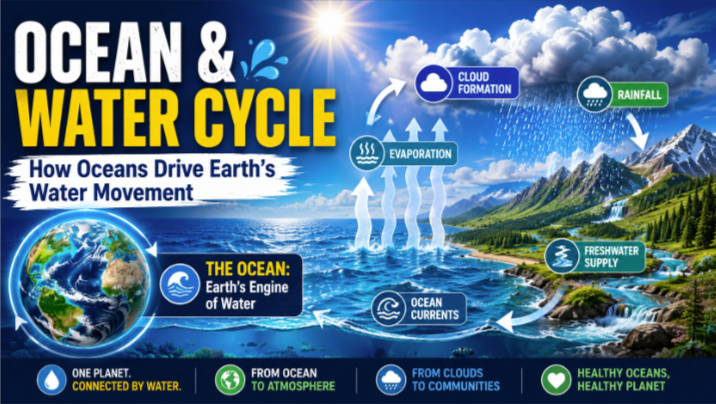
The water cycle describes the continuous movement of water between oceans, land, and the atmosphere. The ocean plays a central role in several major stages of this process.
Evaporation: The Ocean Sends Water Into the Atmosphere
Evaporation is the first major connection between the ocean and the atmosphere. Heat from the Sun warms ocean water, causing some liquid water molecules to change into water vapor.
Because oceans contain such a large amount of Earth’s water, they provide the majority of the moisture that enters the atmosphere. This invisible water vapor becomes the raw material for cloud formation and future precipitation.
Factors such as sunlight, wind, and ocean temperature influence how quickly evaporation occurs.
Condensation: Turning Water Vapor Into Clouds
After rising into the atmosphere, water vapor cools and changes into tiny droplets through condensation. These droplets gather around small particles in the air, forming clouds.
Many clouds that eventually produce rain or snow begin with moisture that originally came from the ocean.
Cloud formation helps transport water far from the ocean, allowing rainfall to reach continents and support life on land.
The Ocean’s Connection to Rainfall and Freshwater
Although the ocean contains most of Earth’s water, it cannot directly provide drinking water because seawater contains salt. The water cycle naturally separates freshwater from saltwater through evaporation.
During evaporation, salt remains behind while water vapor rises into the atmosphere. When this vapor condenses and falls as precipitation, it becomes freshwater that supports plants, animals, and human populations.
This process connects oceans with lakes, rivers, groundwater, and glaciers.
Ocean Currents Influence Global Weather
The ocean affects more than water movement. Ocean currents distribute heat around the planet, influencing regional climates and weather patterns.
Warm currents can increase evaporation and provide additional moisture to the atmosphere. Cold currents can affect air temperatures and rainfall patterns in nearby regions.
For example, changes in ocean temperatures can influence large scale climate patterns that affect storms, droughts, and seasonal weather conditions.
Why the Water Cycle Depends on Healthy Oceans
Healthy oceans help maintain a balanced water cycle. However, human activities can influence ocean conditions and the systems connected to them.
Pollution, rising temperatures, and changes in ocean chemistry can affect marine ecosystems and climate processes. Since oceans interact with the atmosphere constantly, changes in ocean health can have wider environmental effects.
Protecting oceans supports not only marine life but also the natural processes that provide freshwater and regulate Earth’s climate.
The Ocean and the Global Water Balance
Earth does not gain or lose significant amounts of water under normal conditions. Instead, water continuously moves through different forms and locations.
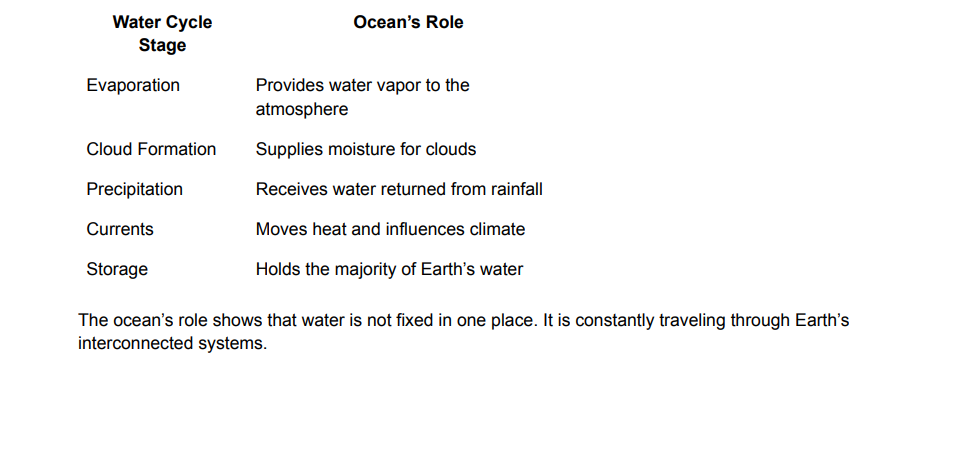
The ocean stores most of this water, while evaporation, precipitation, runoff, and groundwater movement keep it circulating.
A simple way to understand the relationship is:
How Understanding the Ocean Water Cycle Helps Us
Learning about the ocean’s role in the water cycle helps explain many real-world issues, including:
- Why some regions receive more rainfall than others
- How droughts and storms develop
- Why ocean temperatures affect climate
- How freshwater resources are renewed
- Why protecting oceans matters globally
The water cycle is not just a classroom concept. It is a system that supports every living organism on Earth.
Conclusion
The ocean is far more than a large body of water. It is the driving force behind much of Earth’s water cycle, continuously moving moisture between the surface and atmosphere.
Through evaporation, cloud formation, rainfall, and climate regulation, oceans connect nearly every part of Earth’s water system. Understanding this relationship helps us appreciate why healthy oceans are essential for a balanced planet.
Explore more Earth science topics and learn how natural systems shape our planet’s future at Oceanography.com.
FAQs
1. What is the role of the ocean in the water cycle?
Ans: The ocean plays a central role in the water cycle by providing most of the water vapor that enters the atmosphere through evaporation. This moisture helps form clouds and contributes to rainfall around the world.
2. Why is the ocean important for Earth’s water cycle?
Ans: The ocean is important because it stores most of Earth’s water and supplies moisture that moves through evaporation, condensation, and precipitation.
3. How does ocean evaporation happen?
Ans: Ocean evaporation occurs when sunlight heats seawater, causing water molecules to change from liquid into water vapor and rise into the atmosphere.
4. Does rainwater come from the ocean?
Ans: Much of Earth’s rainfall comes from moisture that originally evaporated from oceans. After condensation, this water returns to Earth as precipitation.
5. How do ocean currents affect the water cycle?
Ans: Ocean currents move heat around Earth, influencing evaporation rates, atmospheric moisture, weather patterns, and regional climates.
6. Is ocean water part of the freshwater cycle?
Ans: Yes. Although ocean water is salty, evaporation removes water from the ocean while leaving salt behind. The resulting vapor can later become freshwater precipitation.
7. How much of Earth’s water is in the ocean?
Ans: About 97% of Earth’s water is stored in oceans, making them the largest water reservoir on the planet.
For additional educational information about Earth’s water resources, visit the U.S. Geological Survey Water Science School.
8. Can changes in oceans affect weather?
Ans: Yes. Ocean temperatures and currents influence atmospheric conditions, which can affect rainfall patterns, storms, and climate.
9. What would happen without ocean evaporation?
Ans: Without ocean evaporation, the atmosphere would contain far less moisture, reducing cloud formation and precipitation across Earth.
10. Where can I learn more about ocean science?
Ans: Reliable information about oceans and Earth systems is available through scientific organizations such as NASA Earth Science.
