
14Jul
Ocean Data History: Understanding the Past Through Ocean Observations
Studying the history of ocean data helps scientists uncover past climate trends, track ocean currents, and understand sea-level changes over centuries. By analyzing centuries of measurements from historical ship logs to modern Argo floats, researchers can reconstruct how the oceans have changed over time and contextualize today’s environmental shifts.
Why Ocean Data History Matters
The oceans cover over 70% of Earth’s surface and store vast amounts of heat and carbon dioxide. Studying their history allows scientists to track long-term climate trends, sea-level rise, and ecosystem changes. Without historical ocean data, it is impossible to distinguish natural variability from human-driven changes.
Ocean data history bridges the gap between anecdotal observations and modern measurements, providing a continuous record that is vital for climate research, marine policy, and scientific understanding.
What Ocean Data History Reveals
Past Temperatures and Climate Change
Scientists analyze centuries of ship logs, buoy data, and the World Ocean Database to see how ocean temperatures have increased over time, providing a vital benchmark for today’s climate trends.
Paleoceanography and Proxies
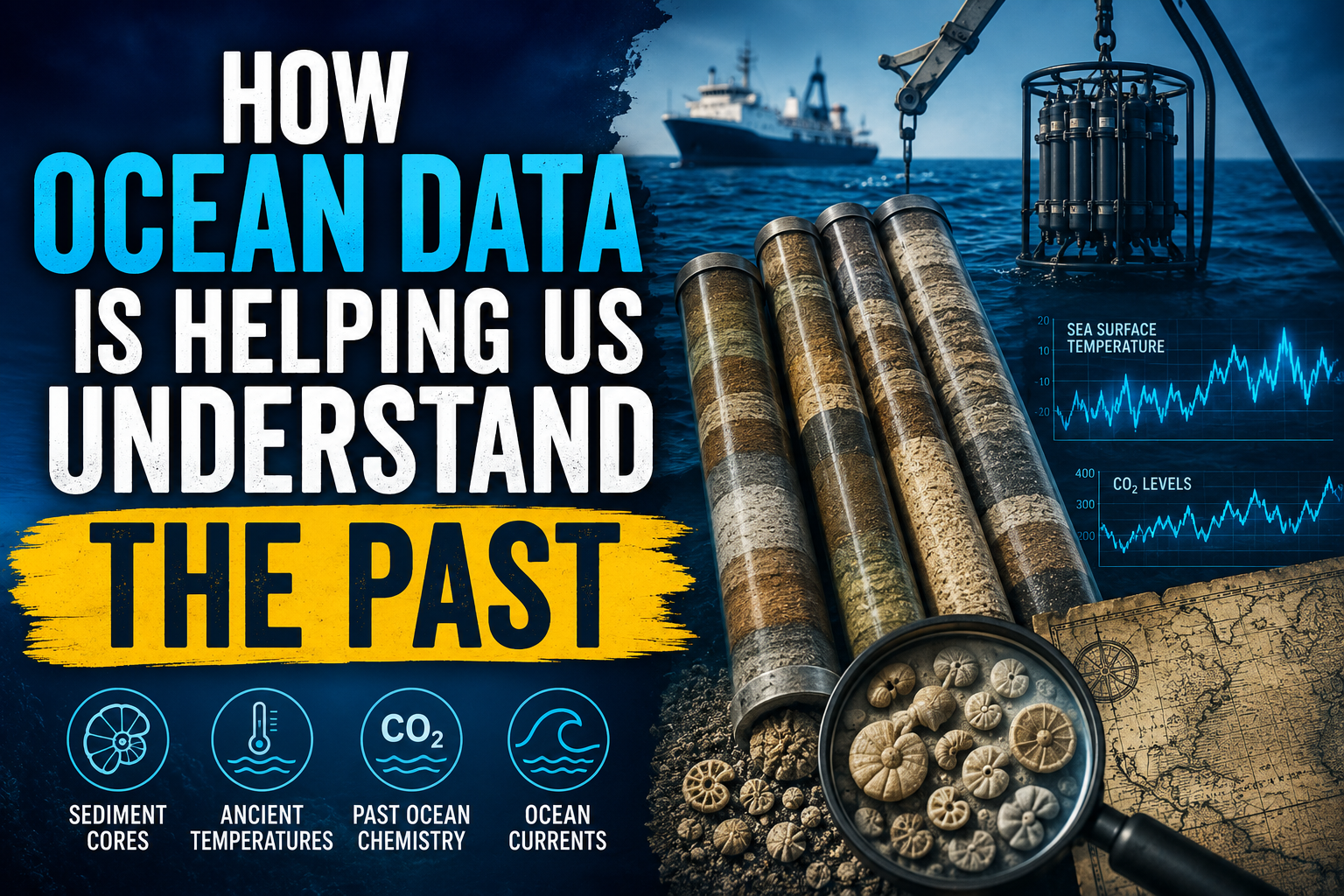
Paleoceanography uses proxies like sediment cores, isotopes, and fossils to reconstruct ancient ocean conditions. These proxies allow scientists to study ocean circulation, temperature gradients, and marine productivity over thousands of years.
Sea Surface Temperature Trends
Datasets like ICOADS aggregate ship log observations dating back to the 1600s. This enables researchers to track historical sea surface temperature changes and compare them to modern observations.
Ocean Circulation and Climate Patterns
Reconstructing past ocean circulation is essential because currents redistribute heat and nutrients globally. Ocean reanalysis techniques combine historical observations with models to visualize circulation changes over centuries.
How Scientists Collect and Use Ocean Data
Modern Tools
Satellites, Argo floats, drifting buoys, and autonomous vehicles provide real-time data on temperature, salinity, currents, and biogeochemical properties. These tools allow precise monitoring of ocean changes and feed into historical reconstructions.
Historical Sources
Ship logs, tide measurements, and early expeditions provide centuries-old ocean data. Scientists digitize and correct these records to build continuous datasets that extend beyond modern measurement periods.
Data Integration and Modeling
Projects like SeaDataNet and the Global Ocean Data Analysis Project standardize and integrate historical and modern datasets. Ocean reanalysis and climate models use this data to reconstruct past ocean conditions and predict future trends.
Key Insights from Ocean Data History
- Sea Level Trends: Reconstructs historical changes due to glacial melting and thermal expansion.
- Climate Events: Helps contextualize El Niño, Little Ice Age, and other historical climate patterns.
- Ecosystem Changes: Tracks shifts in species distribution and marine biodiversity over time.
Importance for the Future
Ocean data history forms the foundation for modern climate models and environmental policy. Understanding past ocean changes allows scientists to predict future trends, improve ecosystem management, and inform conservation strategies.
Conclusion
Ocean data history is more than numbers, it’s a window into Earth’s environmental past. From early ship logs to modern autonomous floats, this data helps scientists reconstruct centuries of ocean behavior, understand climate trends, and guide decisions for a sustainable future.
Explore historical and modern ocean data yourself using resources like Argo floats and ICOADS, start your journey into oceanography today!
FAQs
What is ocean data history?
Ans: Ocean data history refers to the collection and analysis of ocean measurements over time, including temperature, salinity, currents, and sea-level observations.
Why is historical ocean data important?
Ans: It provides context for climate change, sea-level trends, and ecosystem shifts by comparing past and present conditions.
What is paleoceanography?
Ans: Paleoceanography studies ancient oceans using proxies like sediment cores and isotopes.
What are Argo floats?
Ans: Autonomous floats that measure temperature and salinity, providing global ocean data in real time.
How far back do ocean observations go?
Ans: Ship logs and historical records date back to the 1600s, though coverage was sparse.
What is ocean reanalysis?
Ans: A method that combines historical observations with models to reconstruct past ocean conditions.
How does ocean data help climate research?
Ans: It distinguishes natural variability from human-driven changes and informs climate models.
Can old ship logs still be useful?
Ans: Yes, they are digitized and corrected to extend historical ocean datasets.
Where can I find historical ocean data?
Ans: NOAA World Ocean Database, SeaDataNet, and open-access archives provide datasets.
Does ocean data history include biological data?
Ans: Yes, including historical species observations and ecosystem indicators.
