
24Nov
El Niño in Monterey Bay: What MBARI Researchers Are Seeing and How to Read the Signs
Quick answer: MBARI researchers report early evidence of an extreme El Niño in Central California. Over about a month they detected an influx of warm water and sightings of species that usually live farther south. Continuous monitoring in Monterey Bay, including the M1 mooring, helps scientists spot such changes as they begin.
Key Takeaways
- MBARI researchers have detected early signs of an extreme El Niño in Central California.
- The two signals reported are an influx of warm water and sightings of southern species.
- MBARI technology monitors Monterey Bay and Central California waters continuously, which helps scientists notice change as it starts.
- Early signals do not tell us how long the event will last or how every species will respond.
- Oceanography offers regional datasets, articles and learning resources for following ocean change yourself.
What are MBARI researchers seeing in Monterey Bay?
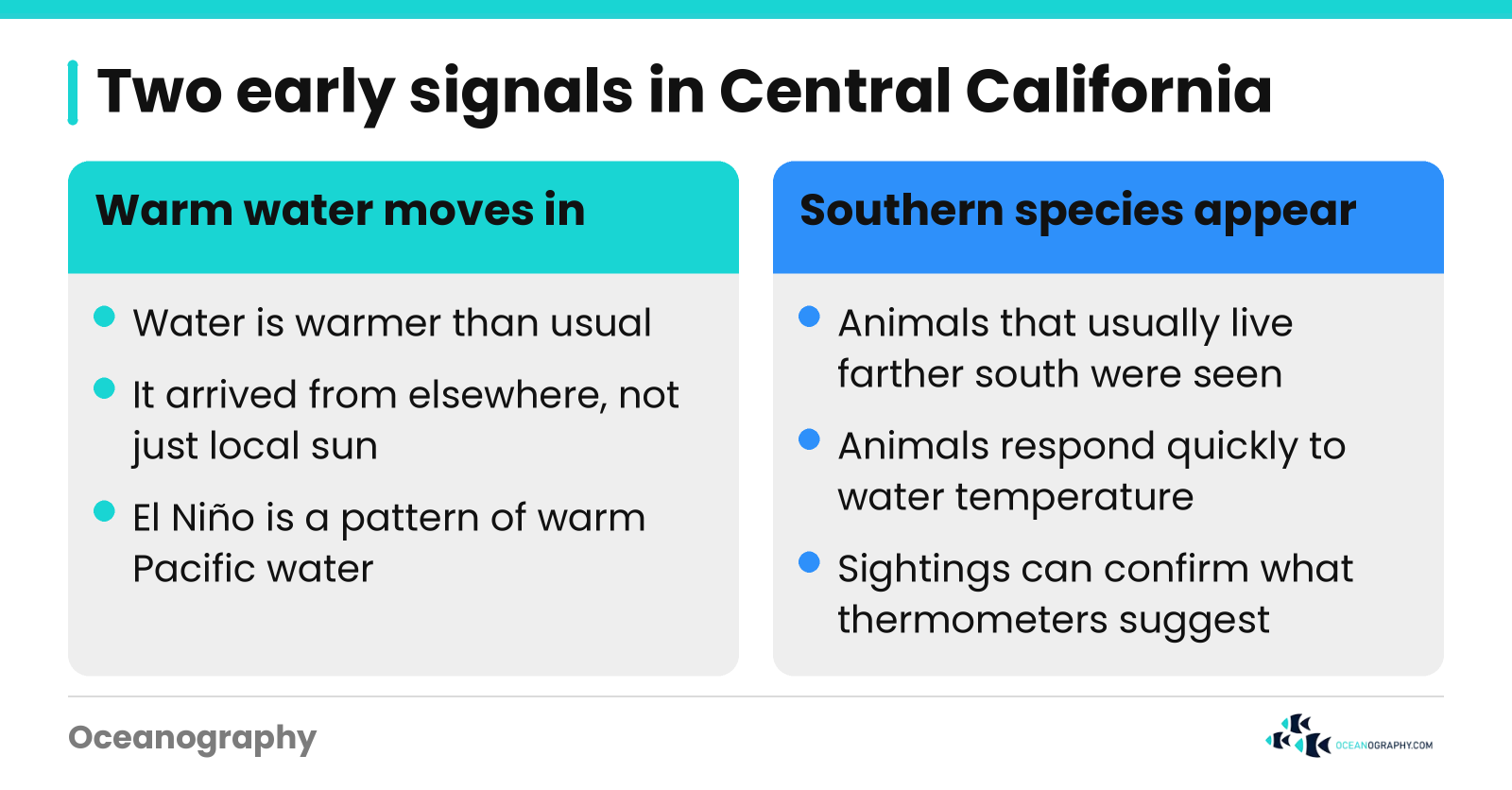
Central California is showing early evidence of an extreme El Niño, according to MBARI researchers. Over roughly the past month they noted two changes: warm water moving into the area and sightings of species that usually live farther south. MBARI is a non-profit oceanographic research center.
This comes from a news item published by MBARI. We have used it as our source for what was observed. Below, we explain what those observations mean and how you can follow ocean changes like this one.
Warm water moves in
An influx of warm water means the water in the bay and nearby coastal areas is warmer than usual, and it arrived rather than slowly building from local sunshine alone. Think of it like a warm bath filling from the tap. New water is coming in from somewhere else.
El Niño is a pattern of unusually warm water in the Pacific that can affect ocean conditions far from where it starts. To see how large-scale currents link distant regions, our page on global circulation is a good place to begin.
Southern species appear
The second signal is biological. People saw animals that normally live to the south of Central California. Sightings like these matter because animals respond quickly to water temperature. A change in who is swimming by can confirm what the thermometers suggest.
How do scientists know El Niño has arrived?
Scientists compare current conditions with what instruments normally record at the same place. Continuous monitoring makes that comparison possible. In Monterey Bay, MBARI technology tracks conditions across Central California waters all the time, so unusual changes can stand out early rather than being found after the fact.
Why continuous monitoring matters
One measurement tells you what the water is like today. A steady record tells you whether today is strange. That is why ocean observing relies on instruments that stay in place and keep reporting.
MBARI's report points to the M1 mooring as part of its monitoring. A mooring is an anchored platform that holds instruments in one spot in the ocean. Because it stays put, it can collect measurements from the same location over time.
The signals at a glance
| Signal | Plain-language meaning | What to check next |
|---|---|---|
| Influx of warm water | Warmer water has entered Central California waters | Regional temperature records over time |
| Southern species sightings | Animals from farther south are showing up | Research on how marine life tracks temperature |
| Continuous monitoring | Instruments show what is normal and what is not | Real-time and historical datasets for the region |
What does El Niño mean for ocean life in Central California?
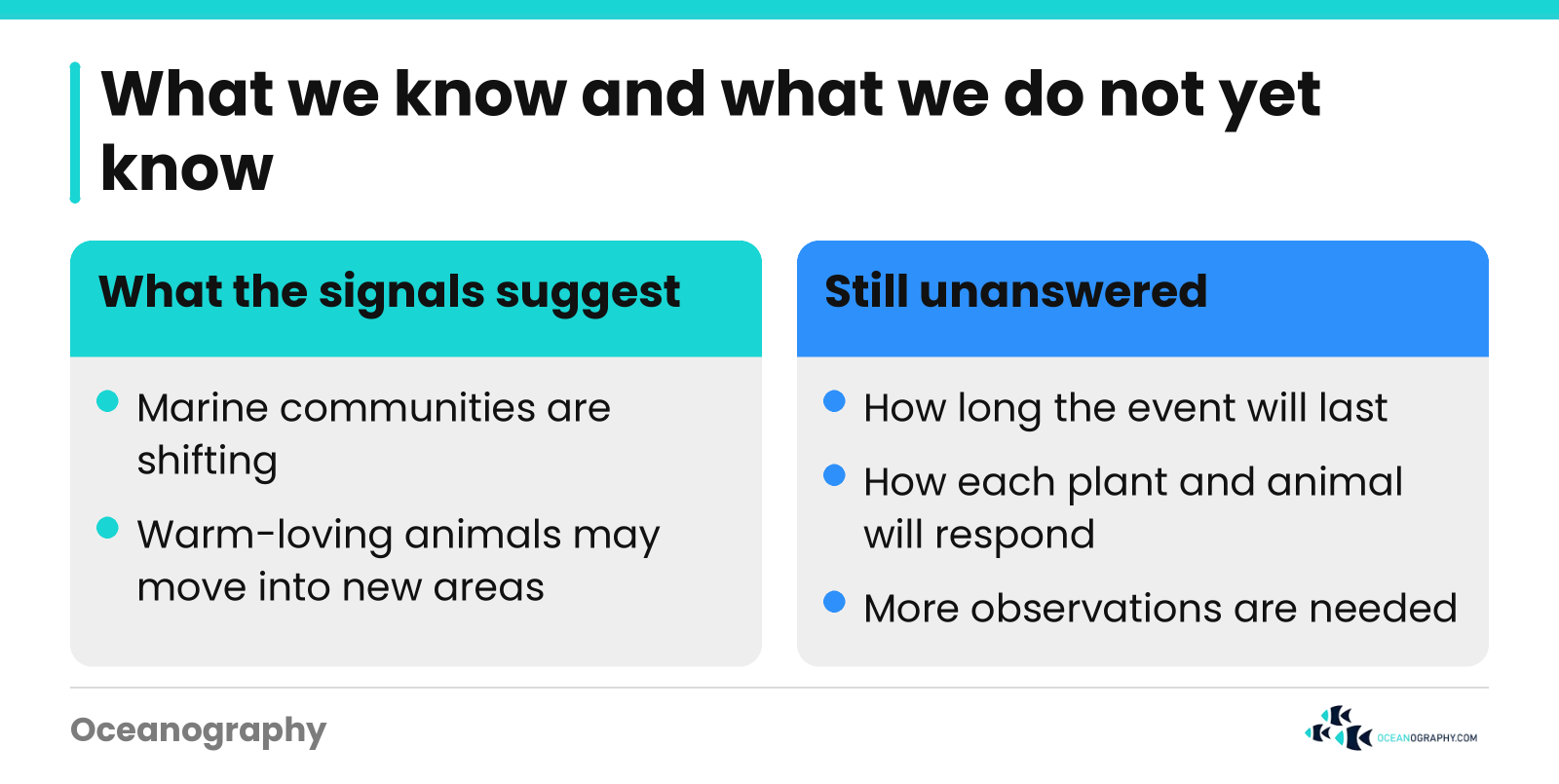
We can only say part of the story from this report. Warm water and southern species suggest marine communities are shifting. How long the event lasts, and how each plant and animal responds, is not answered by the early signals MBARI describes. Researchers will need more observations to say.
Why animals follow temperature
Many marine animals live within a range of water temperatures. When water warms, animals that prefer warmer conditions can move into new areas. That is a reasonable way to understand why southern species may appear, though the details differ from one species to the next.
If you want the basics of how living things and the physical ocean affect each other, our biological oceanography page covers the ideas in plain language.
What we should not assume
Early signals are early. A few points to keep in mind when you read news about an event like this:
- Sightings show that something changed, not how big the change will become.
- One bay is one place. Other coastlines may behave differently.
- Scientists often revise their picture as more data arrives.
How can you follow ocean change with Oceanography?
Oceanography, based in Franklin, Massachusetts, gives you tools to explore ocean conditions yourself. You can search our datasets, view results as tables or graphs, and download them. Our index and article repository add the research behind the numbers.
Our live data comes from some of the largest oceanographic institutions around the world. That means you can look at a region, see how conditions are recorded, and compare it with what researchers report in the news.
A simple way to start
- Open Search Datasets and choose an ocean area you want to study.
- Look at the latest measurements, then switch to the historical records.
- Choose a table or a graph, and download the results if you want to work with them.
- Read related papers in our articles section to see how researchers explain what they find.
Ready to try it? Search Datasets to explore ocean data. You can also call us at +1 (877) 805-3282.
For students and teachers
A live ocean event makes a strong classroom example. Teachers can browse our teacher resources for lesson support. Students can build background knowledge through courses and lectures. Both groups can pair the learning material with real data.
Frequently Asked Questions
What is El Niño in simple terms?
El Niño is a pattern of unusually warm water in the Pacific Ocean that can change ocean conditions in places far from where it begins. In Central California, MBARI researchers describe warm water arriving and southern species appearing as early signs. Our global circulation page explains how ocean currents connect distant regions.
What did MBARI researchers observe in Monterey Bay?
MBARI researchers observed warm water moving into Central California and sightings of species that usually live farther south. They describe these as early signals of an extreme El Niño. The changes were noticed over roughly the past month, using technology that monitors the bay and nearby waters continuously.
What is the M1 mooring in Monterey Bay?
The M1 mooring is a piece of MBARI monitoring technology named in the organization's El Niño report. A mooring is an anchored platform that holds instruments in a fixed spot in the ocean. Staying in one place lets it collect measurements from the same location over time.
Why do southern species show up when the water warms?
Many marine animals prefer certain temperature ranges, so warmer water can let animals from farther south move into new areas. This is a general pattern, not a rule for every species. MBARI's report notes southern species sightings alongside warm water, but exact responses vary by animal.
How long will this El Niño last?
The early signals reported by MBARI do not say how long the event will last. Researchers need more observations before they can describe its size and duration. Continuous monitoring helps because it adds new data over time, letting scientists update their understanding as conditions change.
Where can I find ocean data for my own region?
You can search ocean datasets on Oceanography. Results appear as tables or graphs, and you can download them. The data is collated from some of the largest oceanographic institutions around the world. Use the Search Datasets link to get started.
