
25Jun
The Role of Ocean Data in Protecting Coral Reefs
What is ocean data in coral reef protection?
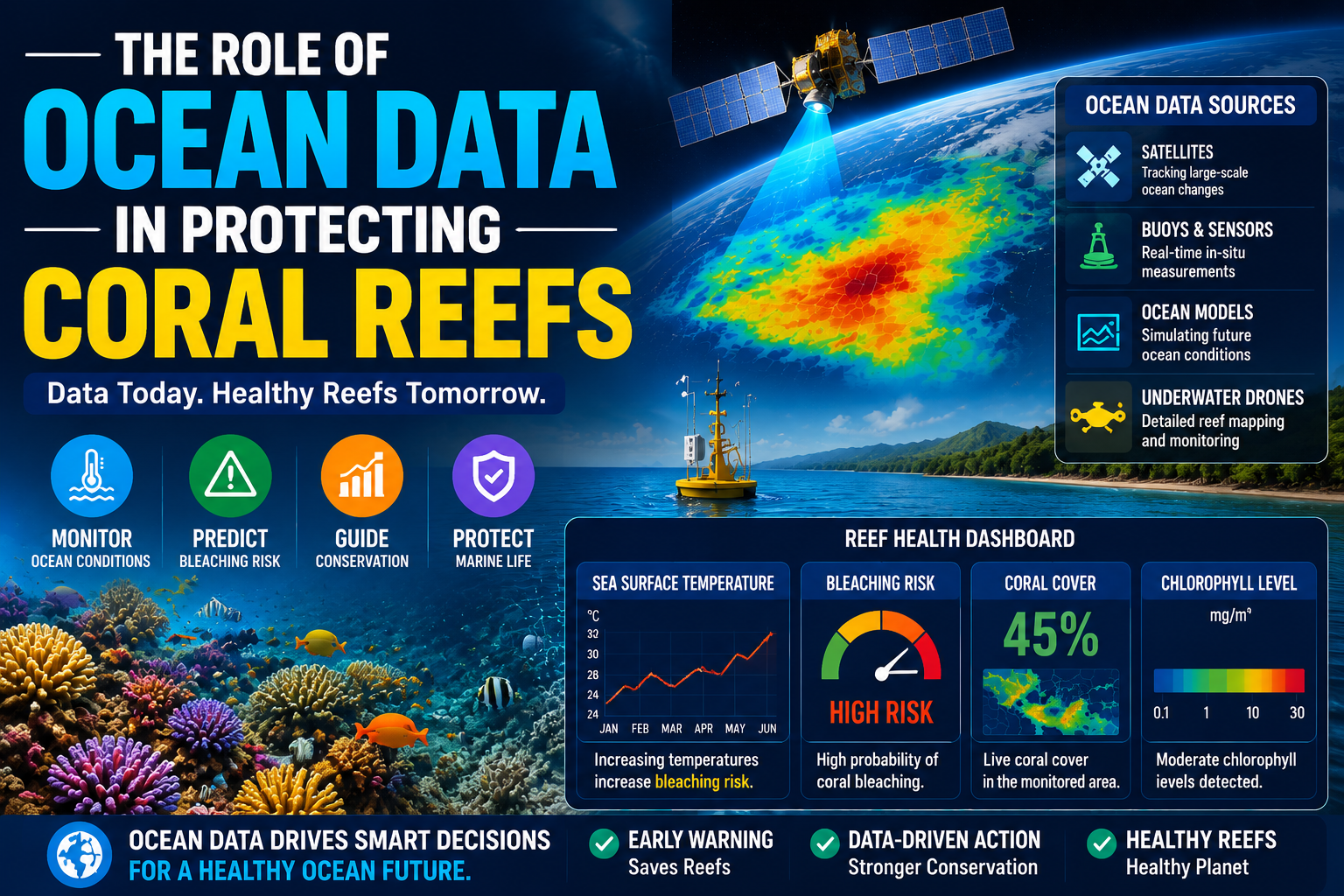
Ocean data coral reef protection refers to the use of environmental measurements such as temperature, salinity, ocean currents, and satellite imagery to monitor reef ecosystems and prevent damage before it becomes irreversible.
Coral reefs are extremely sensitive to changes in ocean conditions. Even a small rise in sea temperature can trigger coral bleaching, a process where corals lose their color and vital symbiotic algae.
Platforms like Oceanography provide access to oceanographic datasets and research tools that help scientists analyze these changes at scale.
Why coral reefs depend on ocean data
Coral reefs are often called the “rainforests of the sea” because they support around 25% of marine biodiversity despite covering less than 1% of the ocean floor.
However, they are highly vulnerable to:
- Rising sea temperatures
- Ocean acidification
- Pollution and sedimentation
- Overfishing and ecosystem imbalance
Ocean data helps scientists detect these threats early by tracking environmental changes in real time.
Without data, reef degradation is often discovered only after visible damage occurs.
Key types of ocean data used for reef protection
1. Sea surface temperature (SST)
Temperature is the most important indicator of coral stress. When waters stay too warm for extended periods, coral bleaching becomes more likely.
Satellite sensors continuously track SST across reef regions, helping identify heat anomalies early.
2. Chlorophyll and ocean color data
These measurements show plankton density and water quality. Sudden changes can indicate pollution or ecosystem imbalance affecting coral health.
3. Salinity and acidity levels
Corals are sensitive to changes in salt balance and ocean acidity. Data from buoys and research stations helps monitor chemical stability.
4. Satellite imagery
High-resolution Earth observation satellites capture reef structure, sediment movement, and bleaching patterns over time.
5. Underwater sensor networks
Deployed near reefs, these sensors collect continuous real-time data on temperature, oxygen levels, and local conditions.
How ocean data helps prevent coral bleaching
Coral bleaching prediction is one of the most important applications of ocean data.
Here’s how it works:
Step 1: Data collection
Sensors and satellites collect temperature and environmental signals across reef regions.
Step 2: Pattern detection
AI systems analyze historical bleaching events and match them with current conditions.
Step 3: Risk forecasting
Models predict which reef zones are at high risk of bleaching.
Step 4: Early warnings
Scientists and conservation teams receive alerts to take preventive actions.
This early-warning approach helps prioritize reef protection efforts before damage becomes irreversible.
The role of AI in ocean data analysis
Modern reef protection relies heavily on artificial intelligence.
AI systems:
- Process massive ocean datasets
- Detect hidden environmental patterns
- Predict coral stress events
- Map reef health over time
Machine learning models are particularly effective at combining multiple variables like temperature, currents, and pollution levels into a single risk prediction system.
This makes reef conservation more proactive rather than reactive.
Real-world impact of ocean data on reef conservation
Ocean data is already transforming marine protection efforts:
Australia’s Great Barrier Reef
Monitoring systems track bleaching events and help guide conservation policies.
Caribbean reefs
Satellite data helps identify coral loss and recovery patterns after storms.
Pacific Islands
Local conservation groups use ocean data to protect biodiversity hotspots and fishing zones.
These systems help governments and NGOs allocate resources more effectively.
Challenges in ocean data-based reef protection
Despite its advantages, several challenges remain:
- Data gaps in remote reef regions
- High cost of sensor deployment
- Limited real-time connectivity underwater
- Complex interpretation of multi-layer datasets
- Climate change accelerating faster than model updates
These challenges highlight the need for improved global collaboration and open data systems.
Future of coral reef protection using ocean data
The future of ocean data coral reef protection is moving toward real-time digital reef ecosystems.
Expected developments include:
- Autonomous underwater drones
- Continuous satellite + sensor integration
- AI-powered reef digital twins
- Predictive climate stress modeling
These innovations will allow scientists to simulate reef futures and test conservation strategies before applying them in real life.
Oceanography platforms like Oceanography will play a key role in centralizing and sharing these datasets globally.
Conclusion
Ocean data has become one of the most powerful tools for protecting coral reefs. By combining satellite observations, underwater sensors, and AI-driven models, scientists can detect threats early, predict bleaching events, and guide conservation efforts more effectively.
As climate pressures increase, data-driven reef protection is no longer optional, it is essential for preserving marine biodiversity and ocean health.
Explore ocean datasets and coral reef monitoring systems to understand how real-time environmental data is helping protect marine ecosystems worldwide.
FAQs
1. What is ocean data in coral reef protection?
Ans: Ocean data refers to environmental measurements like temperature, salinity, ocean currents, and satellite imagery used to monitor coral reef health and detect environmental threats early.
2. How does ocean data help protect coral reefs?
Ans: It helps scientists track ocean conditions in real time and predict coral bleaching risks before they happen, allowing early conservation actions.
3. What is the most important ocean data for coral reefs?
Ans: Sea surface temperature is the most critical factor because even small increases can trigger coral bleaching and ecosystem stress.
4. How do satellites help monitor coral reefs?
Ans: Satellites capture ocean color, heat patterns, and reef changes over time, making it possible to detect bleaching and environmental shifts across large areas.
5. Can AI and ocean data work together for reef protection?
Ans: Yes. AI analyzes ocean data to detect patterns, predict bleaching events, and generate early warning systems for reef conservation efforts.
6. What causes coral bleaching?
Ans: Coral bleaching is mainly caused by rising ocean temperatures, along with pollution, acidification, and long-term climate change stress.
7. Why are coral reefs important for the ocean?
Ans: Coral reefs support about 25% of marine life, protect coastlines from storms, and provide food and income for millions of people worldwide.
8. Where can I learn more about coral reef science?
Ans: You can explore global reef monitoring and marine science research at:
9. What technologies are used in ocean data collection?
Ans: Technologies include satellites, underwater sensors, drones, buoys, and AI-powered analytics systems for continuous ocean monitoring.
10. Where can I access oceanographic research data?
Ans: You can explore ocean datasets and marine research tools at:
Oceanography Research Platform
