
19Nov
Barreleye Fish With a See-Through Head: What Rare 4K Footage Shows About Life in the Twilight Zone
Quick answer: The barreleye fish is a deep-sea species with a clear dome over its head and upward-pointing tubular eyes that rotate forward to track prey. MBARI researchers filmed one about 600 meters down in 4K, only the eleventh time they had met the species in nearly four decades.
Key Takeaways
- The barreleye fish (Macropinna microstoma) has tubular eyes that sit beneath a transparent dome on top of its head.
- Its eyes normally point upward to watch for faint shapes overhead, then rotate forward to follow prey.
- MBARI scientists filmed the fish about 600 meters (1,970 feet) down, roughly 90 kilometers (55 miles) offshore.
- The encounter was only the eleventh for MBARI scientists in nearly four decades of ocean exploration.
- The sighting was unplanned, during an expedition focused on gelatinous animals such as jellyfish, siphonophores and comb jellies.
What is the barreleye fish and why is its head see-through?
Deep-sea barreleye fish (Macropinna microstoma) have a transparent, gel-like dome over the head. Two big, tube-shaped eyes sit under it. The eyes can still swivel inside that shield, which helps the fish spot food in low light.
A head you can see through
Nearly all fish have solid, opaque heads. The barreleye is an exception. Its shield is transparent, so in new footage released by MBARI you can look down through it and see the eyes.
The dome is not just odd to look at. It helps the fish find meals where little light reaches.
Where the barreleye lives
The twilight zone is a dim layer of the ocean, and it is where barreleyes make their home. Since only a little sunlight reaches this depth, hunting for food is hard. The recent sighting was in the Pacific Ocean, at a depth of around 600 meters (1,970 feet).
How does the barreleye fish hunt in the twilight zone?
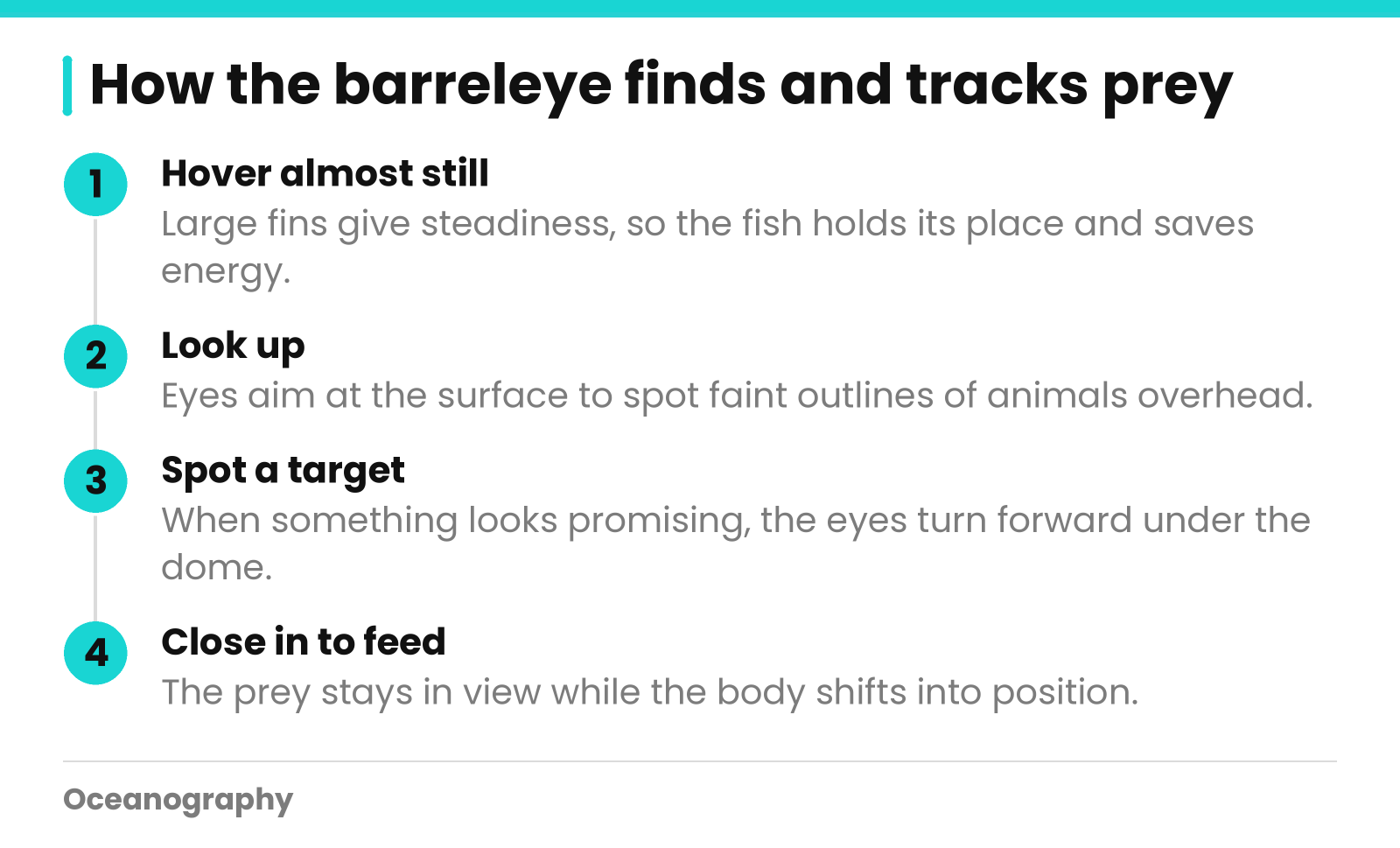
The fish hangs nearly still and watches the water overhead. Its eyes normally point up, ready to catch the faint outlines of animals passing above. If something looks worth chasing, the eyes rotate forward inside the clear dome. The fish can then track its target as it moves in to eat.
Staying still with large fins
Earlier research by MBARI scientists Bruce Robison and Kim Reisenbichler found that a barreleye need not keep swimming to find food. Its large fins give steady, precise control, so it can stay in one spot.
Holding still saves energy. It also keeps the fish in a good position to watch what drifts overhead.
Eyes that rotate under the dome
Think of a periscope that tilts. Looking up is the default, and it works well for spotting shapes against dim light from above. When the fish chooses a target, the eyes swing forward under the dome. The prey stays in sight while the body lines up for the catch.
Feeding near siphonophores
Siphonophores have stinging tentacles, and small crustaceans sometimes get caught in them. Barreleyes can pick off those crustaceans there. A siphonophore is a colony of linked animals, related to jellyfish. MBARI reports that the dome helps shield the fish's eyes during this kind of feeding.
How did MBARI scientists film such a rare fish?
Researchers from MBARI, which stands for Monterey Bay Aquarium Research Institute, recorded the fish with the remotely operated vehicle Doc Ricketts. This robot submarine is flown by pilots on board the ship. The fish appeared roughly 600 meters down and 90 kilometers offshore, while the vehicle was heading up to be recovered as the day's work wrapped up.
An unplanned find on a jelly expedition
Nobody set out to find a barreleye. The crew was partway through an eight-day expedition named Diving Deep for Delicate Drifters, sailing on the research vessel David Packard. They were studying gelatinous animals such as jellyfish, siphonophores and ctenophores (also called comb jellies). Scientists hope to understand how evolution let these soft, fragile creatures live in deep, open water.
Different depths called for different methods. Near the surface, crews did blue-water scuba dives, and hundreds of meters down they ran ROV surveys. Blue-water diving means swimming in open sea, far from the bottom or the shore.
A sighting that stopped the ship
Shannon Johnson, a research specialist, spotted the fish while pilots were raising the ROV, and she asked them to halt. Most of the scientists were in the wet lab, preparing to catalog specimens. Word spread quickly, so they hurried to the control room, where crew members crowded in too.
Senior Scientist Steven Haddock said the animal had everyone's complete attention. He added that awe at deep-sea animals can motivate people to look after the largest habitat on the planet.
Why one sighting matters
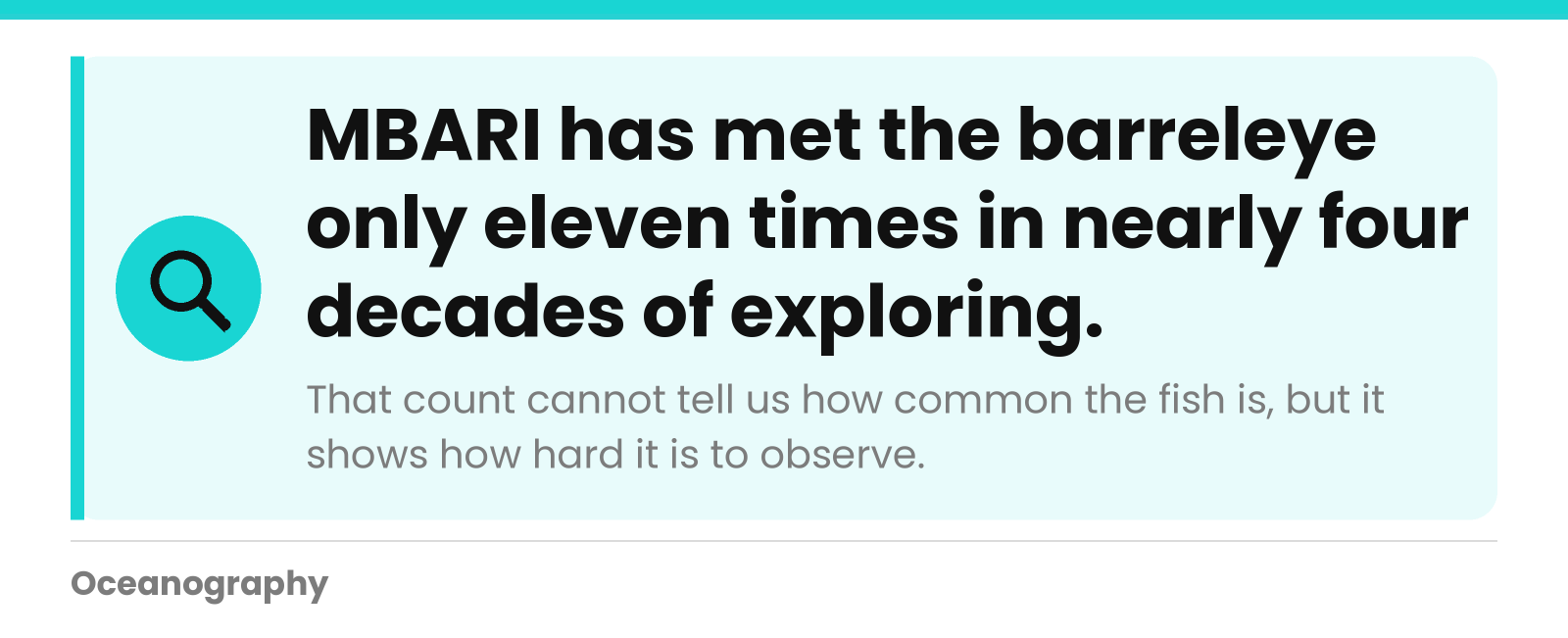
MBARI scientists have encountered the barreleye just eleven times in nearly four decades of exploring. That number says nothing about how common the fish is across the wider ocean. It does show how hard the species is to observe where it lives.
| Detail | What MBARI reported |
|---|---|
| Species | Barreleye fish (Macropinna microstoma) |
| Depth | Around 600 meters, or 1,970 feet |
| Distance offshore | About 90 kilometers (55 miles) |
| Research vessel | David Packard |
| Vehicle | ROV Doc Ricketts |
| Expedition | Diving Deep for Delicate Drifters, eight days |
| MBARI encounters with the species | Eleven in nearly four decades |
How Oceanography helps you explore deep-sea life
We are Oceanography, based in Franklin, Massachusetts. Students, teachers and researchers come to us to follow stories like this one. You can search real-time and historical ocean datasets by region, browse a worldwide index of research documents, and read peer-reviewed articles in our repository.
Steps to keep learning
- Begin on our Biological Oceanography page to see how scientists study marine life.
- Use Search Datasets to find live ocean measurements collated from some of the largest oceanographic institutions. You can view results as tables or graphs and download them.
- Visit View Institutes to find research organizations, some of which study the deep sea.
- Search our articles and index for research on deep-sea animals. Peer-reviewed papers are posted to the repository online immediately after publication, and members can search it for free.
For teachers and students
A rare video like this can open a lesson well. Ask students why eyes that point up might help in dim water. Then have them watch how the fish shifts its eyes to follow prey. To build out the lesson, try our Teacher Resources and Courses and Lectures.
Ready to look at the ocean's own data? Search Datasets or call us at +1 (877) 805-3282.
Frequently Asked Questions
What is a barreleye fish?
A barreleye fish is a deep-sea fish, Macropinna microstoma, known for a transparent dome over its head. Its tubular eyes sit under the dome and usually point upward. They can rotate forward to follow prey. Scientists have watched it in the ocean's twilight zone, a dim layer of the sea.
Can the barreleye fish really see through its head?
In effect, yes. Its eyes sit beneath a transparent dome of tissue, and they look up through it. The clear covering lets light reach the eyes while the eyes rotate underneath. MBARI also reports that the dome helps shield the eyes when the fish feeds near stinging siphonophore tentacles.
How deep was the barreleye fish filmed?
It was filmed about 600 meters (1,970 feet) below the surface. The sighting happened roughly 90 kilometers (55 miles) offshore, during an MBARI expedition aboard the research vessel David Packard. The team used the remotely operated vehicle Doc Ricketts, which was heading back up when the fish appeared.
How often do scientists see barreleye fish?
Rarely. This was only the eleventh time MBARI scientists had encountered the species in nearly four decades of ocean exploration. That is why crew members gathered in the control room to watch. One team's record does not show how common the fish is, only that meetings are uncommon.
What is the twilight zone of the ocean?
The twilight zone is a dimly lit part of the ocean where sunlight is faint. Spotting food there is harder than in bright surface water. Animals such as the barreleye have features suited to it, like upward-pointing eyes that watch for faint shapes passing overhead.
What was the MBARI expedition studying?
The eight-day expedition, Diving Deep for Delicate Drifters, focused on gelatinous animals such as jellyfish, siphonophores and comb jellies. Scientists wanted to learn how these soft-bodied animals evolved to survive in the open ocean at depth. The barreleye was an unplanned find at the end of one day.
