
9Jul
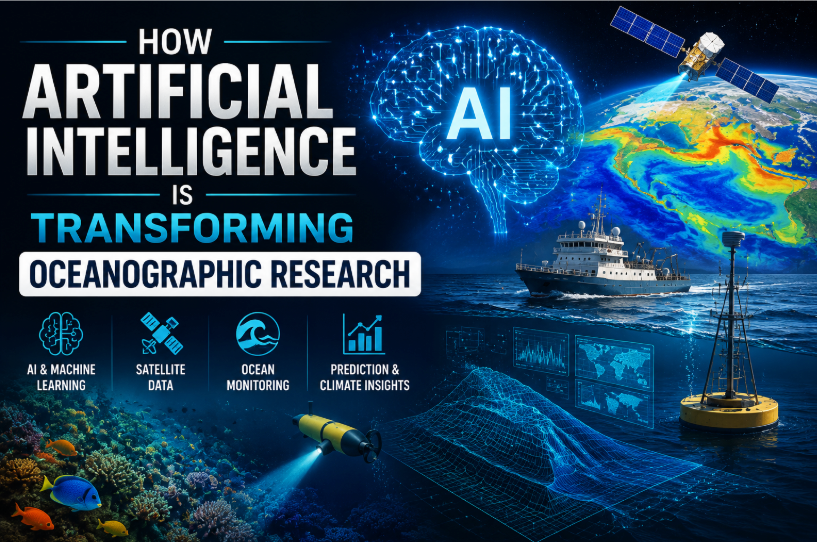
How Artificial Intelligence is Transforming Oceanographic Research
The ocean is one of the most complex systems on Earth. It regulates climate, supports biodiversity, and drives weather patterns across the planet. But despite its importance, it remains difficult to fully observe and understand because of its scale and constant movement.
This is where artificial intelligence is transforming oceanography by making it possible to analyze vast and complex ocean datasets in ways that were not possible before. Instead of relying only on traditional observation methods, scientists now use AI systems to process vast ocean datasets, identify hidden patterns, and improve predictions about how the ocean behaves.
The result is not just faster analysis, but a deeper understanding of how the ocean connects to climate and life on Earth.
Why ocean science needs artificial intelligence
Modern ocean research generates enormous volumes of data every day. Satellites scan sea surface temperatures, underwater sensors record chemical changes, and autonomous vehicles map deep ocean regions.
Individually, these datasets are valuable. But together, they become too large and complex for traditional analysis methods.
Artificial intelligence helps solve this problem by connecting different types of ocean data and finding relationships that are not easy for humans to detect. It allows researchers to move from isolated measurements to a more complete picture of ocean behavior.
AI and the way we understand ocean behavior
One of the most important contributions of AI is its ability to detect patterns across time and space.
Ocean currents, for example, are not random. They are part of a global system that moves heat, nutrients, and carbon across the planet. AI models can analyze these movements and help scientists understand how they influence climate conditions in different regions.
This is especially useful for studying long-term climate systems like El Niño and broader ocean circulation patterns. These systems affect rainfall, storms, and temperature shifts across continents.
By analyzing historical and real-time data together, AI improves how accurately scientists can interpret ocean behavior.
Climate prediction becomes more precise
The ocean plays a major role in regulating Earth’s climate by storing and distributing heat. Even small changes in ocean temperature or circulation can influence global weather patterns.
AI is improving climate prediction by analyzing interactions between the ocean and atmosphere more effectively than traditional models. It can identify subtle signals in sea surface temperature, salinity, and current movement that often appear before major climate events.
This helps researchers better understand how and when climate shifts might occur, improving forecasting accuracy for seasonal and long-term changes.
Monitoring marine ecosystems in real time
Artificial intelligence is also transforming how marine ecosystems are studied.
Instead of relying only on periodic field studies, researchers can now use AI to continuously monitor ocean life through satellite data, sonar readings, and underwater sensors.
This allows scientists to track fish migration patterns, observe coral reef health, and detect changes in biodiversity over time. It also supports sustainable fishing practices by helping identify how marine species respond to environmental changes.
Exploring the deep ocean more effectively
Large parts of the ocean remain unexplored because of extreme depth and pressure conditions. AI helps extend exploration capabilities by processing sonar and imaging data collected from autonomous underwater vehicles.
These systems can generate detailed maps of the seafloor and identify underwater structures that would be difficult to detect manually.
As a result, deep-sea research is becoming more precise and less dependent on direct human exploration.
Real-time understanding of ocean systems
One of the most powerful developments in ocean science is real-time data analysis.
AI systems can now process continuous streams of data from satellites and sensors, allowing scientists to monitor changes in the ocean as they happen. This includes detecting extreme weather conditions, tracking ocean heatwaves, and identifying unusual environmental shifts.
This real-time capability is important for early warning systems and environmental protection.
Challenges scientists still face
Despite its benefits, artificial intelligence in oceanography is not without challenges.
Ocean data is still incomplete in many regions, especially in deep and remote areas. AI models depend heavily on the quality and coverage of available data, which means gaps can affect accuracy.
There is also the issue of interpretability. Some AI systems produce accurate predictions, but it is not always clear how those results are generated. This makes scientific validation more complex.
Finally, computational demands for large-scale ocean models remain high.
The future of AI in ocean research
The future of oceanography is moving toward fully integrated digital ocean systems. These systems will combine satellite data, underwater sensors, and AI models to create continuous, high-resolution maps of ocean conditions.
Instead of studying the ocean in isolated snapshots, scientists will be able to observe it as a constantly updating system.
This shift will improve climate prediction, support conservation efforts, and expand our understanding of marine ecosystems.
Conclusion
Artificial intelligence is not replacing oceanography. It is expanding what is possible in ocean science.
By connecting massive datasets and revealing patterns that were previously hidden, AI is helping scientists understand the ocean in a more complete and dynamic way.
As technology continues to improve, artificial intelligence in oceanography will play an even greater role in shaping how we study climate, ecosystems, and the planet itself.
Explore how artificial intelligence is transforming ocean science through real-time data analysis, climate modeling, and marine ecosystem monitoring.
👉 Learn more at Oceanography
FAQs
1. What is artificial intelligence in oceanography?
Ans: It refers to the use of machine learning and AI systems to analyze ocean data and improve understanding of marine environments and climate systems.
2. Why is AI important in ocean science?
Ans: Because it can process large and complex datasets faster than traditional methods and reveal patterns in ocean behavior that are difficult to detect manually.
3. How does AI help climate prediction?
Ans: AI improves climate models by analyzing ocean temperature, salinity, and circulation patterns that influence global weather systems.
4. Can AI study marine life?
Ans: Yes. AI helps track migration patterns, monitor ecosystems, and analyze biodiversity changes using satellite and sensor data.
5. Is AI used in deep sea exploration?
Ans: Yes. AI processes sonar and imaging data from underwater vehicles to map and analyze the seafloor.
6. Where can I learn more about ocean science?
Ans: You can explore ocean research resources here: NOAA Ocean Data Resources
7. What are the limitations of AI in oceanography?
Ans: Limitations include incomplete data coverage, high computational cost, and challenges in interpreting model outputs.
8. Does AI replace oceanographers?
Ans: No. AI assists scientists by handling data-heavy tasks, while oceanographers interpret findings and guide research direction.
9. How is ocean data collected?
Ans: Through satellites, underwater sensors, buoys, sonar systems, and autonomous exploration vehicles.
10. What is the future of AI in oceanography?
Ans: The future includes real-time global ocean monitoring systems powered by AI and continuous data integration from multiple sources. For broader AI research insights, visit: MIT Climate & AI Research
