
25Jul
The Science of Tides: How They Work and Why They Matter
Tides are long-period ocean waves seen at shore as the regular rise and fall of sea level. They are driven mainly by the Moon’s gravity, shaped by the Sun, Earth’s rotation, seafloor depth, coastline shape, weather, and local geography. They matter because they affect navigation, fishing, coastal safety, ecosystems, engineering, and flood risk.
Stand on a beach for a few hours and the shoreline seems alive. Water creeps up the sand, covers rocks, floats boats that were resting in mud, then pulls back again. This rhythm is familiar, but it is not simple sloshing. The science of tides links astronomy, physics, geology, weather, and human decisions at the coast.
Understanding tides helps answer practical questions: when is it safe to launch a kayak, why do salt marshes flood, why do some harbors need precise tide tables, and why can a full moon bring unusually high water? The useful answer starts in space, then gets complicated as the tide wave meets real ocean basins and irregular coastlines.
The Science of Tides Begins With Gravity
Gravity pulls every object toward every other object. For tides, the important pull comes from the Moon and, to a lesser degree, the Sun. The Moon is much smaller than the Sun, but it is much closer to Earth, so its tide-generating effect is stronger. What matters is not only the pull itself but the difference in pull across Earth.
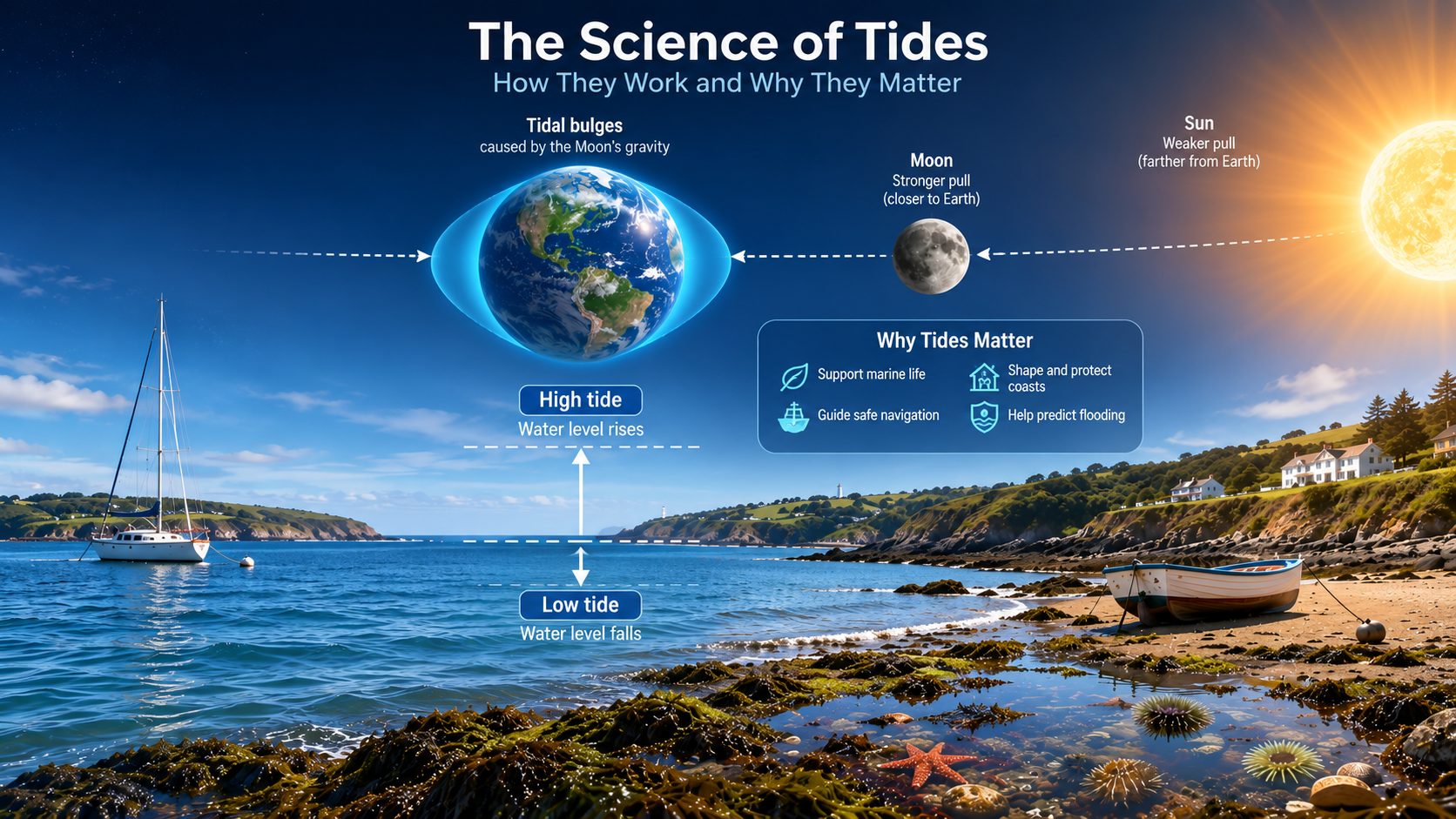
Water on the side of Earth facing the Moon is tugged slightly more strongly than Earth’s center. Water on the far side is tugged slightly less strongly. The result is a stretching pattern, often taught as two tidal bulges. At shore, we experience those changing water levels as high tide and low tide.
Why High Tide Often Happens Twice a Day
Many coastlines have two high tides and two low tides during a lunar day, which is about 24 hours and 50 minutes. The extra 50 minutes matters because the Moon moves forward in its orbit while Earth rotates. This is why tomorrow’s high tide is usually later than today’s, although local conditions can alter the timing.
The familiar two-bulge model is useful, but it is incomplete. Earth is not covered by one smooth ocean. Continents block water, ocean basins have different shapes and depths, and Earth’s rotation bends moving water. In real oceanography, tides behave like very long waves that rotate around basins, reflect from coastlines, and pile up in narrow bays.
Spring Tides, Neap Tides, and Tidal Range
Tidal range is the height difference between high tide and low tide. It changes through the lunar month. During a new moon or full moon, the Sun, Moon, and Earth are nearly aligned. Their tide-generating forces reinforce each other, producing spring tides: higher high waters and lower low waters than average.
About a week later, at the first or third quarter moon, the Sun and Moon sit at right angles from our viewpoint. Their effects partly offset each other, producing neap tides with a smaller range. Spring does not mean the season here. It means the water “springs” farther from average.
Weather can push observed water levels above or below the predicted astronomical tide. Persistent onshore winds, low air pressure, and storms can raise coastal water. Offshore winds and high pressure can lower it. That is why tide predictions are powerful, but local marine forecasts still matter.
Why Tides Differ From One Coast to Another
Two places on the same ocean can have very different tides. A broad continental shelf may slow and amplify a tide wave. A funnel-shaped bay can concentrate incoming water. A deep, open island coast may see a modest range. Local friction, inlet width, river flow, and harbor geometry all matter.
This is why global tide charts cannot be reduced to Moon phase alone. The Moon sets the rhythm, but the coastline writes the local melody. A harbor master, oyster farmer, surfer, and coastal engineer may all care about the same tide, yet each one reads it for a different reason.
Why Tides Matter for Life, Work, and Safety
Tides are not background scenery. They move nutrients, oxygen, sediment, larvae, and organic matter through coastal waters. Salt marshes, mangroves, mudflats, estuaries, and tide pools depend on repeated wetting and drying. For many species, the tide controls feeding windows, nesting sites, migration paths, and shelter.
People depend on tides too. Ships need enough under-keel clearance to enter shallow ports. Fishers plan around tidal currents because moving water can concentrate bait and fish. Beachgoers need to know when a sandbar, cave entrance, or rocky path will be cut off. Rescue teams, dredging crews, bridge designers, and flood managers all use tidal information.
Sea level rise adds urgency. A tide that once stayed below a seawall may now reach streets during a spring tide, especially when wind or storm surge adds water on top. Tides do not cause sea level rise, but they reveal it in the places where people live, build, and travel.
How to Read a Tide Before You Act
Start with the local tide station closest to your activity, not a distant city name. Check the predicted high and low times, the tidal range, and whether the day is near a spring or neap tide. For boating, look at tidal currents as well as tide height. Water level moves up and down; current moves horizontally.
Then add context. Is there a storm offshore? Has rain swollen a river estuary? Will a strong wind blow into the bay? Are you crossing rocks that become slippery as water rises? Good tide use combines prediction with observation.
Conclusion: Tides Are Coastal Intelligence
The science of tides shows how distant gravity becomes local consequence. The Moon and Sun create the forcing, Earth’s rotation and ocean basins shape the wave, and coastline geometry decides what people actually see at the shore. That chain explains both the wonder and the practical value of tides.
Explore oceanography data and learn how researchers track carbon across oceans at oceanography.
FAQs
1. Why are there usually two high tides each day?
Ans: Many coasts pass through two tidal high-water regions during one lunar day. Since the Moon moves in its orbit while Earth rotates, that lunar day is about 24 hours and 50 minutes. Local coastline shape, basin depth, and seafloor features can change the timing and number of tides.
2. Why does the Moon affect tides more than the Sun?
Ans: The Sun is much more massive than the Moon, but it is far farther away. Because tide-generating force depends strongly on distance, the nearby Moon has the larger tidal influence. NASA explains that the Sun still matters, especially during spring and neap tide patterns
3. What is the difference between high tide and low tide?
Ans: High tide occurs when the highest part of the tidal wave reaches a location. Low tide occurs when the lowest part arrives. The vertical difference between those two water levels is called tidal range, and it varies by location, Moon phase, weather, and coastal geography.
4. What causes ocean tides?
Ans: Ocean tides are caused mainly by the Moon’s gravity, with additional influence from the Sun. The effect comes from differences in gravitational pull across Earth, which stretch ocean water into tidal patterns. For a deeper public explanation, see NOAA’s guide to what causes tides.
5. What are spring tides?
Ans: Spring tides are tides with a larger-than-average range. They happen around new moon and full moon, when the Sun, Moon, and Earth are nearly aligned. High tides tend to be higher, and low tides tend to be lower. The term does not refer to the spring season.
