
1Oct
Rogue Wave Formation: How Giant Waves Appear at Sea
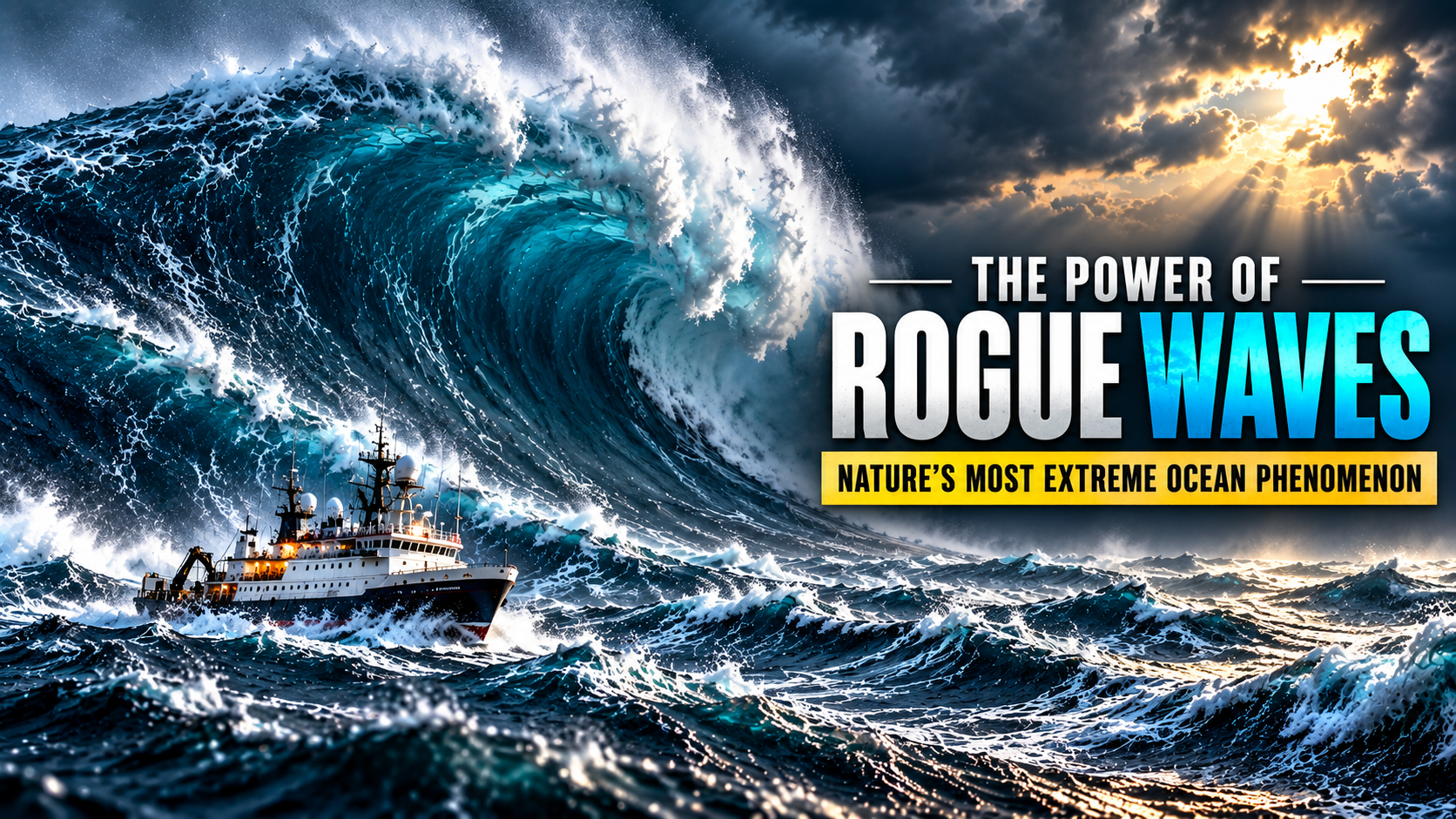
A rogue wave is an unusually large, steep, and unexpected ocean wave that towers above the surrounding sea state. Oceanographers commonly describe a rogue wave as one more than twice the height of surrounding waves, helping explain why one can seem to emerge almost from nowhere.
For centuries, sailors described sudden walls of water that sounded impossible. Modern measurements proved otherwise. Scientists now know that rogue wave formation can occur when physical processes concentrate wave energy into one place and one moment, including constructive interference, current-driven focusing, crossing seas, and nonlinear wave interactions.
What Is Significant Wave Height?
Significant wave height (Hs) is a standard measure used to describe the overall size of a sea state. It is approximately the average height of the highest one-third of individual waves in a wave record.
Because an ocean contains waves of many different heights, Hs is not the height of every wave. Individual waves can be substantially higher than Hs, which is why the ratio between an extreme wave and Hs is useful when identifying rogue waves. NOAA uses significant wave height as an important reference when describing extreme waves.
What Makes a Wave a Rogue Wave?
Ocean waves transport energy through water rather than simply carrying a body of water across the ocean. Most surface waves begin when wind transfers energy to the sea. Their eventual size depends heavily on wind speed, how long the wind blows, and fetch the uninterrupted distance over which that wind acts.
A rogue wave becomes exceptional because of its height relative to the sea around it.
Researchers commonly compare an individual wave with the significant wave height of the surrounding sea state. NOAA describes rogue or extreme storm waves as waves greater than twice the size of surrounding waves. They may also approach from unexpected directions and often have unusually steep faces and deep troughs.
That means not every enormous storm wave is technically rogue. Context matters.
The Draupner Wave Changed Ocean Science
A defining moment arrived on January 1, 1995.
Instruments on the Draupner offshore platform in the North Sea measured a wave approximately 25.6 meters from trough to crest. The significant wave height at the time was about 11.9 meters, making the extreme wave roughly 2.15 times that value.
The measurement provided compelling field evidence that extreme individual waves could exceed conventional expectations based on the surrounding sea state.
It also supplied real-world data against which theories of rogue wave formation could be tested.
Since then, scientists have used wave buoys, offshore platforms, ships, satellites, laboratory tanks, radar systems, and numerical simulations to investigate how such extreme events arise.
Constructive Interference: When Waves Add Together
One of the clearest mechanisms begins with a fundamental property of waves: superposition.
The ocean surface contains countless wave components traveling at different speeds, wavelengths, phases, and directions. Most of the time, their crests and troughs combine into an irregular but unremarkable sea.
Occasionally, however, several large crests arrive at nearly the same location at nearly the same moment.
Their elevations add.
This process is called constructive interference.
The result can be a crest dramatically larger than its individual components. Moments later, those waves move apart and the extraordinary crest disappears.
NOAA identifies constructive interference as one established mechanism behind unusually large ocean waves. Research based on field observations has likewise found strong evidence that constructive interference and dispersive focusing, enhanced by second-order nonlinear effects, can explain many rogue events.
Constructive interference is one of the important mechanisms used to explain rogue-wave formation, although the relative contribution of different mechanisms varies among sea states.
Ocean Currents Can Focus Wave Energy
Ocean currents introduce another layer of complexity.
When waves move against a strong current, their wavelengths can shorten and the wave field may become steeper. Current gradients can also refract and focus wave energy into localized areas.
The Gulf Stream in the North Atlantic and the Agulhas Current near southern Africa are frequently discussed examples of environments where opposing waves and energetic currents can produce hazardous conditions.
NOAA notes that waves interacting with an opposing current can undergo energy focusing capable of creating very large waves.
In this scenario, rogue wave formation is not simply one ordinary wave inexplicably growing taller. The current changes the way wave energy propagates through the ocean, allowing energy to become concentrated into a comparatively small region.
Crossing Seas Create Dangerous Geometry
The ocean is rarely made of neat parallel rows of waves.
A distant storm can send one swell system into an area while local winds produce another. Weather fronts and separate storm systems can generate still more directions of travel.
The result is a multidirectional or crossing sea.
When energetic wave systems intersect, their geometry can create unusually steep and asymmetric crests. Research examining the famous Draupner wave has considered two crossing wave systems as a plausible contributor to the conditions surrounding that event.
Instead of imagining the sea as rows of identical waves, picture a constantly evolving two-dimensional field in which crests and troughs repeatedly intersect.
Where wave systems intersect, their phases and directions can temporarily reinforce the surface elevation and increase the probability of extreme crests.
Can Nonlinear Physics Make Rogue Waves Even Larger?
Real ocean waves are not perfectly linear.
As waves become steeper, interactions between them can redistribute energy and change crest shapes.
One extensively studied nonlinear mechanism is modulational instability, also associated with Benjamin-Feir instability. Under idealized conditions involving narrow-banded, nearly unidirectional waves, small disturbances can grow as energy transfers among waves, potentially producing an extreme localized crest.
But its importance in the real ocean remains debated.
Directionally spread seas allow energy to disperse in multiple directions. Research using real-world observations has found that third-order modulational instability may contribute less than simpler focusing mechanisms in many realistic sea states. Constructive interference, dispersive focusing, and second-order nonlinear effects may instead dominate many events.
The implication is important: rogue wave formation probably does not have one universal cause.
Different oceans and sea states can produce extreme waves through different combinations of physical mechanisms.
Why Can Rogue Waves Appear Without Warning?
Marine forecasts generally predict a sea state not every individual crest.
Meteorologists and oceanographers can estimate variables such as significant wave height, wave period, swell direction, wind, and currents across a region. Predicting the exact location and exact second at which multiple wave components will align is considerably harder.
That is why a ship can encounter a wave dramatically larger than the surrounding conditions seem to suggest.
The challenge is partly statistical.
Thousands of interacting waves may be present, and relatively small changes in phase, direction, current velocity, or local wind can determine where the largest crest develops.
The danger is therefore not necessarily that scientists know nothing about the environment. It is that precise prediction of a rare individual wave inside that environment remains extremely difficult.
Are Rogue Waves the Same as Tsunamis?
No.
A rogue wave is an extreme surface-gravity wave occurring within an existing sea state.
A tsunami is fundamentally different. Tsunamis are very long waves typically generated when a large volume of water is suddenly displaced by an earthquake, submarine landslide, volcanic event, or another major disturbance.
Rogue waves can rise and disappear rapidly in the open ocean. Tsunamis can travel across entire ocean basins and undergo major changes as they reach shallow coastal water.
Can Scientists Predict Rogue Waves?
Scientists can increasingly identify environments associated with elevated extreme-wave risk, but predicting an individual rogue wave remains difficult.
Better buoys, ship sensors, radar, satellites, and higher-resolution numerical models are providing increasingly detailed measurements of the sea surface.
ESA's MaxWave project demonstrated that satellite radar could help identify and study extreme-wave candidates across broad ocean regions.
Recent research is also testing machine-learning approaches that combine large ocean datasets with environmental variables to estimate the probability of rogue-wave formation. These approaches are aimed at risk estimation rather than deterministic prediction of one specific crest.
Even a probabilistic warning would have considerable value.
Shipping companies could alter routes. Offshore platforms could postpone vulnerable operations. Engineers could improve structural safety assumptions.
What Rogue Waves Reveal About the Ocean
Rogue waves demonstrate that the sea is not simply a collection of independent swells.
It is a dynamic energy field in which waves interact with other waves, winds, currents, and sometimes seafloor topography.
The modern scientific picture of rogue wave formation is therefore fundamentally a story of energy concentration. Ordinary components of a wave field can occasionally align, converge, compress, or interact strongly enough to generate an extraordinary result.
That makes rogue waves more than maritime curiosities.
They connect fluid dynamics, probability, meteorology, ocean circulation, remote sensing, naval architecture, and marine engineering in one of the ocean's most dramatic phenomena.
Conclusion: Understanding the Ocean's Sudden Giants
Rogue waves are no longer creatures of maritime legend. They are real, measurable extreme events that can emerge when wave energy becomes unusually concentrated through interference, current focusing, crossing wave systems, and nonlinear interactions.
Scientists understand many of the ingredients capable of creating these ocean giants. The harder problem is determining exactly where and when those ingredients will combine.
That uncertainty is precisely what makes rogue waves such an important frontier in ocean science.
Keep Exploring the Ocean
Rogue waves are only one example of how interacting forces can produce extreme conditions at sea. Explore Oceanography for more science-backed guides on ocean waves, currents, marine ecosystems, seafloor processes, and the technology scientists use to study the ocean.
FAQs
1. What is officially considered a rogue wave?
Answer: A rogue wave is generally an unusually large wave exceeding about twice the height of surrounding waves. NOAA's rogue wave definition also emphasizes their unexpected and unpredictable nature.
2. How can rogue waves suddenly become so large?
Answer: Several ordinary waves can temporarily align through constructive interference, concentrating their energy into one extreme crest. Currents and nonlinear interactions can strengthen that focusing.
3. How high can rogue waves become?
Answer: Measured rogue waves can exceed 20 meters. The famous Draupner wave recorded in 1995 reached approximately 25.6 meters from trough to crest.
4. Where are rogue waves most likely to occur?
Answer: They can occur across the world's oceans, but areas where strong currents oppose energetic waves can create particularly favorable focusing conditions.
5. Can rogue waves occur without a major storm?
Answer: Yes. A severe storm is not required in every case because overlapping swells, currents, and wave interactions can concentrate energy even when local conditions seem less extreme.
6. Are rogue waves caused by underwater earthquakes?
Answer: Generally, no. Underwater earthquakes can generate tsunamis, while rogue waves arise within an existing wave field through wave interactions and energy focusing.
7. What was the Draupner rogue wave?
Answer: The Draupner wave was a 25.6-meter extreme wave recorded in the North Sea on January 1, 1995. It became landmark physical evidence that giant rogue waves were real.
8. Can satellites detect rogue waves?
Answer: Yes. Satellite radar can help scientists study extreme wave conditions over broad ocean regions, as demonstrated by ESA MaxWave research.
9. Can ships receive warnings before a rogue wave strikes?
Answer: Exact individual-wave warnings remain difficult. Modern forecasting can identify hazardous sea states and elevated risk zones more reliably than the precise arrival of one rogue crest.
10. What role does constructive interference play in rogue waves?
Answer: Constructive interference occurs when multiple wave crests overlap and reinforce one another. The temporary concentration of wave energy can produce a crest far larger than surrounding waves.
