
21Oct
Deep Seabed Permafrost in the Arctic Ocean: Could It Cover 7 Million Square Kilometers?
Quick answer: Deep seabed permafrost is a proposed kind of permafrost under the deep Arctic Ocean floor, where sediment stays below freezing because the seawater above it is salty and supercooled. Early calculations suggest it could cover about 7.0 million square kilometers at depths below 150 meters. It is a proposal, not a measured fact.
Key Takeaways
- Deep seabed permafrost (DSP) is a newly proposed type of subsea permafrost beneath the deep Arctic Ocean.
- Early calculations suggest DSP deeper than 150 m could reach about 7.0 million km², with seawater between -2.5 °C and 0 °C.
- The sediment in DSP is cold enough to count as permafrost but is not frozen, because salty, supercooled seawater touches it.
- The authors suggest the cold deep-water regime may have begun about 3.5 to 2.4 million years ago.
- The estimate comes from primary calculations, and the deep seabed is rarely reachable for direct measurements.
What is deep seabed permafrost in the Arctic Ocean?
Deep seabed permafrost, or DSP, is a proposed type of permafrost under the deep Arctic Ocean floor. The sediment sits at or below 0 °C because the seawater touching it is salty and supercooled, yet the sediment is not frozen solid. Wojciech Dobiński and Kazuyuki Saito put the idea forward in a 2026 Scientific Reports paper.
Permafrost in plain words
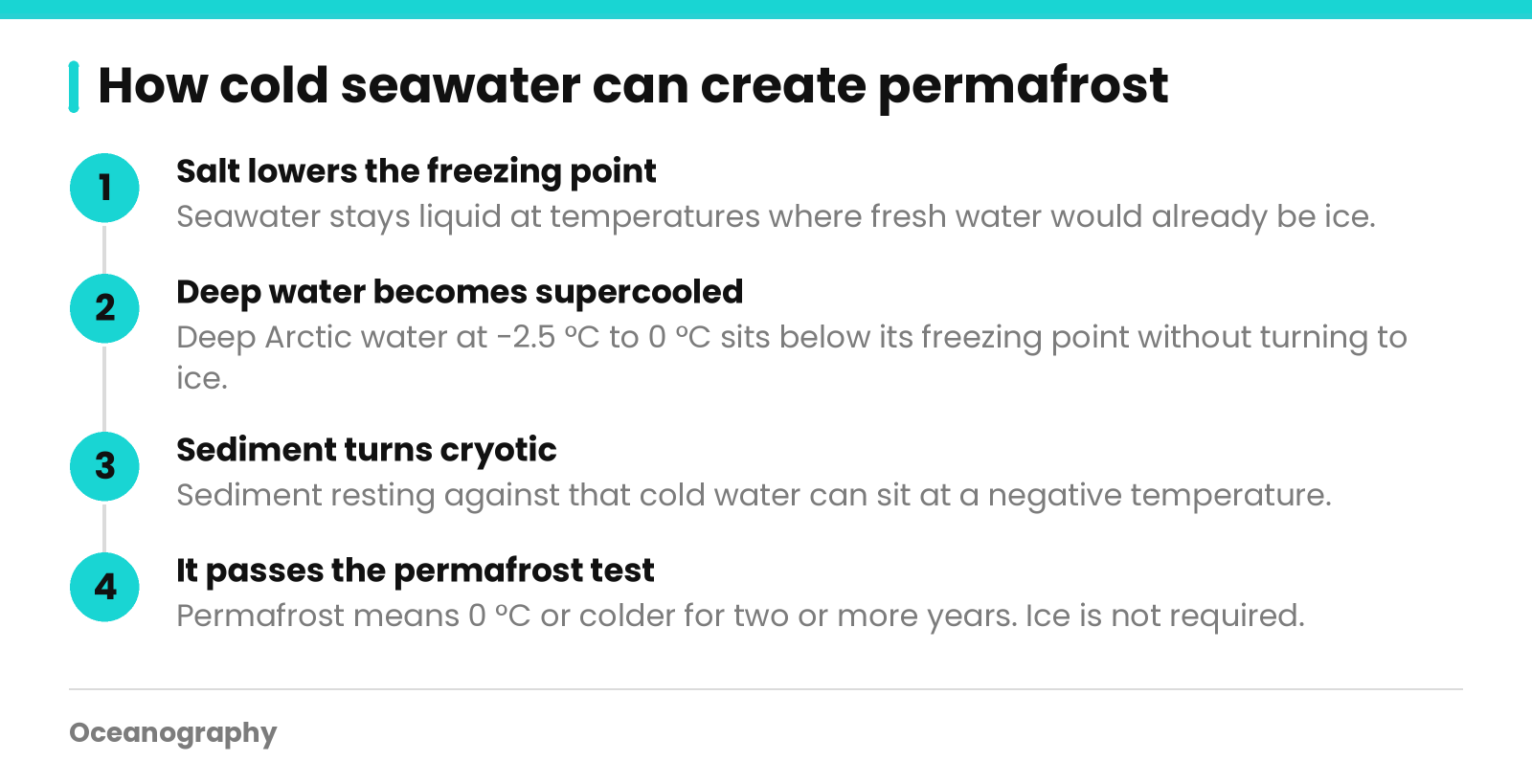
Scientists define permafrost as earth material that stays at or below 0 °C for two or more years in a row. The key word is temperature, not ice. A related term, the cryotic state, describes material that sits at a negative temperature.
That is why the DSP idea works. The sediment can meet the temperature test even when it is not locked in ice.
Why salty water can stay liquid below 0 °C
Salt lowers the freezing point of water. Seawater can therefore stay liquid at temperatures where fresh water would already be ice. When it cools below its freezing point without turning to ice, we call it supercooled.
The paper describes seawater in the deep Arctic Ocean with temperatures from -2.5 °C to 0 °C. Sediment resting against that cold water can end up in a cryotic state.
How is deep seabed permafrost different from other subsea permafrost?
Most known subsea permafrost sits on the shallow continental shelves and formed from cold air chilling the ground. Deep seabed permafrost would instead be driven by cold seawater lying on the bottom of deep basins. The authors present it as a new addition to several types already described.
Types at a glance
| Type | How it forms or persists |
|---|---|
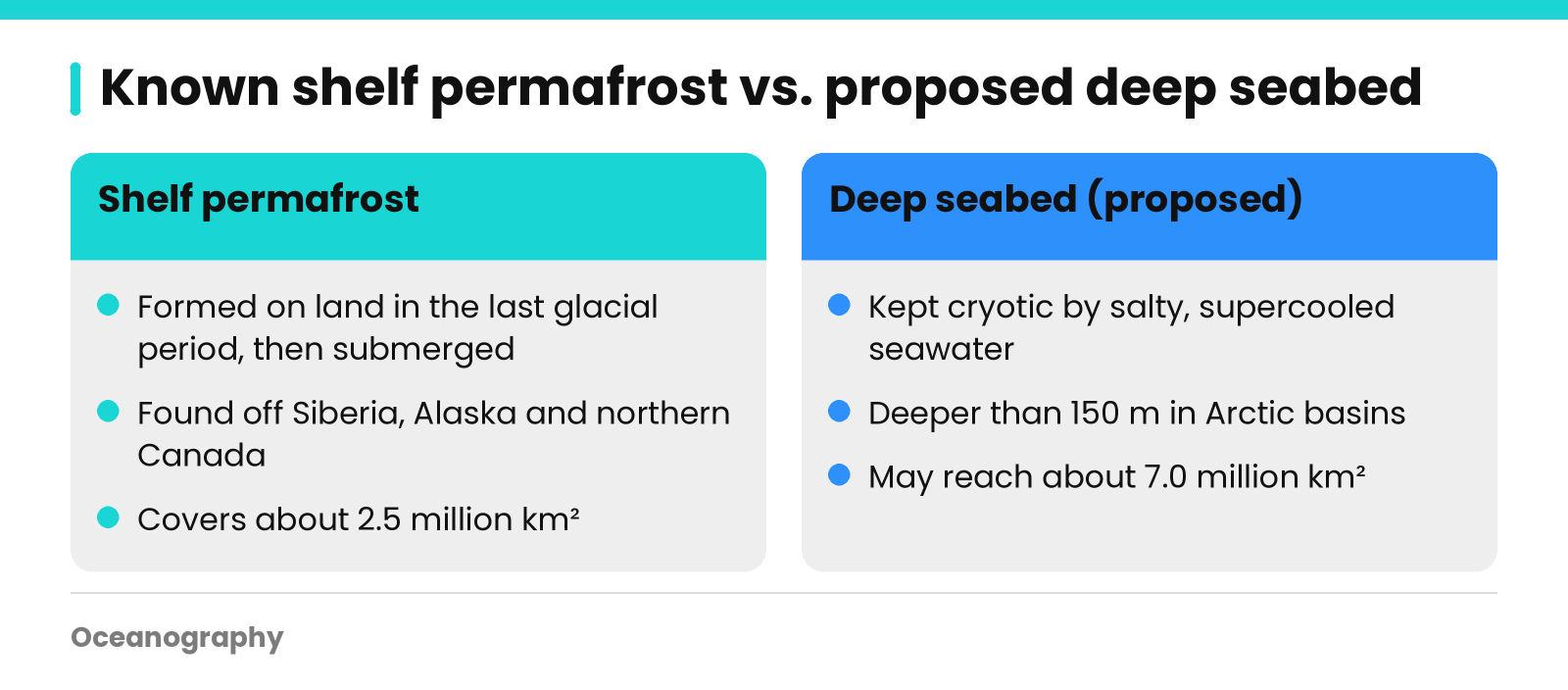
| Shelf permafrost | Formed on land during the last glacial period, then submerged as ice sheets melted. It underlies about 2.5 million km² off Siberia, Alaska and northern Canada. |
| Freshened porewater layers | Ice-bearing sediment that formed as water in the sediment pores became fresher, with land origins. |
| Refrozen lake taliks | Unfrozen ground under former thermokarst lakes (lakes formed by thawing ground ice) that refreezes under cold seabed conditions. |
| Bottom-fast ice | Ice that reaches the seabed in shallow water and helps preserve permafrost through winter heat loss. |
| Island and spit permafrost | Permafrost that builds up under small islands and sand spits as sediment shifts. |
| Seepage permafrost | Linked to underground fresh water flowing out into the sea, found near Nain, Nunatsiavut, in Labrador. |
| Deep seabed permafrost (proposed) | Sediment kept cryotic by salty, supercooled seawater in deep Arctic basins. |
Why the seepage finding matters
The paper points to the Labrador discovery as a sign that subsea permafrost does not depend only on cold air. Groundwater flowing into the sea can also shape it. DSP stretches that idea further, since the cold seawater itself becomes the driver.
How could deep seabed permafrost cover about 7 million square kilometers?
The authors' primary calculations suggest that DSP deeper than 150 meters may reach about 7.0 million km². The estimate rests on the cold seawater that fills the deeper Arctic Ocean, with temperatures between -2.5 °C and 0 °C. It is a possibility drawn from field-based datasets, not a surveyed map.
The numbers behind the estimate
- Depth: deeper than 150 m.
- Water temperature at the bottom: from -2.5 °C to 0 °C.
- Estimated area: up to about 7.0 million km².
For scale, the known shelf permafrost covers about 2.5 million km². The DSP figure is nearly three times larger. These are different kinds of permafrost in different places, so the numbers describe separate pieces of the Arctic seabed.
When it may have started
The paper suggests that DSP, or almost equivalently the below-zero regime of deep Arctic seawater, may have begun near the Pliocene-Pleistocene border. That was roughly 3.5 to 2.4 million years ago. The Pliocene and Pleistocene are two geological epochs, and the border between them marks a long shift in Earth's climate history.
If that timing holds, this cold deep water has been in place for a very long time. That is a much longer story than the last ice age alone.
How certain is the deep seabed permafrost estimate?
Not very certain yet. The authors describe their figures as primary calculations, and they note that the deep Arctic seabed is rarely reachable for direct measurements. The 7.0 million km² value is best read as a proposal that others can test, not as a settled measurement.
What the authors say is still unknown
The paper argues that the overall nature of subsea permafrost across the whole Arctic Ocean, and its exact extent, are still not known. The topic is only beginning to be discussed in research. That is normal for a new idea in a hard-to-reach place.
In our view, direct sampling and temperature readings from deep sediments would be the clearest way to check the idea. The paper itself does not claim that has been done.
A checklist for reading new ocean papers
- Look for words like possibility, may and primary. They signal how firm the claim is.
- Find out what data the estimate used and where it came from.
- Check whether the numbers come from direct measurement or from calculation.
- Note what the authors say remains unknown.
- Compare the claim with earlier work on the same topic.
How Oceanography helps you follow Arctic research
Oceanography, based at 15 Main Street, Unit 12A in Franklin, MA, is a learning and research community built for this kind of curiosity. We bring together live and historical ocean data, a worldwide index of research documents and our own repository of peer-reviewed articles. Students, teachers and researchers can all use them.
Explore ocean data by region
Our map tool lets you search real-time datasets by region. Results come as tables or graphs, and you can download them. The measurements are collated from some of the largest oceanographic institutions in the world. Search Datasets to see what is available for the regions you care about.
Read and learn more
- Browse the Articles index and repository for peer-reviewed research. Articles are posted online right after publication and are free for members to search.
- Read our explainer on global circulation to see how ocean water moves around the planet.
- Teachers can find classroom materials in our Teacher Resources.
Questions about membership or the site? Call us at +1 (877) 805-3282.
Frequently Asked Questions
What is deep seabed permafrost?
Deep seabed permafrost is a proposed type of permafrost beneath the deep Arctic Ocean floor. The sediment is at or below 0 °C because salty, supercooled seawater touches it, but it is not frozen. Researchers Dobiński and Saito proposed the idea in a 2026 Scientific Reports paper.
How large could deep seabed permafrost be?
Early calculations suggest it may reach about 7.0 million square kilometers at depths below 150 meters. The authors call these primary calculations, so the figure is an estimate to be tested. Known shelf permafrost in the Arctic covers about 2.5 million square kilometers.
Does permafrost have to be frozen?
No, permafrost is defined by temperature, not by ice. It is earth material that stays at or below 0 °C for two or more consecutive years. The deep seabed permafrost idea relies on this, since the sediment would be cryotic but not frozen.
Why does seawater stay liquid below 0 °C?
Salt lowers the freezing point of water, so seawater can stay liquid below 0 °C. When it cools below its freezing point without turning to ice, it is called supercooled. The paper describes deep Arctic seawater between -2.5 °C and 0 °C.
When might deep seabed permafrost have started forming?
The authors suggest it may have begun around the Pliocene-Pleistocene border, about 3.5 to 2.4 million years ago. They link it to the below-zero temperature regime of deep Arctic seawater. This timing is a proposal based on their analysis, not a directly dated measurement.
Has deep seabed permafrost been measured directly?
The paper says the deep Arctic seabed is rarely accessible for direct measurements. The 7.0 million square kilometer figure comes from primary calculations using field-based datasets. More direct observations would be needed to confirm how far this type of permafrost extends.
