
3Sep
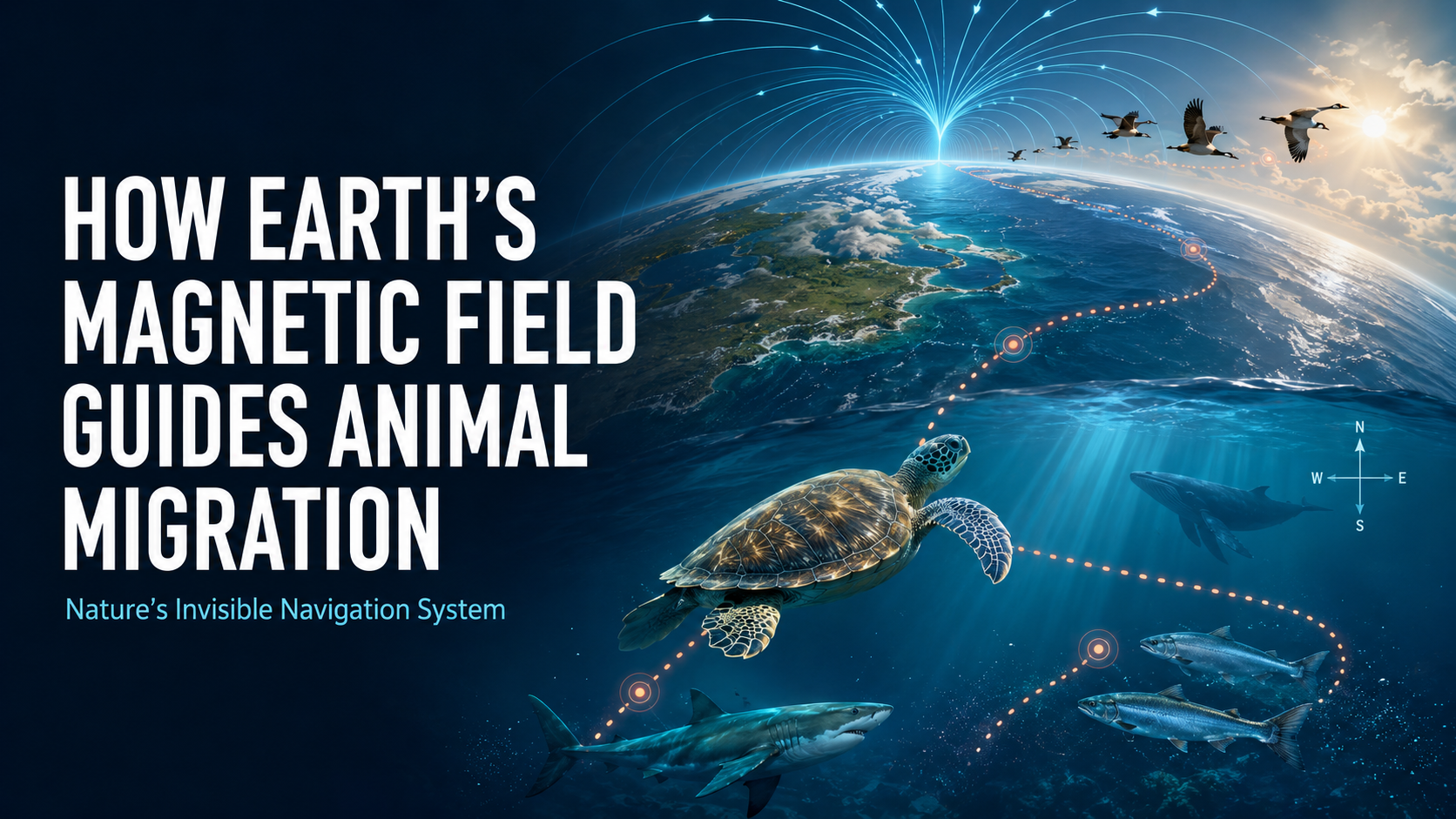
How Earth’s Magnetic Field Guides Animal Migration
Introduction
Imagine crossing an ocean without a map, compass, road sign, or GPS. Many migratory animals accomplish exactly that, traveling thousands of miles and often returning to remarkably precise destinations.
A major part of this navigational mystery lies beneath our feet. Scientists have found that many species can detect Earth’s magnetic field and use it to guide animal migration. This invisible planetary signal acts like a natural compass and sometimes like a geographic map.
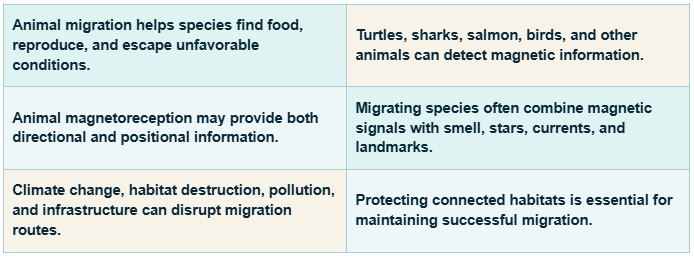
Key Takeaways
What Is Animal Migration?
Animal migration is the regular movement of animals between habitats, often following an annual or seasonal cycle. These journeys may occur across land, through rivers, high in the atmosphere, or over enormous stretches of open ocean.
Unlike ordinary wandering, wildlife migration usually has a predictable destination and biological purpose. Familiar examples of animal migration include whales reaching warmer breeding grounds, salmon returning to rivers, and sea turtles traveling between feeding and nesting areas.
Why Do Animals Migrate?
So, why do animals migrate? Most undertake these demanding journeys to reach food, suitable temperatures, safer habitats, or breeding grounds. Migration may involve serious risks, but remaining in one location can be even more dangerous.
Some species perform seasonal breeding migration, while others make a feeding migration as resources shift. These movements demonstrate how closely seasonal animal movement is connected to changing environmental conditions.
How Do Animals Navigate During Migration?
Scientists studying how animals navigate have discovered that migration rarely depends on one sense. Animals may follow coastlines, recognize smells, observe stars, detect polarized light, feel ocean currents, or remember familiar landmarks.
These environmental cues for migration work like instruments in an orchestra. If one becomes unreliable, another may keep the journey on course. This combination makes biological navigation flexible enough to work across changing landscapes and oceans.
Navigation by the Sun, Stars, and Magnetic Field
Some migratory birds use the Sun during the day and patterns of stars at night. Smell is important for salmon approaching their home rivers, while whales may use sound, water conditions, and geographic features.
However, clouds can hide the sky, and the open ocean offers few visible landmarks. Under these conditions, animals using Earth’s magnetic field gain access to a signal that operates day and night across the planet.
What Is Animal Magnetoreception?

A scientific review available through the National Library of Medicine explains how variations in magnetic intensity and inclination can provide positional information. In simple terms, different regions may carry different magnetic “addresses.”
How Do Animals Sense Magnetic Fields?
Exactly how animals sense magnetic fields remains under investigation. One theory involves magnetite, an iron-containing mineral that could respond physically to magnetic forces inside specialized cells.
Another theory involves light-sensitive proteins called cryptochromes. Chemical reactions in these proteins may change in response to magnetic conditions. Different animals may use different mechanisms or combine more than one magnetic sense.
How Sea Turtles Navigate Across Oceans
Sea turtle migration offers one of the clearest examples of magnetic guidance. Young turtles enter powerful currents and cross ocean basins, yet they respond to magnetic conditions associated with different geographic regions.
This ability may help explain how sea turtles navigate and later return toward their natal region. According to NOAA Fisheries, some sea turtles migrate thousands of miles between feeding and nesting grounds.
Magnetic Imprinting and Natal Beaches
Researchers think hatchlings may learn, or imprint on, the magnetic signature around their birthplace. Years later, adults may use that information to approach the same general coastline for nesting.
Magnetic guidance probably does not identify one exact patch of sand. Near shore, turtles may add wave direction, smell, and visual features to their internal magnetic map.
Magnetic Navigation in Sharks and Salmon
Sharks and rays possess highly sensitive electroreceptors. Because seawater conducts electricity, movement through Earth’s field may produce signals that support shark magnetic field navigation during long journeys.
Evidence also suggests that salmon use magnetic information while crossing the ocean. During salmon migration and navigation, magnetic cues may guide fish toward the correct coastal region before smell helps them locate their home river.
How Multiple Cues Improve Accuracy
Magnetic sensing works best as part of a larger navigational toolkit. Ocean currents move, magnetic conditions slowly change, and storms can push animals away from their expected course.
Using several cues gives marine animal migration a backup system. It is like checking a compass, road signs, and landmarks instead of trusting only one direction.
How Birds Follow a Magnetic Compass
Bird migration provides some of the strongest evidence for a magnetic compass in animals. Many species maintain a migratory direction even when clouds obscure the Sun and stars.
Research suggests that some birds may perceive magnetic direction through light-dependent chemical processes in their eyes. Nevertheless, bird migration using magnetic fields often works alongside celestial cues, smell, and learned geographic knowledge.
How Scientists Study Magnetic Navigation
Researchers studying the science of animal navigation expose animals to controlled magnetic fields and observe their orientation. Magnetic coils can imitate the field found in another location without physically moving the animal.
Scientists also use satellite tags, acoustic transmitters, genetic studies, and long-term wildlife tracking. Combining laboratory experiments with real journeys produces a clearer understanding of migration patterns and decision-making.
Threats to Migratory Animals
The greatest threats to migratory animals include habitat destruction, fishing, pollution, shipping, dams, artificial lights, and climate change. A species may have healthy breeding habitat but still decline if a feeding site or stopover disappears.

Animal Migration and Climate Change
Animal migration and climate change are increasingly connected. Warming temperatures can alter food availability, breeding seasons, currents, and the timing of familiar environmental signals.
Some animals adjust their annual animal migration cycle, but not every species can adapt quickly. When predators, prey, and habitats shift at different speeds, established ecological relationships may begin to unravel.
Why Animal Migration Matters
The importance of animal migration extends far beyond individual species. Migrating animals transport nutrients, disperse seeds, connect habitats, support predators, and influence food webs across enormous regions.
Understanding animal movement ecology also improves conservation. By identifying crucial migration corridors, researchers and governments can focus protection where animals are most vulnerable.
Conclusion: Following Nature’s Invisible Map
Animal migration is one of nature’s greatest journeys, and Earth’s magnetic field appears to be one of its most dependable guides. Turtles, sharks, salmon, birds, and other species use this invisible information to cross landscapes and oceans that would leave us hopelessly lost.
The full mechanism remains mysterious, but every discovery reveals a more connected planet. Protecting migratory species means protecting the routes, habitats, and natural signals that allow these extraordinary journeys to continue.
EXPLORE MORE OCEAN DISCOVERIES
Discover the remarkable science shaping our oceans and the animals that depend on them. Visit Oceanography.com for more accessible marine research, stories, and insights.
Frequently Asked Questions
1. What is animal migration?
Answer: Animal migration is a regular, directed movement between habitats for feeding, breeding, survival, or seasonal reasons.
2. How do animals find their way?
Answer: Animals may combine magnetic signals, smells, currents, landmarks, sunlight, stars, sound, and memory to navigate.
3. Which animals use Earth’s magnetic field?
Answer: Sea turtles, sharks, salmon, lobsters, birds, insects, and several other animals that migrate show evidence of magnetic sensitivity.
4. What is a magnetic compass in animals?
Answer: A magnetic compass in animals provides directional information, helping an animal determine north, south, or a preferred migratory heading
5. What are magnetic maps in animal navigation?
Answer: Magnetic maps in animal navigation use geographic variations in field intensity and inclination to provide approximate positional information.
6. Do whales use magnetic navigation?
Answer: Some evidence links whale migration routes and strandings with geomagnetic patterns, but scientists have not fully established how whales sense or use them.
7. Can magnetic storms disrupt animal migration?
Answer: Solar activity can temporarily disturb Earth’s magnetic environment. Scientists are investigating whether these changes sometimes confuse magnetically sensitive species.
8. Why are migration corridors important?
Answer: Protecting wildlife migration corridors preserves the connected feeding, resting, and breeding areas animals need to complete their journeys.
9. How does climate change affect migration?
Answer: Climate change can shift migration timing, suitable habitats, food supplies, winds, and ocean currents, potentially separating animals from vital resources.
10. Why is animal migration research important?
Answer: Animal migration research helps scientists predict ecological change, identify dangerous routes, and design more effective conservation strategies.
