
21Apr
The Interconnectedness of Oceans and Global Water Cycles
Table of Contents
Introduction to the Global Water Cycle
The Role of Oceans in the Water Cycle
Evaporation and Ocean’s Contribution to Atmospheric Moisture
The Impact of Ocean Currents on Precipitation Patterns
The Hydrological Cycle and Its Global Impact
How Oceans Influence Global Climate and Weather Systems
The Water Cycle’s Role in Maintaining Freshwater Supplies
The Influence of Climate Change on Oceanic Water Cycles
The Impact of Rising Ocean Temperatures on Precipitation
Extreme Weather Events and Ocean Currents
Interactions between Oceans and Atmospheric Systems
The Role of the Oceans in Carbon Sequestration
How El Niño and La Niña Influence the Global Water Cycle
The Future of Ocean Exploration and Water Cycle Research
Technological Advancements in Oceanic and Water Cycle Research
Sustainability Practices for Managing Water Resources
Conclusion: The Future of Water Cycles and Ocean Health
FAQs
Introduction to the Global Water Cycle
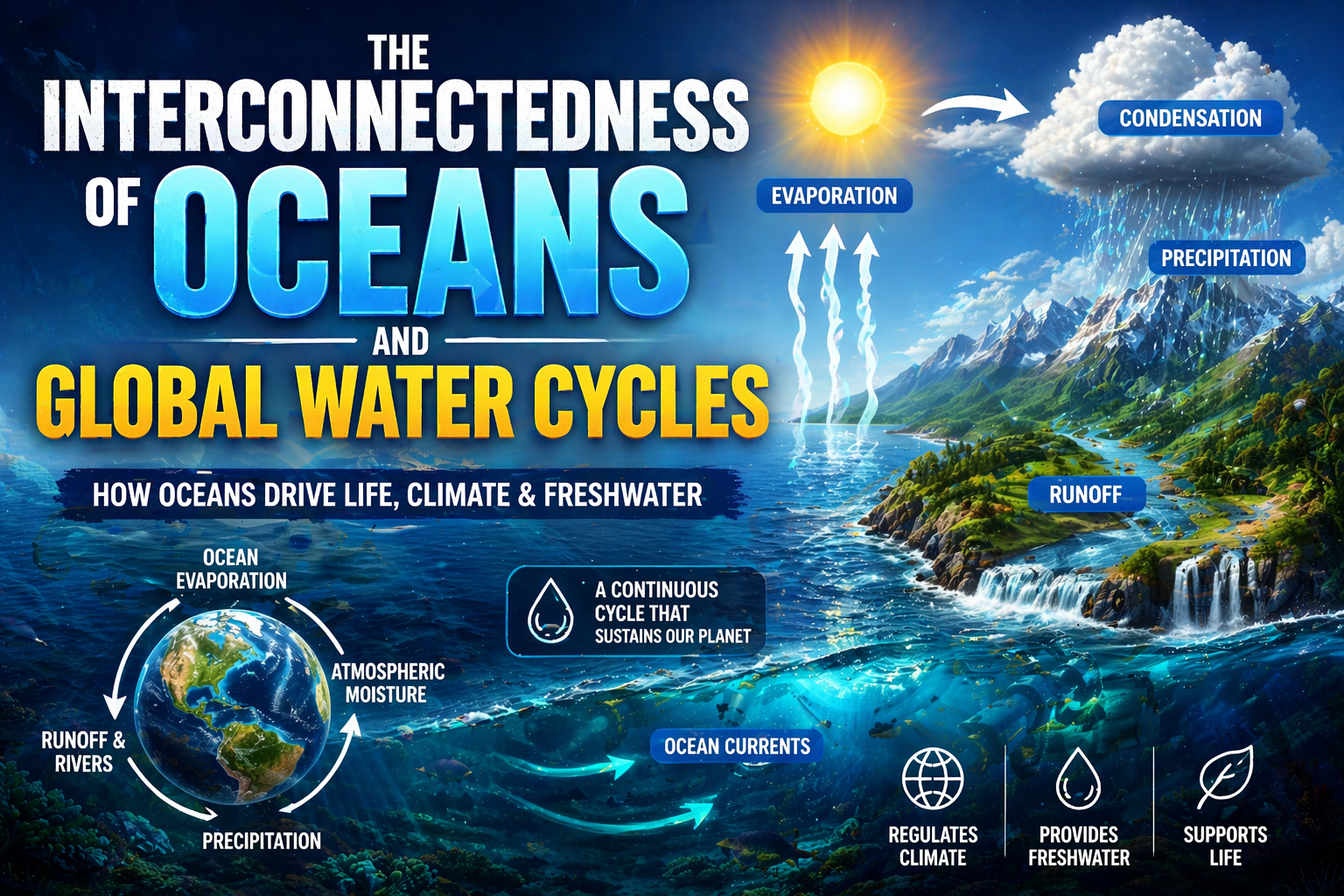
The global water cycle, or hydrological cycle, is the continuous movement of water within the Earth’s atmosphere, oceans, and land. It is driven by solar energy and involves several processes such as evaporation, precipitation, and runoff. Without the water cycle, Earth would not be able to sustain life as we know it.
Water is constantly exchanged between different parts of the Earth, from the oceans to the atmosphere, to land and back again. The oceans play a central role in this process. In fact, they serve as the primary source of moisture that fuels much of the Earth’s weather systems. Without oceans, the global water cycle would be disrupted, leading to severe consequences for life on Earth.
Key Takeaways
- Oceans contribute significantly to the global water cycle, primarily through evaporation, which supplies moisture to the atmosphere.
- The oceans regulate the global climate by influencing weather patterns, precipitation, and freshwater availability.
- Rising ocean temperatures, caused by climate change, are having a profound impact on the water cycle, affecting precipitation and extreme weather events.
The Role of Oceans in the Water Cycle
Oceans, covering more than 70% of Earth’s surface, play a fundamental role in the water cycle. The vast expanse of water not only stores moisture but also helps transport it around the globe.
Evaporation and Ocean’s Contribution to Atmospheric Moisture
The oceans are responsible for supplying about 80% of the water vapor in the atmosphere. Evaporation occurs when heat from the sun causes water from the surface of the ocean to turn into vapor. This vapor then rises into the atmosphere, where it can condense into clouds and eventually fall as precipitation.
As moisture from the oceans enters the atmosphere, it is carried by winds and spreads across the globe. This process ensures that areas far from the coast also receive moisture, which is essential for maintaining ecosystems and supporting agriculture in inland regions.
The Impact of Ocean Currents on Precipitation Patterns
Ocean currents are not only crucial for regulating the climate but also for determining rainfall patterns. These currents, which are driven by factors like wind, the Earth’s rotation, and temperature differences, distribute heat across the globe. As warm ocean currents flow towards cooler regions, they help maintain stable temperatures and influence the location and intensity of rainfall.
For instance, areas near warm ocean currents, like the Gulf Stream, tend to experience higher precipitation levels. Conversely, regions near cold currents, such as the Humboldt Current, are often much drier.
The Hydrological Cycle and Its Global Impact
The hydrological cycle affects much more than just the movement of water. It impacts ecosystems, human populations, and the global climate.
How Oceans Influence Global Climate and Weather Systems
Oceans serve as the planet’s heat regulator, absorbing heat from the sun during the day and releasing it slowly at night. This helps maintain a more stable temperature on Earth, preventing drastic temperature changes. The ocean’s role in regulating the climate is also seen in its ability to modulate atmospheric conditions, helping to stabilize global weather patterns.
Without the heat exchange provided by the oceans, the Earth would experience extreme weather fluctuations, which would disrupt life as we know it.
The Water Cycle’s Role in Maintaining Freshwater Supplies
The water cycle also plays a key role in ensuring a steady supply of freshwater. While most of Earth’s water is in the oceans, the cycle ensures that this water is distributed around the planet in the form of precipitation. The cycle constantly replenishes rivers, lakes, and aquifers, which supply us with the freshwater needed for drinking, agriculture, and industry.
The Influence of Climate Change on Oceanic Water Cycles
The global water cycle is being dramatically affected by climate change, particularly the warming of oceans. Rising ocean temperatures are altering precipitation patterns, which have significant implications for water availability around the world.
The Impact of Rising Ocean Temperatures on Precipitation
As ocean temperatures rise, more water evaporates into the atmosphere, which can lead to heavier rainfall in some areas and droughts in others. Warmer ocean waters also increase the energy available for storm systems, leading to more intense and frequent storms, such as hurricanes and typhoons.
Extreme Weather Events and Ocean Currents
The warming of ocean currents is causing disruptions in established weather patterns. In particular, shifts in El Niño and La Niña events can cause significant changes to global weather, affecting everything from rainfall to the occurrence of extreme weather events. These changes can lead to floods, droughts, and other disruptions in water availability.
Interactions between Oceans and Atmospheric Systems
Oceans and atmospheric systems are intricately connected. The atmosphere and oceans constantly exchange moisture, heat, and energy, making them a critical part of the global climate system.
The Role of the Oceans in Carbon Sequestration
Oceans act as a carbon sink, absorbing a significant portion of the carbon dioxide (CO2) in the atmosphere. This helps mitigate the impacts of greenhouse gases and reduces the rate of global warming. The health of the oceans is thus directly tied to the planet’s ability to regulate its climate and water cycles.
How El Niño and La Niña Influence the Global Water Cycle
El Niño and La Niña are major climatic events that occur in the Pacific Ocean. These phenomena affect ocean currents, temperature, and weather systems around the world. El Niño, for example, typically causes drier conditions in some regions and wetter conditions in others. La Niña tends to have the opposite effect. These ocean-driven events demonstrate the powerful influence the oceans have on global water distribution and climate.
The Future of Ocean Exploration and Water Cycle Research
Advancements in technology are driving ocean exploration forward, and as we continue to better understand the oceans, we gain new insights into their role in the water cycle.
Technological Advancements in Oceanic and Water Cycle Research
New technologies, including autonomous underwater vehicles (AUVs) and remote sensing satellites, are helping scientists gather more accurate data on ocean conditions. These innovations are allowing researchers to track ocean currents, temperatures, and moisture levels, leading to a better understanding of their impact on the global water cycle.
Sustainability Practices for Managing Water Resources
Sustainable water management is increasingly important as we face challenges related to climate change and water scarcity. Protecting ocean health, reducing pollution, and managing water resources responsibly are essential for maintaining the balance of the global water cycle.
Conclusion: The Future of Water Cycles and Ocean Health
As our understanding of the oceans and their role in the global water cycle continues to evolve, so does the importance of preserving these vital ecosystems. The oceans are not just large bodies of water; they are key to regulating climate, supporting life, and ensuring the availability of freshwater. As we move forward, it is critical that we continue to advance ocean exploration and implement sustainable practices to protect these essential resources.
FAQs
1.What is the global water cycle?
The global water cycle refers to the continuous movement of water on, above, and below the Earth’s surface. It involves processes like evaporation, condensation, and precipitation.
2.How do oceans affect the water cycle?
Oceans contribute 80% of the moisture in the atmosphere through evaporation, which is then carried by winds to form clouds and eventually fall as precipitation.
3.What impact do rising ocean temperatures have on the water cycle?
Rising ocean temperatures increase the amount of moisture in the atmosphere, which can lead to more intense rainfall, droughts, and extreme weather events.
4.How do ocean currents influence weather patterns?
Ocean currents redistribute heat around the planet, which affects temperature and precipitation patterns, contributing to stable weather systems.
5.What is the role of oceans in carbon sequestration?
Oceans absorb large amounts of carbon dioxide, helping to mitigate climate change by reducing the amount of greenhouse gases in the atmosphere.
6.What are El Niño and La Niña?
These are periodic climate events in the Pacific Ocean that disrupt weather patterns globally. El Niño leads to warmer ocean temperatures, while La Niña causes cooler conditions.
7.Why is the water cycle important for freshwater availability?
The water cycle ensures the continuous replenishment of freshwater supplies through precipitation and runoff, making water available for drinking and agriculture.
8.How does climate change affect ocean water cycles?
Climate change causes rising ocean temperatures, which in turn affect the water cycle, leading to more extreme weather events and shifts in precipitation patterns.
9.How do AUVs help in ocean exploration?
Autonomous underwater vehicles (AUVs) allow scientists to explore deep-sea regions, gather data on ocean currents, and better understand the role of oceans in the global water cycle.
10What are the future trends in ocean exploration?
Technological advancements, such as remote sensing and robotic exploration, will continue to enhance our understanding of how oceans influence the global water cycle and climate.
Explore more about ocean health and the water cycle
Learn More About Ocean Exploration
