
24Feb
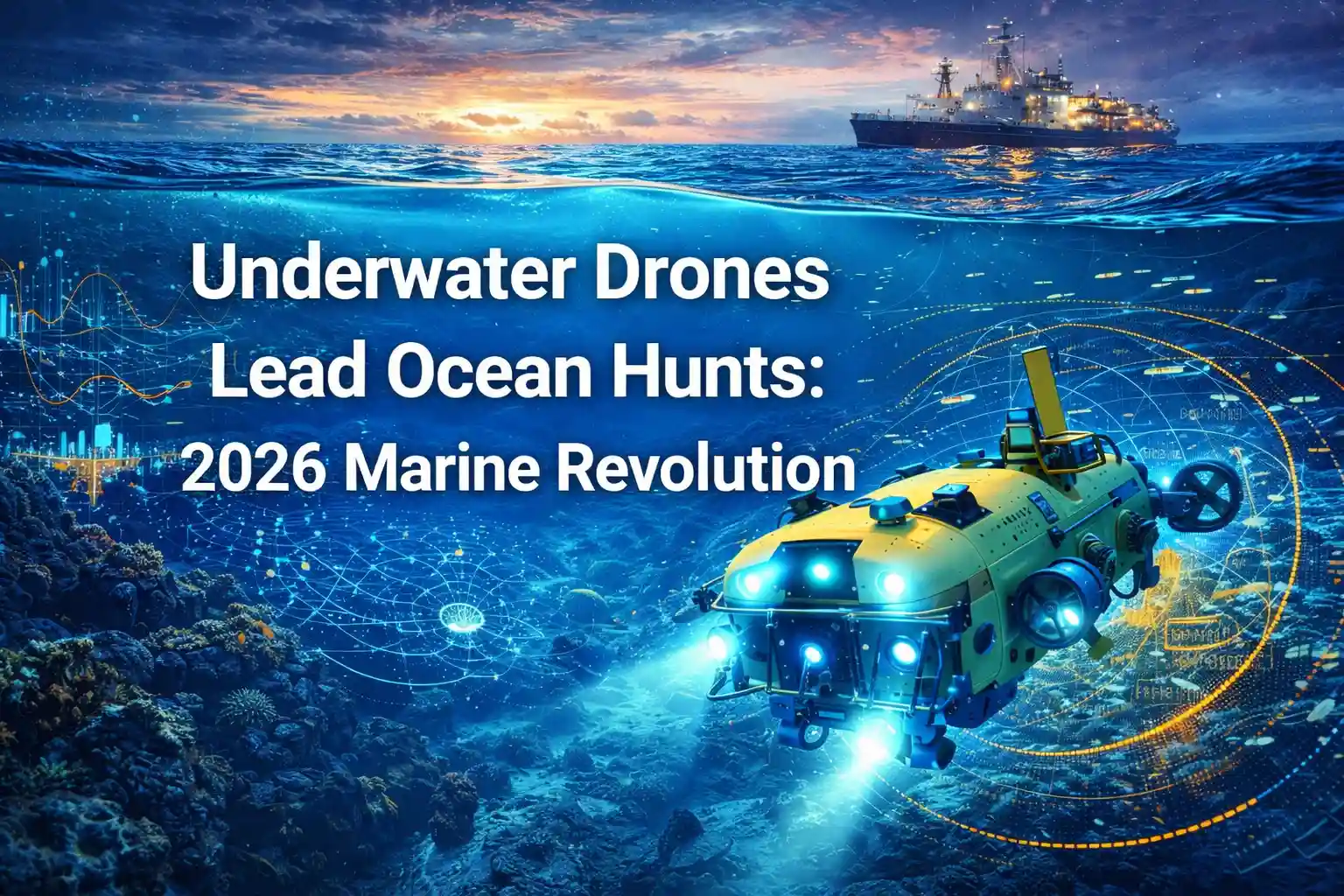
Underwater Drones Lead Ocean Hunts: 2026 Marine Revolution
Table of Contents
- Introduction to Underwater Drones in Marine Exploration
- What Are Underwater Drones?
- The Growing Role of AUVs and ROVs in 2026
- Evolution of Autonomous Underwater Vehicles (AUVs) by 2026
- Enhanced Endurance and Power Systems
- Advanced Sensor Payloads and Data Fusion
- Swarm Robotics and Collaborative Navigation
- Sectoral Impact: Where Underwater Drones Will Dominate
- Deep-Sea Resource Exploration and Mapping
- Maritime Security and Anti-Submarine Warfare (ASW)
- Offshore Energy Infrastructure Inspection
- Data Superiority: Intelligence Gathering Beyond Human Reach
- Precision Environmental Monitoring and Conservation
- Real-Time Incident Response and Search & Recovery
- Addressing Operational Blind Spots
- Ships vs. Drones: The Future of Ocean Operations
- Challenges in Underwater Drone Communication and Signal Interference
- Challenges and Regulatory Frameworks for the 2026 Landscape
- Navigating the Acoustic Spectrum and Interference
- Standardization and Interoperability Requirements
- Legal and Ethical Dimensions of Autonomous Ocean Missions
- Who Takes Responsibility for Autonomous Drone Operations?
- Ethics and AI Decisions in Underwater Hunts
- Conclusion: The Future of Underwater Drones in Marine Exploration and Security
Introduction to Underwater Drones in Marine Exploration
What Are Underwater Drones?
Underwater drones, also known as Autonomous Underwater Vehicles (AUVs) and Remotely Operated Vehicles (ROVs), are revolutionizing marine exploration. These machines are designed to navigate the oceans and perform tasks that were previously dangerous or impossible for human divers. Unlike traditional submarines or surface vessels, these drones can operate autonomously or under remote control, enabling them to explore deep-sea environments, monitor ocean health, and even locate underwater wrecks.
What sets underwater drones apart is their ability to reach depths and handle conditions that human divers simply cannot endure. With advancements in technology, underwater drones can be deployed for long-term monitoring, environmental assessments, and even search and rescue operations, all without the need for a human presence in the dangerous depths of the ocean.
The Growing Role of AUVs and ROVs in 2026
By 2026, the role of AUVs and ROVs is expected to expand significantly. As technology improves, these underwater drones will become more efficient, reliable, and cost-effective. With enhanced sensors, increased power capabilities, and longer operational endurance, AUVs and ROVs will be able to cover larger areas and conduct more complex tasks than ever before. These advancements will make them invaluable for industries such as offshore energy, maritime security, and environmental monitoring, where traditional methods have limitations.
Evolution of Autonomous Underwater Vehicles (AUVs) by 2026
Enhanced Endurance and Power Systems
In the past, one of the main limitations of underwater drones was their relatively short operational time. However, by 2026, underwater drones will feature enhanced endurance due to advancements in battery technology and power systems. Solid-state batteries and energy harvesting technologies will allow these drones to operate for days, even weeks, without needing to recharge. This breakthrough in power systems will enable drones to explore vast ocean regions, conduct long-term environmental monitoring, and perform complex tasks such as mapping underwater terrains and monitoring oceanic health over extended periods.
Energy harvesting from ocean currents or wave power will further extend the operational life of these drones. This eco-friendly technology will not only improve the efficiency of oceanic exploration but will also make drones more self-sufficient, reducing the need for external charging stations.
Advanced Sensor Payloads and Data Fusion
Advanced sensor payloads are another area where underwater drones have evolved. These drones now carry a variety of specialized sensors, including high-resolution sonar, chemical analyzers, and hyperspectral cameras, to gather detailed data on ocean ecosystems and structures. These sensors allow drones to map the ocean floor, identify underwater species, detect pollutants, and track changes in ocean health.
One of the most exciting developments is data fusion technology, which enables drones to combine different types of data—sonar, chemical, and visual into cohesive, actionable insights. This data fusion is powered by onboard edge computing, which processes the information in real-time, providing immediate feedback to scientists and decision-makers. This capability will significantly enhance environmental monitoring and allow for faster responses to issues like ocean pollution, illegal fishing activities, and marine biodiversity threats.
Swarm Robotics and Collaborative Navigation
By 2026, the concept of swarm robotics will revolutionize underwater drone operations. Rather than relying on a single drone, fleets of autonomous underwater vehicles will work together, covering larger areas and performing tasks collaboratively. These drones will communicate via acoustic signals or mesh networks, allowing them to coordinate movements, share data, and act in unison.
For example, a swarm of drones could be deployed to search for shipwrecks, with each drone handling a specific section of the search area. One drone could detect an anomaly, and the others would immediately converge to assist in the mapping and data gathering process. This collaborative approach will make ocean exploration more efficient, precise, and scalable.
Sectoral Impact: Where Underwater Drones Will Dominate
Deep-Sea Resource Exploration and Mapping
Underwater drones are transforming the way we explore and map the ocean floor. With the ability to conduct deep-sea resource exploration, drones are being used to locate valuable minerals, oil reserves, and gas deposits beneath the ocean. These drones can navigate the challenging conditions of the deep sea, where human exploration is impossible, to perform detailed surveys and generate high-quality 3D maps of underwater features.
By 2026, AUVs and ROVs will play a key role in driving the growth of deep-sea resource exploration, saving industries time and money while increasing the safety of underwater operations. Drones will significantly reduce the need for expensive, human-led explorations, and they will become an essential tool for sustainable marine resource management.
Maritime Security and Anti-Submarine Warfare (ASW)
Another area where underwater drones are making an impact is maritime security and anti-submarine warfare (ASW). By operating in stealth mode, drones can patrol strategic maritime areas, detect threats, and assist in military operations without alerting adversaries. Drones are already being tested by military organizations, including NATO and Pacific navies, for their ability to detect submarines, monitor maritime borders, and locate illegal activities such as smuggling or piracy.
The use of underwater drones for security and ASW will become even more prevalent in the coming years, with their ability to operate autonomously and continuously in hazardous environments. Their small size and ability to remain undetected by enemy sonar make them the perfect addition to modern naval fleets.
Offshore Energy Infrastructure Inspection
Offshore energy companies, including those in the oil, gas, and wind power sectors, rely heavily on underwater drones for infrastructure inspection. These drones are used to inspect subsea pipelines, oil rigs, and wind turbine foundations, ensuring that these critical systems remain in good condition and are free from cracks or leaks.
As ROVs and AUVs become more capable, they will be able to perform inspections more efficiently and frequently, reducing the need for expensive human divers and surface vessels. This will save energy companies millions in operational costs, minimize downtime, and ensure the safety and longevity of offshore energy infrastructure.
Data Superiority: Intelligence Gathering Beyond Human Reach
Precision Environmental Monitoring and Conservation
One of the most exciting aspects of underwater drones is their ability to gather high-precision data for environmental monitoring and conservation. Drones can monitor ocean temperatures, track fish migration patterns, detect signs of coral bleaching, and identify the presence of pollutants in real-time. This data allows scientists to respond more quickly to environmental threats and implement conservation strategies more effectively.
By 2026, underwater drones will be essential for large-scale environmental monitoring programs aimed at protecting marine ecosystems and ensuring the long-term health of the oceans. With their advanced sensors and autonomous capabilities, these drones will help preserve marine biodiversity and maintain the balance of oceanic ecosystems.
Real-Time Incident Response and Search & Recovery
When an incident occurs, such as a shipwreck or a chemical spill, speed is critical in minimizing the damage. Underwater drones can be deployed rapidly to assess the situation, gather data, and assist in search and recovery efforts. With AI-powered image recognition, drones can quickly identify debris, locate missing vessels, and map the spread of contaminants in the water.
This real-time incident response capability allows for faster, more effective recovery operations, reducing the time it takes to locate and mitigate environmental hazards. For families, this means getting answers faster in search-and-rescue scenarios, and for environmentalists, it means addressing ocean pollution with greater efficiency.
Addressing Operational Blind Spots
Ships vs. Drones: The Future of Ocean Operations
Traditional ships and submersibles are limited by their size, power, and operational endurance. They can't stay submerged for extended periods, and they often require large crews, which increases operational costs and risks. In contrast, underwater drones can operate 24/7 without needing rest or a crew, making them the future of ocean operations.
Drones are already outperforming traditional methods in terms of coverage, speed, and cost-effectiveness. By 2026, they will be the go-to solution for a wide range of marine exploration and security tasks, surpassing traditional vessels in many applications.
Challenges in Underwater Drone Communication and Signal Interference
Despite their many advantages, underwater drones still face challenges related to communication and signal interference. Acoustic communication, which is often used by drones to relay data to operators, can be disrupted by background noise from ships, ocean currents, and other environmental factors. As drone technology advances, finding ways to mitigate these issues will be essential for ensuring the reliability and effectiveness of autonomous underwater vehicles.
Challenges and Regulatory Frameworks for the 2026 Landscape
Navigating the Acoustic Spectrum and Interference
To tackle communication challenges, researchers are developing advanced acoustic technologies that can operate in noisy ocean environments. By using low-power waves and improved signal processing, these technologies will allow underwater drones to transmit data over greater distances without interference.
Standardization and Interoperability Requirements
As underwater drones become more widespread, the need for standardization in their operation and interoperability with other systems will grow. Fleets of drones from different manufacturers must be able to work together seamlessly, exchanging data and coordinating efforts during missions. Standardizing drone components and communication protocols will be key to making this a reality.
Legal and Ethical Dimensions of Autonomous Ocean Missions
Who Takes Responsibility for Autonomous Drone Operations?
With autonomous drones performing complex tasks, questions about accountability arise. Who is responsible if a drone causes environmental damage or malfunctions? Legal frameworks will need to evolve to address these concerns and ensure that autonomous vehicles operate ethically and safely in ocean environments.
Ethics and AI Decisions in Underwater Hunts
Another ethical consideration is the use of AI in decision-making. Underwater drones rely heavily on AI to make autonomous decisions during missions. However, these AI systems must be designed to respect environmental and ethical boundaries. Decisions such as identifying targets for security operations or deciding how to interact with marine life require careful thought and oversight.
Conclusion: The Future of Underwater Drones in Marine Exploration and Security
Underwater drones are set to transform the way we explore, secure, and manage our oceans. With advancements in autonomy, sensor technology, and data analysis, these drones will play a pivotal role in marine exploration and security operations by 2026. As challenges related to communication, regulation, and ethics are addressed, the potential for underwater drones to revolutionize the marine industry will only continue to grow.
Explore More About Underwater Drones in Marine Exploration
FAQs
1. What are underwater drones used for?
Underwater drones, such as AUVs and ROVs, are used for tasks like marine exploration, environmental monitoring, offshore inspections, and maritime security.
2. How do underwater drones work?
These drones operate autonomously or remotely, gathering data from ocean environments using sensors, cameras, and sonar systems. They can map the ocean floor, detect pollutants, and assist in search and recovery missions.
3. What industries benefit from underwater drones?
Industries such as offshore energy, marine conservation, security, and resource exploration all benefit from the capabilities of underwater drones.
4. What is the difference between AUVs and ROVs?
AUVs (Autonomous Underwater Vehicles) operate independently, while ROVs (Remotely Operated Vehicles) are controlled by humans from a distance.
5. What advancements are expected in underwater drones by 2026?
By 2026, underwater drones will have enhanced endurance, more powerful sensors, and greater autonomy, allowing for more effective operations in deep-sea exploration and marine security.
6. How do underwater drones contribute to environmental monitoring?
They gather precise data on ocean health, monitor marine life, and detect pollutants, helping researchers respond to environmental threats more efficiently.
7. What role do underwater drones play in maritime security?
Underwater drones are used for surveillance, detecting submarines or illegal activities, and safeguarding maritime borders.
8. Are there any challenges in underwater drone communication?
Yes, underwater drones face communication challenges due to environmental factors that interfere with signal transmission. New acoustic technologies are being developed to improve reliability.
9. How can underwater drones help with offshore infrastructure inspection?
Underwater drones are used to inspect offshore energy structures like wind turbines and oil rigs, ensuring they remain safe and operational without the need for human divers.
10. What are the ethical concerns surrounding underwater drones?
Ethical concerns include accountability for drone actions, privacy issues, and the decision-making power of AI systems in autonomous operations.
